Employee Benefits in India: The Complete HR Guide for 2026

Employee benefits in India include statutory benefits employers must provide, voluntary benefits used to attract and retain talent, and tax-efficient benefits designed to improve employee value without adding unnecessary payroll complexity. For 2026, HR and finance teams need a sharper benefits strategy because salary structures, statutory calculations, tax treatment, employee communication, documentation, and offboarding timelines now require closer coordination.
TL;DR
- Employee benefits in India include statutory mandates like provident fund, gratuity, ESI, maternity benefits, statutory bonus, leave entitlements and other establishment-specific obligations, alongside voluntary offerings.
- Employers must align salary structures with statutory wage definitions, wage thresholds, employee categories and applicable laws to reduce the risk of compliance gaps, interest, penalties and employee disputes.
- Tax-efficient perks like meal benefits, insurance-linked benefits, learning support and device benefits should be backed by clear policy language, clean documentation, appropriate payroll workflows and legal/tax review.
- Device benefits managed through a structured salary-linked or salary-sacrifice lease model may help employees access work-relevant devices in a tax-efficient manner, depending on the employee’s income-tax slab, selected tax regime, employer policy, lease documentation and applicable tax treatment. allow employees to save up to ~40% depending on their income-tax slab.
- Resignation and exit policies must specify full and final settlement timelines, asset recovery rules, benefit closure rules, pending deductions, reimbursement cut-offs and ownership or buyout treatment, where applicable, to prevent offboarding disputes.
A strong employee benefits policy in India should begin with compliance, then layer in benefits that employees understand and use. For private sector employers, this means aligning HR, payroll, finance, legal, procurement and IT around one operating model rather than managing benefits as scattered reimbursements or informal exceptions.
What employee benefits include
Employee benefits in India are the non-salary programmes, protections, and support structures that an employer provides alongside compensation. Some are required by law, while others are employer-designed benefits that support retention, productivity, employee welfare and total rewards strategy.
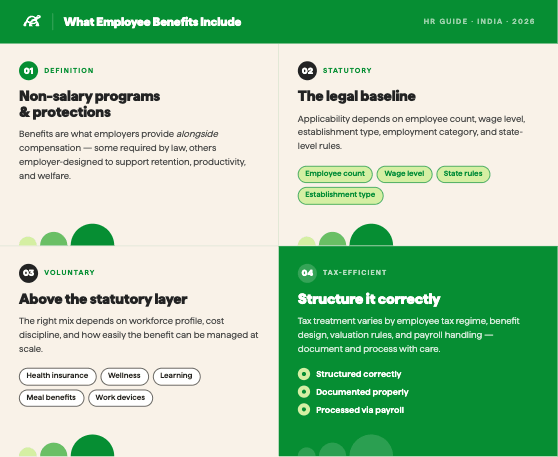
Statutory employee benefits in India create the baseline. These benefits depend on various factors, including employee count, wage level, establishment type, employment category, location, nature of work, and state-level regulations. Employers should validate final applicability with legal and payroll advisors, especially when updating salary structures, expanding across locations, acquiring entities, or changing employment models.
Voluntary benefits sit above the statutory layer. These can include group health insurance, wellness programmes, learning allowances, meal benefits, flexible work support, OPD support, mental health support, transport support, and work-device access. The right mix depends on workforce profile, cost discipline, talent market expectations, employee utilisation, and how easily the benefit can be administered at scale.
Tax-efficient benefits require extra care. A benefit should be described as tax-efficient only when it is structured, documented, and processed correctly. Tax treatment can vary by employee tax regime, benefit design, valuation rules, documentation, payroll handling, and the employer’s internal policy.
Employers should avoid presenting any benefit as automatically tax-free or universally tax-saving. A benefit may create employee value, but the actual tax outcome depends on the Income-tax Act, applicable rules, payroll implementation, supporting documentation and the facts of each case.
To see how these layers work in practice, let’s look at a simplified monthly CTC illustration.
- Total CTC: ₹1,00,000
- Employer PF (12% of ₹50k Basic): ₹6,000
- Employer Paid Insurance: ₹2,000
- Gross Monthly Salary: ₹92,000
Inside that Gross Salary, the employee can choose tax-efficient benefits to acquire a phone and cover daily costs:
- Device Lease (for a new phone): ₹5,000
- Meal Card: ₹4,000
- Taxable Income: ₹83,000
By shifting ₹9,000 into properly structured benefits, an employee in a higher tax bracket may realise tax efficiencies and improved take-home value compared to a standard cash-only salary structure. An employee in the 30% tax bracket saves ₹2,700 in taxes every month. However, the actual savings will depend on the employee’s tax regime, income level, payroll treatment, documentation, statutory deductions, and the specific benefit design adopted by the employer.
This structure can provide access to a device, insurance cover, and meal support while improving the employee’s perceived compensation value. However, the illustration should not be treated as payroll, tax, or legal advice. Employers should validate actual salary structures and benefit treatment before implementation.
Mandatory employee benefits in India
Mandatory employee benefits in India are the starting point for every benefits policy. They are not replaced by voluntary benefits, even when the employer offers strong insurance or welfare programs.
Statutory employee benefits may arise under multiple laws, including the Employees’ Provident Funds and Miscellaneous Provisions Act, the Employees’ State Insurance Act, the Payment of Gratuity Act, the Maternity Benefit Act, the Payment of Bonus Act, applicable state Shops and Establishments Acts, labour welfare fund laws, professional tax laws, and the Code on Social Security as and when relevant provisions are notified and implemented. Applicability should always be assessed based on the employer’s establishment, employee category, wage level, location, and current legal position.
| Benefit | Employer relevance |
| Provident fund | Applies to eligible establishments and eligible employees. Employer and employee contributions are typically linked to statutory wage definitions, wage ceilings, and contribution rules. |
| ESI | Applies where wage thresholds, establishment rules, and location applicability are met. It provides medical and cash benefits for covered employees and cannot be replaced by voluntary group health insurance where ESI applies. |
| Gratuity | Applies to eligible establishments and eligible employees after qualifying service, with rules for calculation and payment at exit or other qualifying events. |
| Maternity benefit | Provides paid maternity leave and related protections for eligible women employees, subject to applicable law and eligibility conditions. |
| Statutory bonus | Applies to eligible establishments and employees based on wage limits, service conditions, and statutory calculation rules. |
| Leave entitlements | Include earned leave, sick leave, casual leave, public holidays, and leave encashment rules, subject to state-specific Shops and Establishments laws, employment terms, and company policy. |
| Crèche facility | May apply to establishments meeting prescribed employee-count thresholds and other legal conditions. |
Employers should document eligibility and applicability in plain language. A policy that only names the benefit is not enough for daily administration. Payroll teams need calculation rules, HR needs eligibility rules, finance needs cost visibility, legal needs compliance comfort, and employees need clarity on what they receive.
Common voluntary benefits
Common voluntary employee benefits in India include group health insurance, group term life insurance, group personal accident insurance, device benefits, wellness support, OPD benefits, mental health support, meal benefits, transport support, learning budgets, flexible work policies, parental support, and employee assistance programmes.
Group health insurance remains a common private sector benefit because it gives employees visible protection outside their monthly salary. Many companies also extend coverage to dependents, add OPD or wellness support, and combine insurance with preventive health programmes. However, group health insurance should not be positioned as a substitute for statutory ESI coverage where ESI is applicable.
Learning and development benefits are useful when they connect directly to role growth, business capability, and employee retention. Meal and transport benefits can improve daily convenience when structured clearly. Flexible work benefits need written rules around eligibility, equipment, attendance, cybersecurity, confidentiality, reimbursement, workplace safety, and data protection.
Device benefits are becoming more relevant because laptops, phones, and tablets now sit close to employee productivity. For hybrid, field, and knowledge workers, access to reliable devices affects performance, onboarding speed, employee experience, and security.
Voluntary benefits should not be introduced only because they look attractive in a compensation deck. Each benefit should have a clear purpose, defined eligibility, budget ownership, employee communication, payroll treatment, claims process, documentation requirements, and exit treatment.
Tax-efficient benefit design
Tax-efficient employee benefits in India should be designed with payroll, documentation, and compliance in mind. The aim is to improve employee value while staying aligned with the Income-tax Act, GST law, labour laws, internal policy rules, and the employer’s accounting treatment.
Employers should avoid vague claims around tax savings. A benefit may be useful, but its tax treatment depends on structure. Meal benefits, employer-paid insurance, education-linked support, non-cash benefits, and device-related benefits can all require different handling.
A benefit should be called tax-efficient only when the tax position is supported by the structure, policy, documentation, and payroll treatment. The employee’s selected tax regime may also affect whether a benefit creates meaningful tax value.
The practical question for HR and finance is whether the benefit creates clear value without creating monthly exceptions. Reimbursement-heavy programmes often look attractive in compensation decks, yet they can become difficult to administer when claims, approvals, and documentation are inconsistent.
A cleaner approach is to offer fewer benefits with stronger policy design. Each benefit should have defined eligibility, payroll treatment, tax references, approval ownership, employee communication, audit trails, and exit treatment.
Tax-efficient benefit design should also consider GST treatment, input tax credit positions, invoice flows, vendor documentation, employee declarations.
Salary structure changes
Salary structure has a direct impact on employee benefits in India. Statutory contributions, gratuity exposure, payroll deductions, benefit eligibility, and employee take-home pay often depend on how wages are defined and processed.
For employers reviewing benefits in 2026, salary design should not be treated as a payroll-only exercise. HR, finance, payroll, and legal need to agree on how basic pay, allowances, reimbursements, flexible benefits, and salary-linked benefits interact. Any change in wage definition can affect contribution costs, compliance obligations, and employee take-home pay.
Older compensation structures often relied on multiple allowance lines that were difficult for employees to understand. A clearer structure can improve compliance and employee trust at the same time. When employees can see what is statutory, what is voluntary, and what improves their take-home value, benefits communication becomes easier.
Policy language should also match payroll reality. Offer letters, salary breakups, HRMS records, payroll systems, and employee handbooks should describe the same rules. Misalignment across these documents can create disputes during audits, exits, salary revisions, or employee queries.
Device benefits for employers
Device benefits can be a practical addition to employee benefits in India when they are structured with payroll, lifecycle management, tax treatment, insurance, documentation, and exit handling in mind. Employees often need high-quality devices for work, while employers want to avoid heavy asset ownership, manual tracking, repair coordination, replacement delays, and recovery disputes.
A salary-sacrifice or salary-linked lease model can help companies offer laptops, phones, tablets, and related accessories through structured gross salary deductions, subject to the employer’s compensation design and applicable law. When designed correctly, this may create meaningful tax efficiencies for employees, depending on the employee’s income-tax slab, tax regime, benefit structure, lease terms, payroll treatment, and compliance with the employer’s policy. This can create up to ~40% savings, depending on the employee’s income-tax slab, with ownership at lease end.
The model should be framed as tax-efficient and designed for compliance with the Income Tax Act and GST Act. For employers, the appeal is operational as much as financial. A structured model can reduce upfront capital outflow, improve employee access to devices, and make approvals easier to manage. It also gives HR, finance, payroll, procurement, and IT a clearer workflow than ad hoc device purchase or reimbursement models.
A strong device benefit programme should cover:
- Eligibility by employee category, grade, tenure, department, or role
- Permitted device categories and price limits
- Approval flow between employee, HR, payroll, finance, lessor, and supplier
- Payroll deduction treatment and monthly reporting
- Insurance coverage, including accidental damage, liquid damage, theft, extended warranty
- Claim process for damage, theft, repair, replacement, and beyond economic repair cases
- Device return, buyout, or ownership treatment at the end of tenure
- Exit treatment during resignation, termination, absconding, death, or long leave
- GST and invoice documentation
- Audit trails and employee acceptance records
Device-related benefits need special attention because they sit at the intersection of HR policy, payroll deduction, asset lifecycle, insurance, employee experience, and legal recovery. If these points are not clearly documented, the employer may face confusion at the time of damage, theft, resignation, or payroll closure.
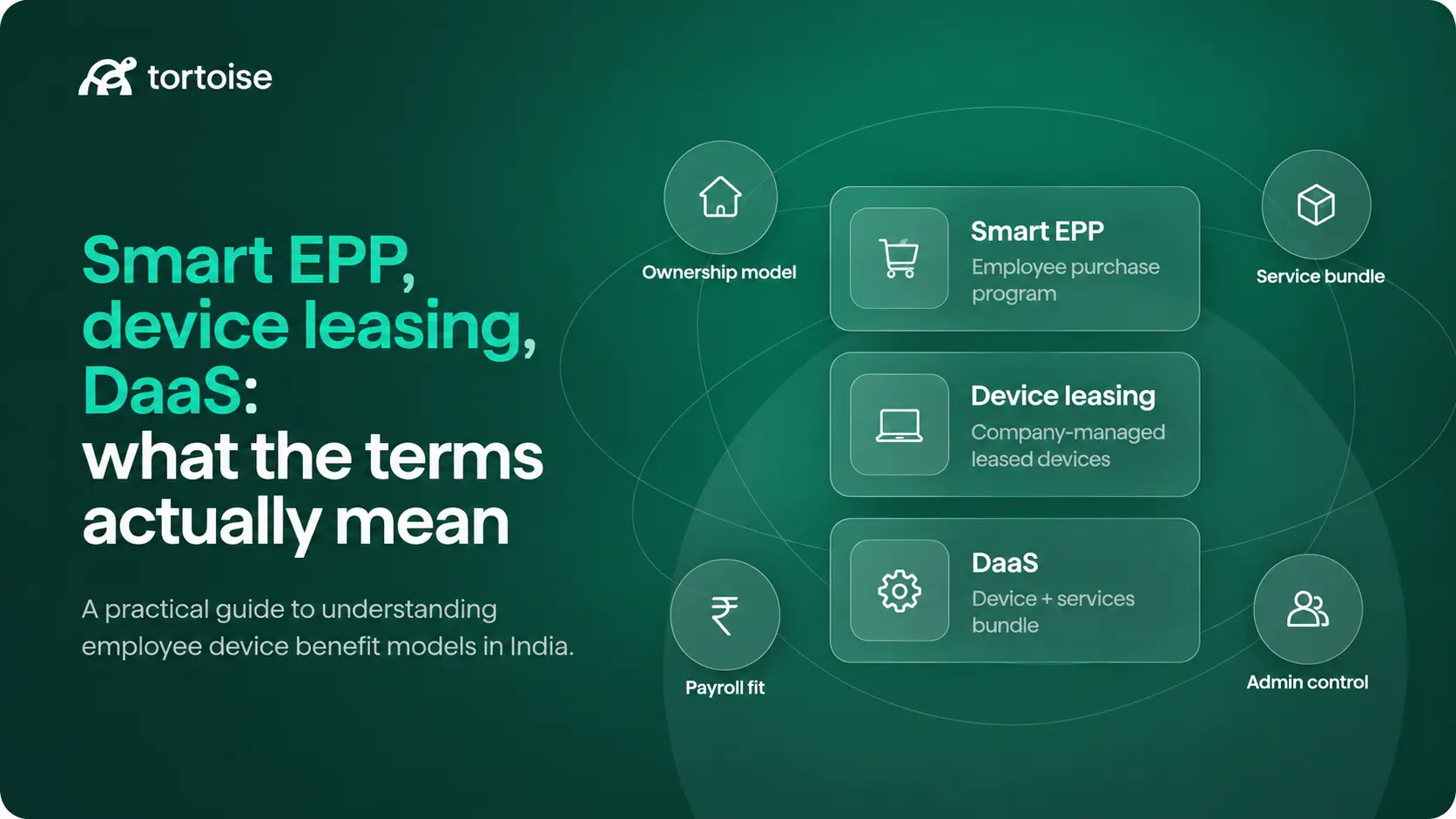
A device management platform such as Tortoise can support this category through Smart EPP, payroll-linked workflows, device lifecycle administration, and protection through Tortoise Corporate Care. Used well, this makes device access part of the benefits strategy rather than a separate procurement problem.
Benefits after resignation
Employee benefits after resignation in India need clear rules from the beginning of employment. Exit is where unclear benefit policies usually create friction, especially when payroll dues, leave encashment, reimbursements, insurance end dates, device handling, and recoveries overlap.
Employers should separate statutory dues from policy-based benefits. Unpaid wages, leave encashment, bonus treatment, gratuity, and other payable amounts should follow applicable law, employment contracts, and company policy. Voluntary benefits should follow the policy terms already communicated to the employee.
Resignation policies must specify immediate full and final settlement guidelines. Resignation and exit policies should specify full and final settlement timelines in accordance with applicable law, employment contracts, and company policy, including asset recovery rules, deduction treatment, and benefit closure procedures.
Device-related benefits need special attention at exit. The policy should explain what happens to deductions, ownership transfer, buyout, protection coverage, and unfinished lease terms. Clear language protects both the employer and the employee because there is less room for last-minute interpretation.
Faster exit timelines also require better coordination. HR, payroll, finance, and IT should not wait for sequential approvals when an employee resigns. A benefits policy that supports parallel closure will reduce disputes and improve compliance.
Building the policy
A strong employee benefits policy in India should be written for real use, not only for documentation. Employees should understand what they are eligible for, how the benefit works, and what happens when their role, salary, location, employment status or tax regime changes.
The policy should define statutory benefits, voluntary benefits, tax-efficient benefits, and salary-linked benefits in separate sections. Each section should explain eligibility, approval flow, payroll treatment, employee communication, and offboarding impact in plain language.
Ownership matters. HR may own policy design, but payroll owns calculations, finance owns cost control, IT may own device workflows and legal may review compliance wording. When these functions work from different assumptions, employees experience delays and inconsistent answers.
Digital administration also matters for scale. HRMS and payroll integrations, approval records, deduction reports, and audit trails make benefits easier to run. This is especially important for salary-linked benefits, device benefits, and any programme that continues across onboarding, monthly payroll, and exit.
The policy should also state that benefit terms may be amended by the employer from time to time, subject to applicable law and employee communication. This gives the employer flexibility to update benefits when laws, tax positions, vendor terms, or business requirements change.
A practical employee benefits policy should answer the following questions:
- Who is eligible?
- When does eligibility start?
- What is the benefit limit?
- Is employee consent required?
- Who approves the benefit?
- What happens if the employee changes role, location, or salary structure?
- What happens on resignation, termination, absconding, or death?
- How are recoveries handled?
- How often is the policy reviewed?
Final word
Employee benefits in India need to be compliant, useful, and easy to administer. For 2026, employers should move away from scattered benefit decisions, and build a policy that connects statutory obligations, salary structure, tax-efficient design, voluntary benefits, employee communication, governance, technology, and exit rules.
The opportunity is to create a benefits programme that employees can value, and internal teams can run with confidence. For employers exploring device benefits as part of that strategy, Tortoise offers a structured device management platform for salary-linked device access, payroll-linked workflows, lifecycle management, and device protection. To evaluate the model for your workforce, book a demo.
If your organisation is evaluating modern employee benefit programmes, Tortoise can help you design, administer, and scale device benefit programmes through payroll-integrated workflows, lifecycle management, and policy-driven administration. Speak with our team to understand whether the model is suitable for your workforce.
Disclaimer: This guide is intended for general informational purposes only and should not be treated as legal, tax, payroll or accounting advice. Applicability of employee benefit laws in India depends on several factors, including the nature of the establishment, employee category, wage levels, location, headcount, employment terms and applicable central and state laws. Tax treatment of benefits may also vary depending on the structure adopted, documentation, payroll processing and the employee’s applicable tax regime. Employers should consult their legal, tax and payroll advisors before implementing or modifying any employee benefit programme.
Frequently asked questions
Are employee benefits mandatory in India?
Some employee benefits are mandatory in India, subject to eligibility rules. These usually include provident fund, ESI where applicable, gratuity, maternity benefit, statutory bonus, leave entitlements, and certain facility obligations based on headcount, employee category, and location. Applicability depends on wage level, establishment type, employee category, location, and applicable central or state law.
Is group health insurance mandatory?
Group health insurance is generally a voluntary benefit for employees above statutory ESI coverage. Many private employers still offer it because it improves employee protection and supports retention. Employers should avoid treating group health insurance as a replacement for statutory social security obligations where those obligations apply.
What benefits do employees value?
Employees usually value benefits that are easy to understand and useful in daily life. Health insurance, family coverage, wellness support, paid leave, meal benefits, learning support, flexible work policies, and device access can all improve perceived value when they are administered clearly.
Are employee benefits taxable?
Some employee benefits may be taxable, while others may receive favourable treatment depending on structure, documentation, and payroll processing. Tax treatment can vary by benefit type, employee tax regime, payroll handling, valuation rules, and applicable law. Employers should describe benefits as tax-efficient only when the structure supports that position and after appropriate review.
How do device benefits work?
Device benefits can let employees access laptops, phones, or tablets through a structured salary-linked or salary-sacrifice lease model. Monthly rentals may be deducted from gross salary, subject to the employer’s compensation structure, payroll process, and applicable law. This may create tax efficiencies depending on the employee’s income-tax slab, selected tax regime, benefit structure, lease documentation, and payroll treatment.
The employer should clearly define tenure, deduction treatment, insurance coverage, damage or theft handling, and exit treatment.
What happens after resignation?
After resignation, statutory dues must be handled as required by law, while voluntary benefits should follow the employer’s written policy. Employers should clearly define treatment of leave encashment, pending reimbursements, insurance end dates, device benefits, deductions, recovery rules, and ownership or buyout treatment.
How should employers choose employee benefits?
Employers should choose benefits based on compliance requirements, workforce needs, cost sustainability, ease of administration, and employee utilisation. A smaller set of well-designed benefits is often more effective than a long list of benefits that employees do not understand or HR teams cannot administer smoothly.
How often should employee benefits be reviewed?
Employee benefits should be reviewed at least annually, and sooner if there are major legal, tax, payroll, workforce, or business changes. The review should consider statutory updates, employee feedback, utilisation, cost, vendor performance, audit issues, and exit disputes.
Why are device benefits becoming important?
Device benefits are becoming important because employees increasingly rely on phones, laptops, and tablets for daily work. A structured device benefit programme can help employees access better devices while giving employers clearer workflows for approval, payroll deduction, insurance, claims, lifecycle management, and exit treatment.
What should a device benefit policy include?
A device benefit policy should include eligibility, device categories, price limits, approval flow, payroll deduction treatment, tenure, insurance coverage, claim process, damage and theft handling, beyond economic repair treatment, return or buyout rules, exit treatment, recovery rights, and employee consent.
Can employee benefits improve retention?
Yes, employee benefits can improve retention when they are relevant, easy to understand, and consistently administered. Benefits that improve employee protection, daily convenience, productivity, or financial value can strengthen the overall employee value proposition. However, retention impact depends on programme design, communication, employee utilisation, and the overall employment experience.
Written by
Founder & CEO
Vardhan Koshal is the Co Founder of Tortoise, India’s fastest growing employee device benefit platform. He has led India growth and product for companies like TripAdvisor and Udacity, and earlier founded Ridingo, a car pooling startup recognised by Forbes as one of the Hottest Global Startups and acquired by Carzonrent. At Tortoise he works with HR leaders, CFOs and tax experts to design compliant, high impact device benefit programs for Indian employers.