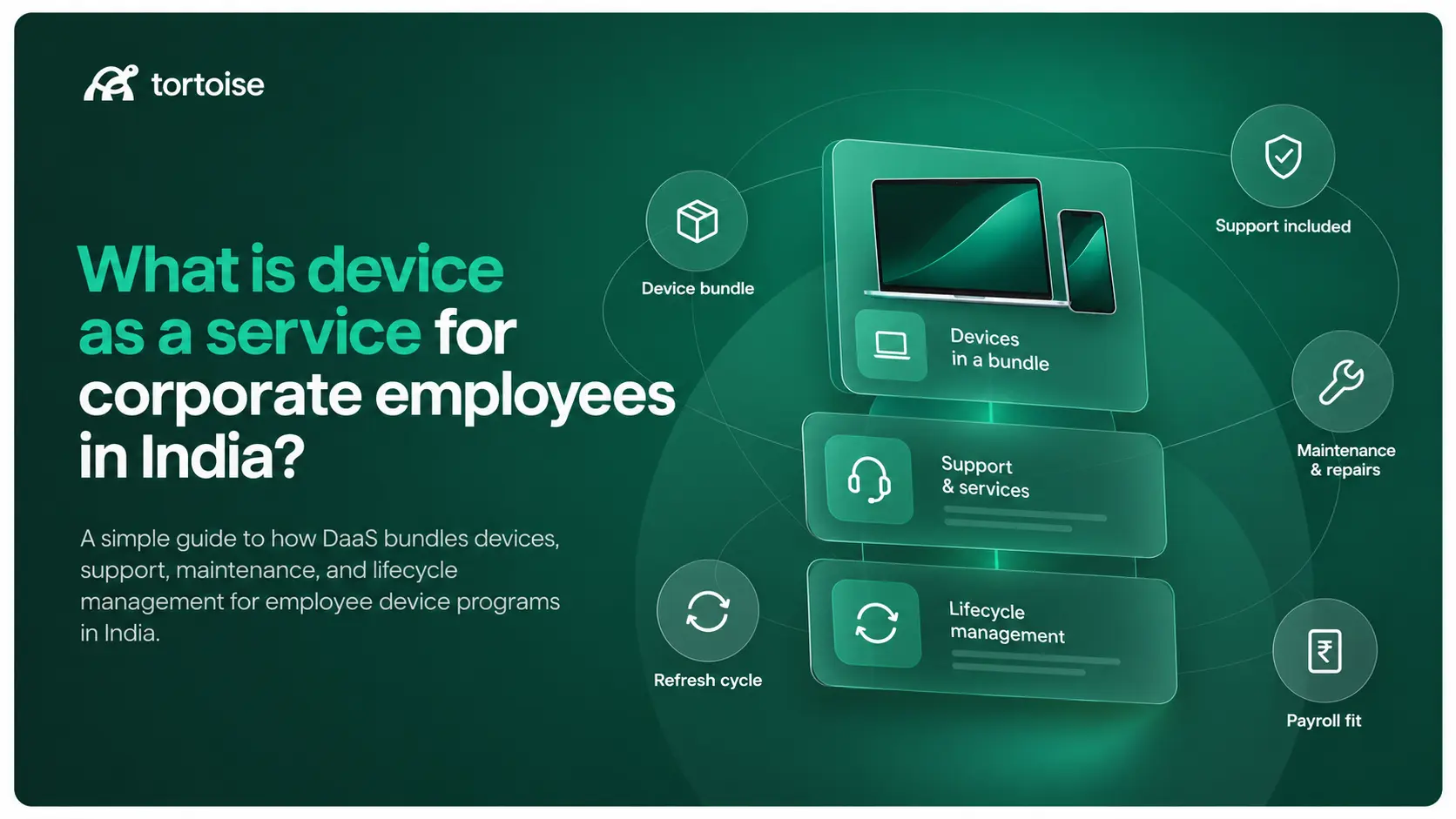
What is device as a service for corporate employees in India?

Device as a service for corporate employees in India is a recurring access model in which employees get laptops, phones, tablets, or other devices through a monthly program instead of a one-time purchase.
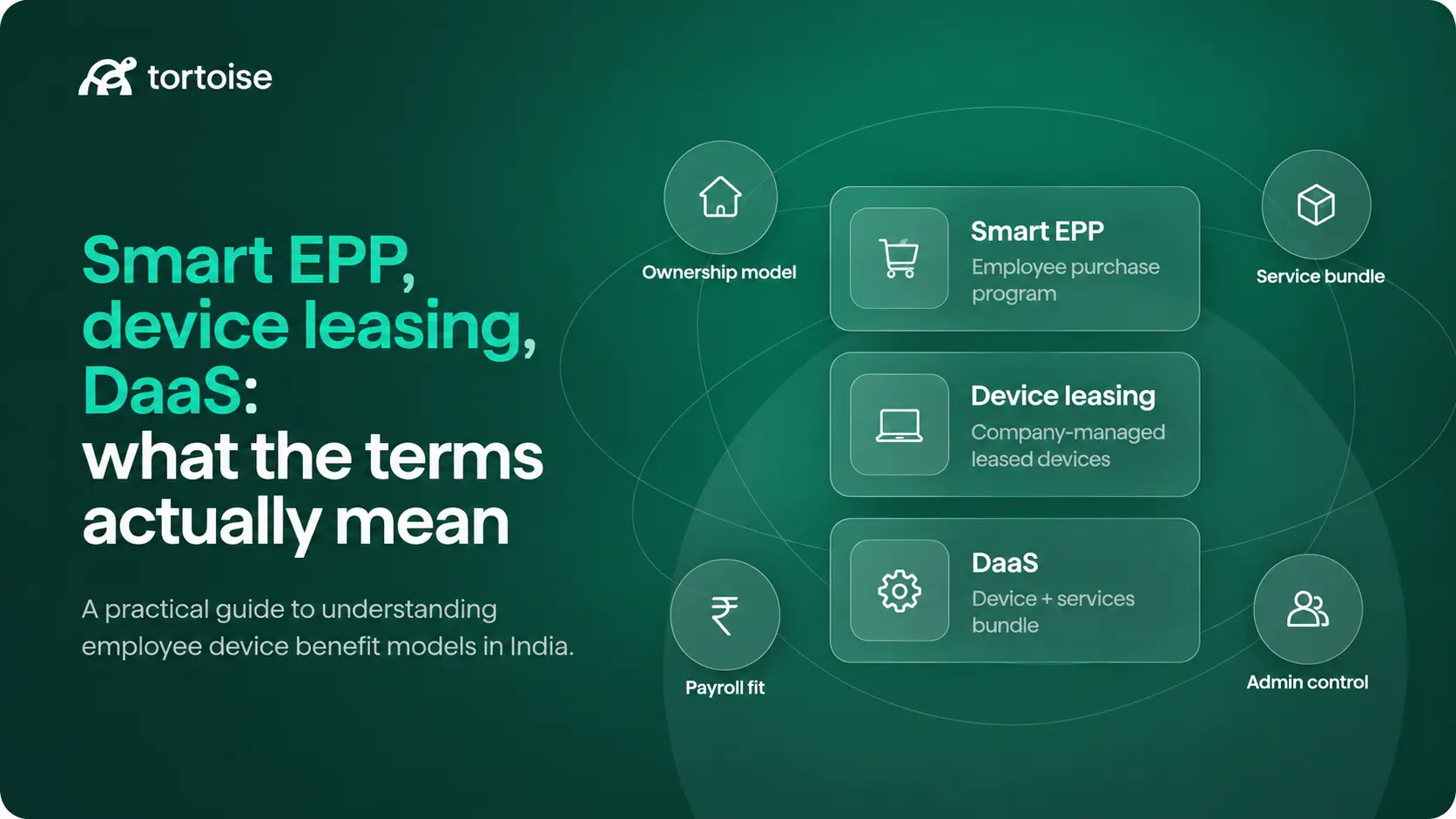
In practice, the phrase can mean two different things: an IT-managed subscription for company-owned fleets, or an employee-facing program that combines leasing, payroll-linked administration, insurance, and lifecycle support.
That distinction matters. For many HR, payroll, and finance teams, the real question is not just how to procure hardware. It is how to offer better access to devices without creating unnecessary admin work, policy confusion, or balance-sheet friction. Device decisions are no longer only an IT matter. They now sit inside conversations about employee benefits, salary structuring, retention, and workforce experience.
What device as a service means in the Indian corporate context
At its simplest, device as a service means access over ownership. Instead of paying the full cost of a device upfront, the cost is spread over time and bundled with support services such as delivery, maintenance, protection, upgrades, or end-of-term handling.
In India, however, there are two separate models hiding under the same label.
IT-led corporate DaaS for company-owned fleets
The first is traditional enterprise DaaS. This is usually led by IT or procurement. A company sources laptops or other hardware under a recurring contract, and the provider helps with deployment, support, replacement, and retirement.
Employee device benefit or leasing programs
The second is an employee device benefit model. Here, the program is designed around individual employees rather than just the corporate asset register. Employees get access to approved devices through a policy-led program, often supported by payroll deductions, insurance, and a defined ownership or upgrade path.
This is much closer to what Indian HR teams usually mean when they talk about employee device leasing or corporate device leasing in India.
If you are an HR or payroll leader, this second model is usually more relevant because it is built around employee experience, affordability, and administration, not only fleet control.
How device as a service works for employees in India
Employer sets the policy and eligibility
A typical employee device program starts with the employer setting the rules. The company decides who is eligible, what device categories are allowed, what price bands apply, and whether the program covers laptops, smartphones, tablets, or all three.
Employee selects an approved device
Next, employees choose from an approved catalog. Depending on the provider, they may see major brands, transparent pricing, and a preview of the monthly impact. This is one reason laptop leasing for employees has become easier to operationalise than informal reimbursement models.
The commercial structure is applied
Then the commercial structure is applied. In many Indian programs, the device is made available through a leasing or payroll-linked benefit model rather than a direct upfront purchase.
Delivery, support, and end-of-term handling are managed
Once the device is delivered, the program does not end there. The stronger offerings include protection, claims support, repair workflows, replacement handling, and end-of-term options such as return, upgrade, or transfer of ownership.
Our comprehensive article on employee device leasing in India outlines this model in detail as a mix of employer policy, leasing support, payroll deductions, and platform-led administration.
What is usually included in a good employee device program
A good employee device program does more than finance a device.
It usually includes device choice, clear eligibility rules, payroll visibility, and post-purchase or post-delivery support. The better platforms also bundle accidental damage protection, claim handling, repair coordination, and clear end-of-term terms. Some providers also package this as device lifecycle management for employees, covering delivery, servicing, replacement, and closure at the end of the tenure.
From an employer perspective, integration matters just as much as pricing. If approvals, payroll deductions, and employee communication all happen in separate systems, the program becomes hard to run.
If the device program connects cleanly with HRMS and payroll workflows, the admin load drops sharply. Employees also need clarity. They should be able to understand what they are getting, what they are paying each month, what happens if they leave the company, and what their options are when the term ends.
The positive side of device as a service for employers and employees
Lower upfront cost and more predictable budgeting
The biggest advantage is that it reduces the upfront burden of device access. Employees do not always want to pay the full retail price of a premium laptop or smartphone. A structured monthly model can make better technology accessible much sooner.
For employers, the appeal is predictability and process control. Instead of handling one-off exceptions, reimbursements, or manual approvals, companies can define a repeatable policy and let the program run inside that framework.
Better employee experience and access to premium devices
There is also an employee experience upside. A better device is no longer just an IT asset. It can affect productivity, flexibility, remote work quality, and even how employees perceive the employer.
Easier upgrades and device lifecycle management for employees
Lifecycle support is another major positive. Enterprise DaaS providers often position support, deployment, and retirement as core value drivers, not add-ons.
Employee-focused programs extend this logic by making the experience easier for individuals too, especially when insurance and service support are included.
Potential tax efficiency when structured correctly
In some structures, there may also be tax efficiency or payroll-related savings, but this is where companies need discipline. The benefit is not automatic and should never be described as universal.
The outcome depends on program design, payroll treatment, and compliance review. Indian tax guidance on perquisite valuation and employer-provided assets is relevant here, especially when companies are deciding whether a device is being provided, used, or transferred under a particular structure.
Broader coverage of employer-led mobile and laptop leasing has also helped make the category more visible in India.
Stronger retention and employer branding
A well-run program can strengthen retention. When employees feel the company helps them access high-value tools in a practical way, the benefit feels tangible rather than symbolic.
The downsides and limitations of device as a service (DaaS)
Tax, payroll, and policy complexity
The first downside is complexity. Device programs often sit at the intersection of HR, payroll, finance, tax, legal, and IT. If ownership is unclear, rollout can stall.
Savings vary by structure and employee profile
The second downside is that savings are not the same in every case. Some providers market large headline savings, but actual employee benefit depends on the exact structure, device category, tenure, tax profile, and end-of-term terms. HR teams should always look past the top-line number and review the mechanics carefully.
Employee exits and exceptions need clear workflows
The third downside is employee movement. People resign, go on leave, switch policies, or ask for exceptions. If the provider does not have a clear workflow for exits, buyouts, returns, or outstanding obligations, the admin burden can shift back to the employer.
Traditional DaaS can be too IT-centric for an employee device program
There is also the risk of choosing a model that solves the wrong problem. Traditional DaaS is useful when the company mainly wants asset standardisation, control, and support across a device fleet. But that does not automatically make it the best model for employee benefits.
A program built for IT asset management may offer less flexibility, weaker employee communication, or limited focus on payroll and employee experience.
Limited choice can weaken adoption
Finally, employees can get frustrated if the catalog is too narrow or the terms are hard to understand. A device benefit only works when it feels transparent and worthwhile.
Let’s give your workforce the best benefits experience!
Over 50,000 employees are already enjoying their new devices with heavy savings. Get it for your workforce too
Device as a service vs buying devices outright vs reimbursement
The best model depends on what your company is trying to optimise: upfront cost or CapEx, admin effort, employee experience, and support burden over the life of the device.
| Model | Best for | Main strengths | Main limitations |
|---|---|---|---|
| Device as a service | Companies that want structured access, monthly predictability, and ongoing support | Spreads cost over time, improves lifecycle support, can reduce admin when integrated well | Needs policy design, payroll clarity, and strong provider operations |
| Buying devices outright | Companies that want direct ownership and simple procurement for a small, standard fleet | Clear ownership, no recurring vendor design complexity, easy for one-time issuance | Higher upfront cost, harder upgrades, more internal responsibility for support and recovery |
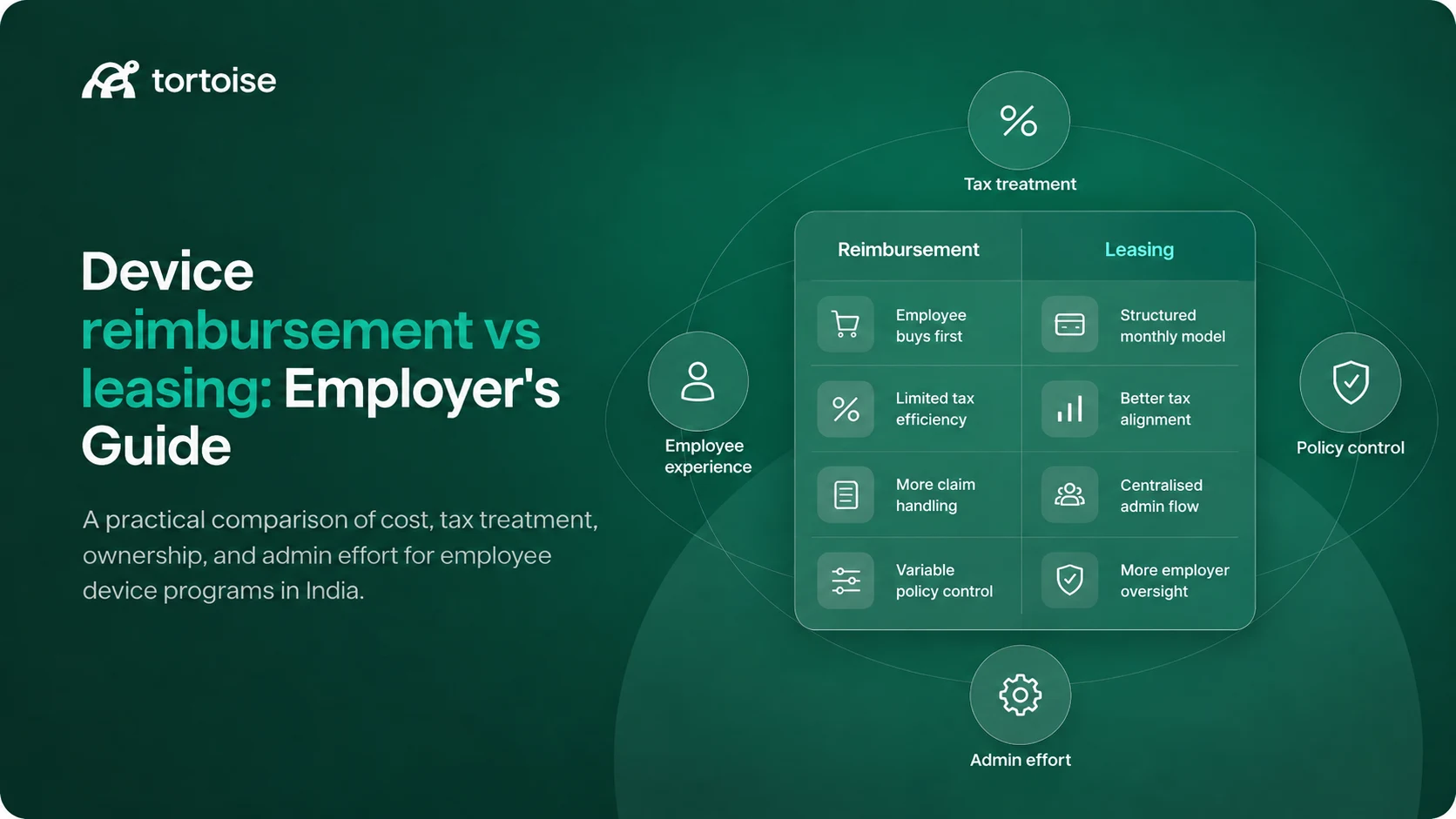
| Reimbursement | Companies that want employees to buy devices independently | Flexible for employees in some cases, limited procurement involvement | Inconsistent employee experience, weaker control, potential policy disputes, no built-in lifecycle support |
In short, outright purchase suits businesses that want maximum ownership. Reimbursement suits businesses that prefer decentralisation. Device as a service suits businesses that want a repeatable, support-backed access model.
If your company wants employees to choose devices within policy while HR and payroll keep administration controlled, a benefit-led DaaS or device leasing model is usually the better fit. If you mainly want standard-issued company machines with tight central control, classic enterprise DaaS may be more suitable.
What Indian HR and payroll teams should check before launch
Before launching any employee device program in India, companies should answer five practical questions.
- What exactly is the policy?
Eligibility, device caps, tenure, exit handling, and end-of-term rules should all be written clearly. - How will payroll handle deductions or benefit treatment?
If the monthly treatment is confusing, employee trust drops quickly. - What happens when a device breaks, is lost, or needs replacement?
Insurance and service scope should be easy to understand. - Who owns the experience internally?
HR, payroll, IT, and finance all need defined roles, even if one provider manages most of the workflow. - How well does the provider handle exceptions?
Resignations, policy breaches, manager approvals, and edge cases are where poor programs become expensive.
A final check is governance. Ownership, tax treatment, payroll treatment, and end-of-term documentation should all be reviewed before the first employee is onboarded. This is especially important in corporate device leasing programs in India, where the commercial model may look simple to employees but still require careful back-end controls.
Employers should also be clear on whether they are dealing with use of an employer-provided asset, lease-linked recovery, or end-of-term transfer, because those scenarios are not treated identically under Indian tax rules.
Why Tortoise is a better fit for employee device benefits
Generic device as a service providers usually start from the hardware side. Tortoise starts from the employee benefit side.
Built for employee benefits, not just asset provisioning
Tortoise can be a better fit for companies that want to offer employee devices as a structured benefit rather than simply rent a fleet. The model is designed for Indian employers that care about payroll simplicity, employee satisfaction, and compliance-friendly rollout.
Payroll and HRMS integration with lower admin overhead
That shows up in a few practical ways. Tortoise positions device access as a benefit employees can actually understand and use. It supports payroll and HRMS integrations, helps companies define policy guardrails, and reduces manual coordination.
Care, insurance, and lifecycle support in one flow
The platform also emphasises care, insurance, repair support, and employee workflows rather than treating those services as afterthoughts. Its site also highlights broad device choice, service coverage across thousands of pincodes, and payroll and HRMS integrations that reduce manual coordination.
Better fit for companies that want choice, compliance support, and employee satisfaction
This is a better fit for companies that want easier administration and a better employee experience without pushing complexity back onto HR or payroll teams.
So if your goal is purely IT fleet control, a traditional DaaS contract may be enough. But if your goal is to offer a practical, employee-friendly, policy-backed employee device benefit in India, Tortoise can be a better fit.
Final takeaway
Device as a service for corporate employees in India is best understood as a way to turn device access into a structured monthly program rather than a one-time purchase decision. But not every version of DaaS is built for the same purpose.
Some models are designed for IT teams managing corporate fleets. Others are designed to help employees access devices through a more benefit-led experience. That second category is where the biggest opportunity lies for HR and payroll teams.
If your company wants a compliant, easier-to-run way to offer laptops, phones, or tablets as an employee benefit, Tortoise can be a strong fit because it combines policy support, payroll integration, lifecycle services, and employee experience in one model.
Frequently asked questions
What is device as a service for employees?
Device as a service for employees is a model where employees get access to laptops, phones, tablets, or other devices through a monthly program instead of buying them outright. Depending on the provider, the program may also include payroll-linked administration, support, insurance, repairs, and end-of-term options.
Is device as a service the same as employee device leasing?
Not always. Device as a service is the broader category. Employee device leasing is one version of it, usually built around giving individual employees access to approved devices through structured monthly payments and employer policy controls.
Are there tax benefits on employee device programs in India?
There can be, but they are not automatic. The outcome depends on how the program is structured, documented, and handled in payroll, so companies should validate the treatment with their tax, finance, legal, and payroll advisors before launch.
Who should own an employee device program: HR, IT, or finance?
Most companies need HR, IT, finance, and payroll to work together. HR often owns the employee benefit policy, IT may guide device standards and security, finance reviews the commercial model, and payroll ensures deductions and reporting are handled correctly.
Written by
Founder & CEO
Vardhan Koshal is the Co Founder of Tortoise, India’s fastest growing employee device benefit platform. He has led India growth and product for companies like TripAdvisor and Udacity, and earlier founded Ridingo, a car pooling startup recognised by Forbes as one of the Hottest Global Startups and acquired by Carzonrent. At Tortoise he works with HR leaders, CFOs and tax experts to design compliant, high impact device benefit programs for Indian employers.