How does employee device leasing work in India? Explainer guide

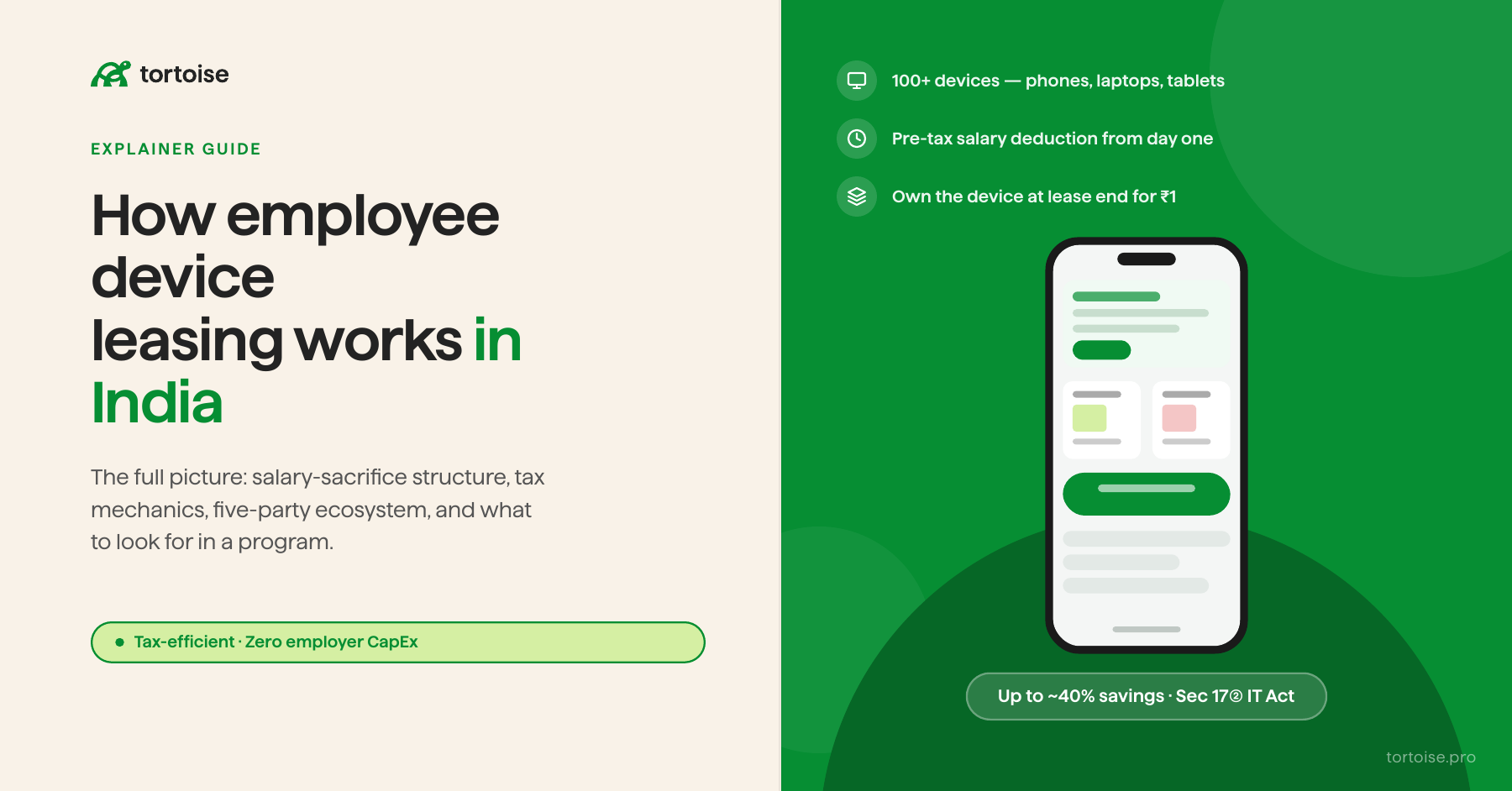
Employee device leasing in India is a workplace benefit where a company enables employees to access laptops, phones, or tablets through a structured lease instead of buying devices outright. With a managed platform like Tortoise, employers can run the program across device selection, payroll deduction, insurance, support, and end-of-lease ownership while keeping the employee experience simple.
The employee pays monthly lease rentals through deductions from gross salary, which can reduce the effective cost of the device because the deduction happens before income tax is calculated.
When structured correctly, this model can help employees save up to around 40% compared to buying a device at retail price, depending on their income-tax slab and the company’s program design. The employer does not need to buy the device upfront, carry it as a capital asset, or manage the full lifecycle manually. At the end of the lease, the employee usually gets ownership of the device for a nominal amount, often ₹1.
For businesses, employee device leasing works as a practical benefits program because it improves access to high-quality devices without creating a large upfront cost. For employees, it turns a planned personal device purchase into a more affordable workplace benefit.
Let’s give your workforce the best benefits experience!
Over 50,000 employees are already enjoying their new devices with heavy savings. Get it for your workforce too
What is device leasing?
Employee device leasing is an employer-sponsored arrangement where an employee gets access to a device through a lease managed by the company and its leasing partner. The device can be a smartphone, laptop, tablet, or other eligible work-use device, depending on the company’s policy.
The company signs the required lease and service agreements with the relevant partners. The employee selects a device within the approved eligibility limit. Once the device is delivered, the lease rental is deducted from the employee’s gross salary through payroll.
This is commonly called a salary-sacrifice arrangement. A portion of salary that would otherwise be paid out and taxed is used to pay the device lease rental. That is where the tax efficiency comes from.
Employee device leasing is different from buying a phone or laptop on EMI. In an EMI purchase, the employee pays from post-tax income. In a salary-deduction lease, the monthly rental is recovered from gross salary before income tax is calculated, subject to correct program structuring and company policy.
How employee device leasing works
A device leasing program has a few moving parts, but the employee experience is designed to stay simple.
The company first defines who is eligible, what device limits apply, and which approval process will be followed. A leasing partner evaluates the employer and assigns a lease credit limit. The platform then connects the employer, employee, leasing partner, supplier, insurer, payroll, and HR systems into one workflow.
Once the program is live, an employee can log in, view eligible devices, check the monthly salary impact, and place an order. The request goes through the company’s approval process. After approval, the supplier delivers the device, and payroll deductions begin according to the lease schedule.
The employer pays the lease rental to the leasing partner and recovers the employee’s portion through payroll. At the end of the lease tenure, ownership transfers to the employee for a nominal amount, depending on the structure agreed for the program.
This creates a cleaner experience than reimbursement policies, where employees often have to buy the device first, submit invoices, wait for approvals, and deal with unclear tax treatment.
Parties in a device leasing program
An employee device leasing program usually involves five parties.
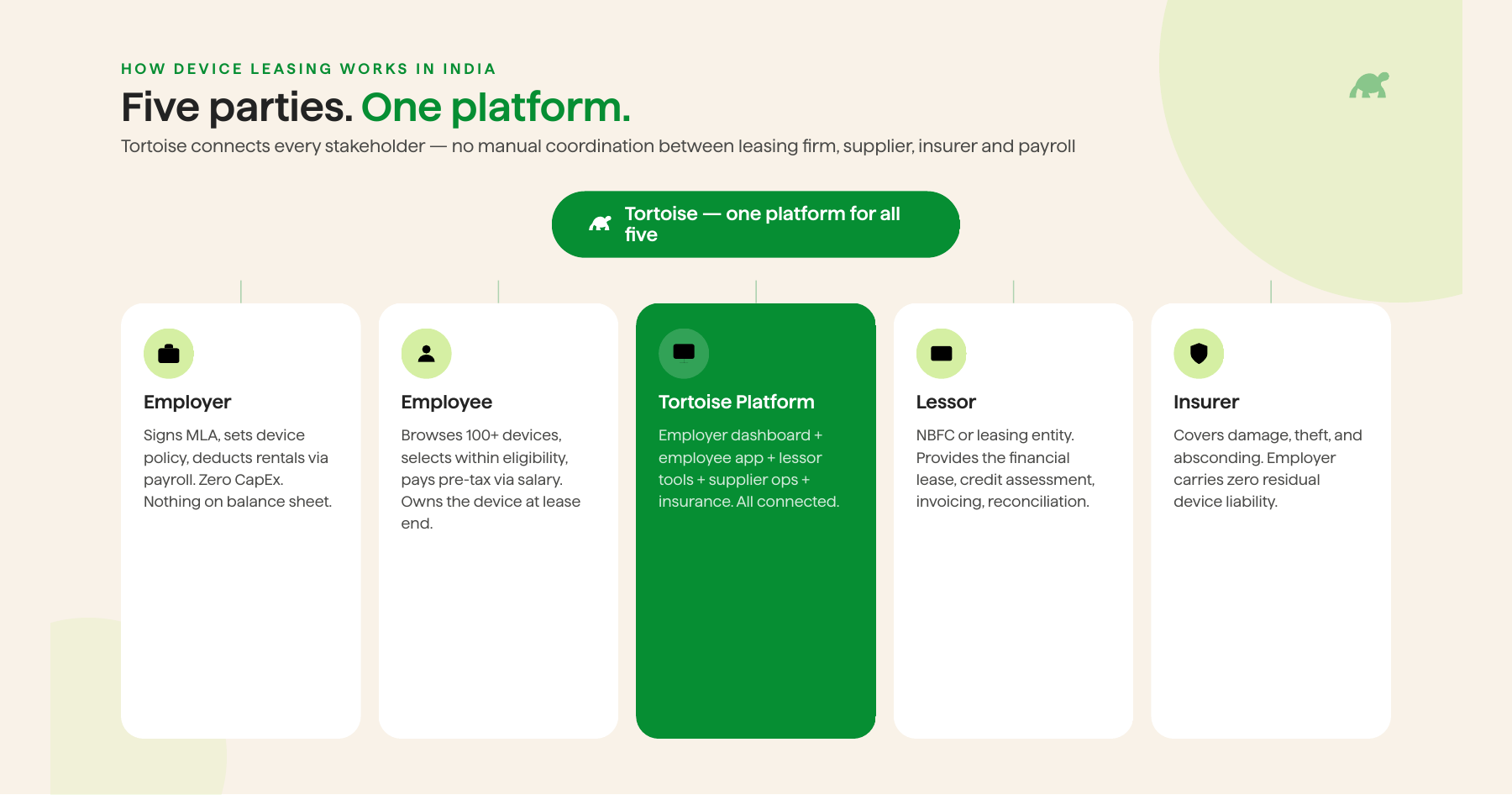
The employer acts as the lessee, signs the Master Lease Agreement, defines the device policy, manages approvals, and runs payroll deductions. The employee chooses the device, agrees to the policy, and pays the lease rental through salary deduction. The leasing partner provides the financial lease, performs the employer credit assessment, sets the credit limit, and manages lease invoicing. The device supplier handles inventory, order fulfilment, and delivery. The insurer covers risks such as accidental damage, liquid damage, theft, and in some programs, absconding.
A platform like Tortoise brings these parties into one managed system. That matters because a device benefit can become difficult to run when HR, finance, suppliers, insurers, and payroll teams are working across separate processes. A central platform reduces manual work and gives employees a clearer experience from selection to ownership transfer.
Salary deduction and tax savings
The main reason employee device leasing works well in India is the salary-deduction structure.
Under a correctly designed program, the lease rental is deducted from the employee’s gross salary. Since income tax is calculated after eligible deductions, the employee’s taxable income reduces by the amount of the lease rental.
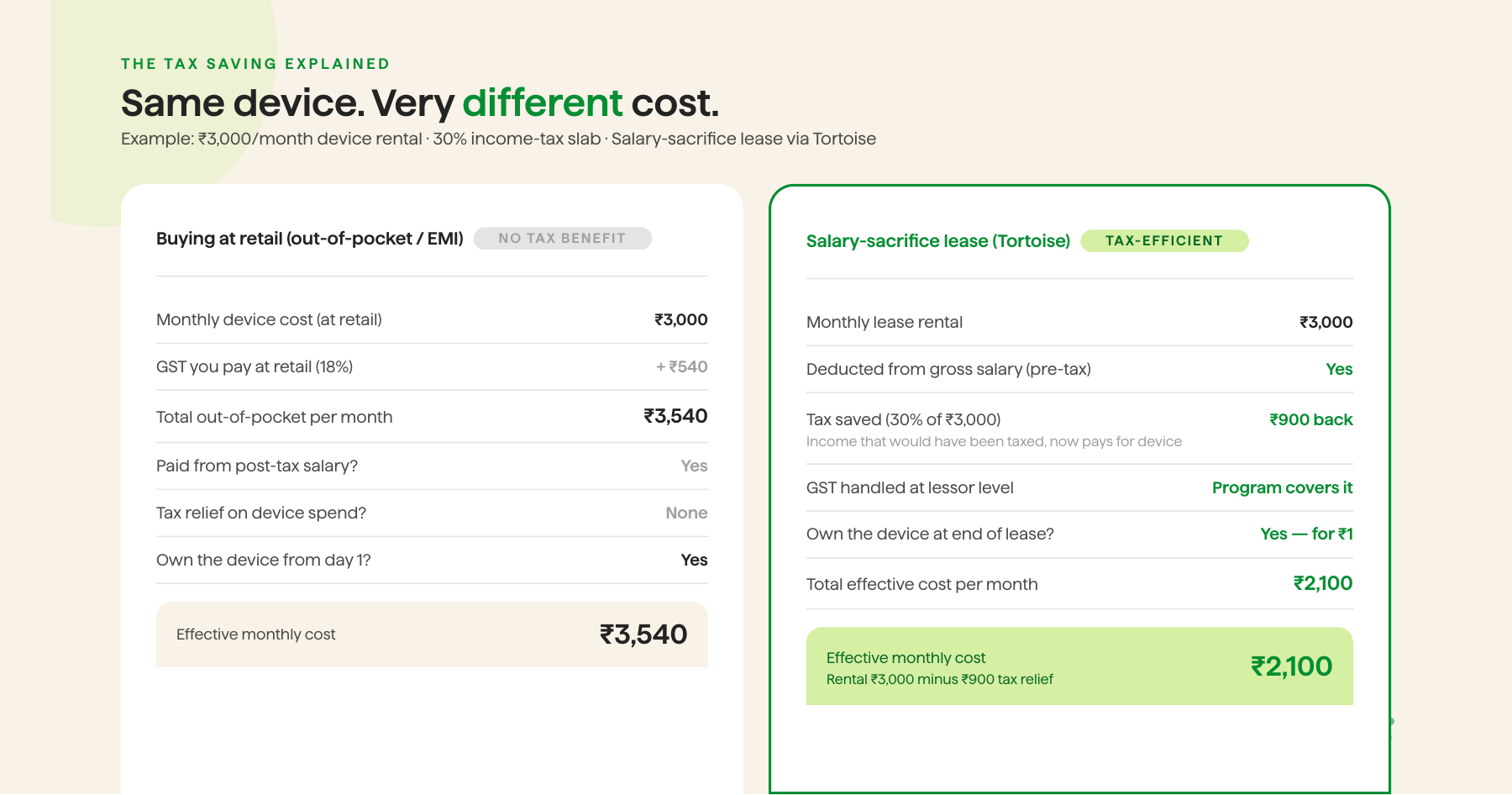
For example, an employee in the 30% tax slab with a monthly device rental of ₹3,000 could save roughly ₹900 per month in income tax from the salary deduction alone. Over a 24-month lease, this can mean around ₹21,600 in tax savings, before accounting for the broader program-level GST efficiency.
The actual saving depends on the employee’s income-tax slab, device cost, lease tenure, salary structure, and the specific program design. Employees in higher tax slabs usually see higher savings. Employees in lower slabs may still benefit, but the effective saving will be different.
This is why the savings should always be presented as slab-dependent. Employee device leasing is tax-efficient, not tax-free. The structure must be reviewed and implemented correctly by the employer’s finance and tax teams.
GST and tax treatment
The tax treatment of employee device leasing in India depends on correct structuring.
Work-related assets and employer-provided benefits are governed by Section 17(2) of the Income Tax Act and Rule 3 of the Income Tax Rules, 1962. These provisions are relevant when evaluating how employer-provided devices and related salary deductions should be treated.
On the GST side, Input Tax Credit rules under Section 17(5) of the CGST Act are important. In a retail purchase, an individual usually pays GST as part of the device price and cannot claim input credit. In a structured lease program, GST is handled within the leasing framework rather than being borne by the employee in the same way as a direct retail purchase.
Tortoise’s tax structure has been evaluated by Deloitte India and Lakshmikumaran & Sridharan, one of India’s leading tax law firms. This gives employers a stronger foundation than relying on informal interpretations or self-certified benefit structures.
Companies should still confirm their final treatment with their own finance, tax, and legal teams before rolling out the program. The old and new income-tax regimes, internal salary structure, and lease documentation can affect the final outcome.
Employer setup and documentation
The employer setup starts with internal alignment. HR, finance, taxation, and legal teams should review the proposed structure before the first device is made available to employees. This helps avoid confusion later around perquisite treatment, payroll deduction, insurance, employee exits, and device ownership.
The leasing partner then conducts a credit assessment of the employer. This usually involves reviewing audited financial statements, current-year financials or MIS data, and a company profile. Based on this assessment, the lessor assigns a lease credit limit. This limit determines the total value of devices that can be active under lease at a given time.
After that, the employer signs the required agreements. The Master Lease Agreement defines the lease relationship between the employer and the leasing partner. The Master Servicer Agreement defines the service scope, platform responsibilities, operational workflows, data handling, support process, and program governance.
The platform then integrates with payroll and HRMS systems. Eligibility rules, grade-wise limits, approval flows, and deduction schedules are configured. Employees receive the device usage policy, usually with digital acknowledgement inside the platform or app.
A good implementation also includes an internal launch communication. Employees need to understand what the benefit is, how much they can save, what happens when they leave the company, and how ownership transfers at the end.
Employee ordering journey
Once the program is live, the employee journey is straightforward.
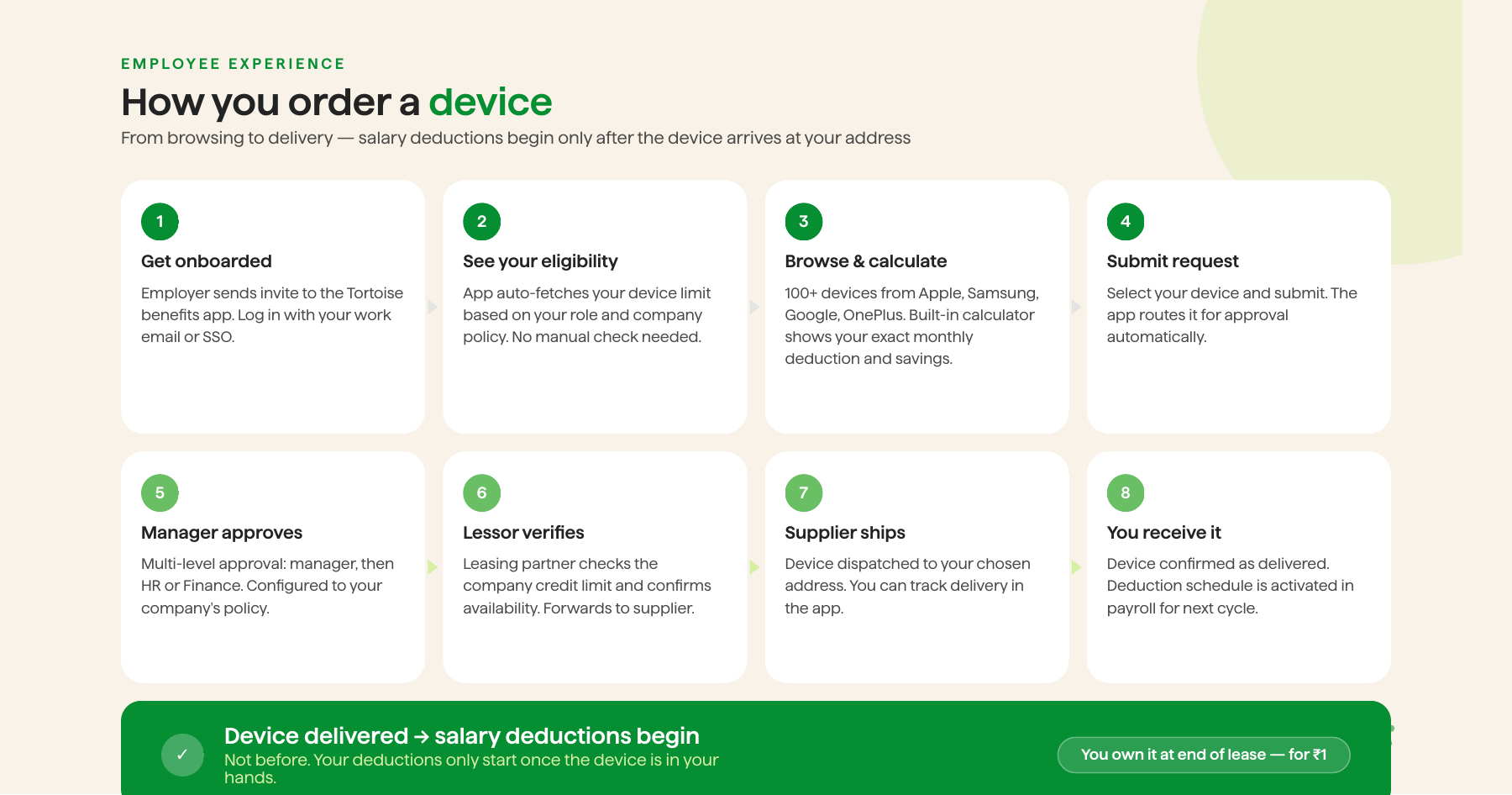
The employee receives access to the benefits app or platform. Their eligibility limit is shown based on the company’s policy. They can browse eligible devices such as smartphones, laptops, and tablets from approved brands and choose a device within the available limit.
Before placing the order, the employee can view the estimated monthly deduction, effective device cost, and savings compared to MRP. This step is important because a strong device benefit should be transparent. Employees should know the effect on monthly salary before making a decision.
After the employee submits the request, it goes through the company’s approval process. This may involve HR, reporting managers, finance, or other approvers depending on the company’s policy. The leasing partner verifies the request against the employer’s credit limit, and the supplier then fulfils the order.
Salary deductions begin after the device is delivered and the lease schedule is activated. Each month, the employer pays the lessor and recovers the rental through payroll deduction.
End-of-lease ownership
At the end of the lease tenure, ownership of the device usually transfers to the employee for a nominal amount, often ₹1. In some structures, the transfer value may range between 0% and 2% of the original device cost.
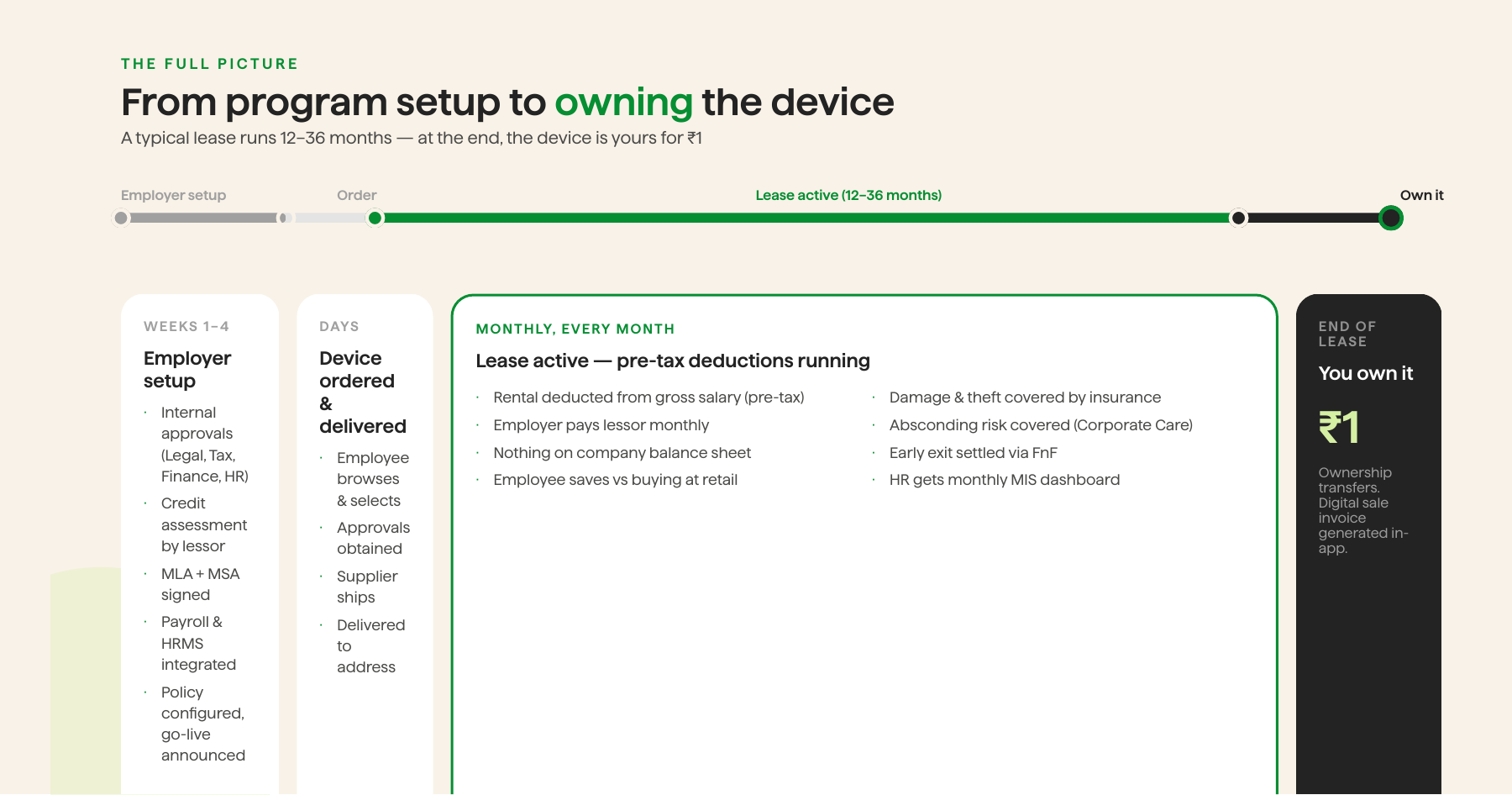
A sale invoice is generated and made available to the employee. After this step, the employee owns the device fully.
This ownership outcome is one reason employees find the benefit attractive. They are able to access a device they may have planned to buy anyway, pay through a tax-efficient salary deduction, and own the device at the end of the lease.
For employers, this also avoids the administrative burden of collecting old devices, tracking depreciated assets, managing refresh cycles manually, or deciding what to do with used devices after employees move on.
Damage, loss, and theft coverage
Device benefits can create risk when damage, loss, or theft is not planned for. A well-structured leasing program defines these events upfront.
Tortoise Corporate Care covers accidental damage, liquid damage, theft, and two free broken-glass screen repairs per year. It also includes on-site pickup and repair, a replacement device during repair, and support through toll-free, WhatsApp, and email channels.
This matters for both employees and employers. Employees do not want a benefit that becomes stressful the first time a device breaks. Employers do not want hidden liability from damaged or missing devices.
Insurance turns uncertain device risk into a defined program feature. It also makes the benefit easier for HR and finance teams to support internally.
Employee exits and foreclosure
Employee exits need special handling in any device leasing program.
When an employee resigns before the lease ends, foreclosure charges are calculated and recovered through the Full and Final settlement. In many cases, the employee can still purchase the device by paying the remaining amount as defined in the program terms.
Absconding is a separate risk. In a self-managed device policy, the employer may be left with an unpaid device and limited recovery options. Tortoise Corporate Care covers absconding risk, which helps protect the employer from exposure when an employee leaves without completing the required exit process.
This is one of the reasons insurance should be evaluated carefully when selecting a device leasing platform. The lowest-cost program may not be the safest one if it leaves the employer exposed during exits, damage claims, or lost-device events.
Why employees value device leasing
A device benefit works well when employees understand the value clearly.
Many employees already plan to buy a smartphone, laptop, or tablet for work and personal productivity. Without a structured benefit, they usually buy it through post-tax income, pay full retail price, and manage repairs on their own.
Employee device leasing changes that experience. The employee can choose from approved devices, understand the salary impact before ordering, save depending on their tax slab, and receive support for damage or theft. At the end of the lease, they can own the device.
From an employee-benefits lens, this is valuable because it combines choice, affordability, convenience, and ownership. It does not feel like a distant benefit that only applies in rare situations. It is practical, visible, and easy to understand.
For companies competing for talent, benefits that employees can use directly often carry higher perceived value than generic additions to the benefits stack.
Why employers offer device leasing
For employers, the case for device leasing is strongest when device access already matters to the workforce.
Companies in IT, ITeS, BFSI, GCCs, professional services, pharma, and other knowledge-driven sectors often have employees who need reliable devices for productivity. Many of these companies already support devices through reimbursements, corporate procurement, or ad hoc allowances.
These approaches can be expensive or administratively heavy. Reimbursements require claims, invoice checks, approvals, and policy interpretation. Company-owned devices create asset tracking, depreciation, retrieval, and refresh-cycle work. Ad hoc allowances may not create the same tax efficiency or employee experience.
Employee device leasing gives employers a more structured option. The company can offer a meaningful benefit without upfront device purchase, without adding company-owned assets to the balance sheet, and without building a device operations process from scratch.
For HR teams, the benefit supports employee experience and retention. For finance teams, it keeps cost, compliance, and risk more predictable. For leadership, it creates a visible employee-friendly program without the usual cost burden of high-value benefits.
Device leasing vs other options
| Arrangement | How it works | Employer impact | Employee impact |
|---|---|---|---|
| Out-of-pocket purchase | Employee buys directly using post-tax salary | No employer administration | No tax efficiency or employer support |
| EMI purchase | Employee pays monthly from post-tax income | No employer administration | Device cost is spread out, but savings are limited |
| Reimbursement | Employee buys and claims under company policy | Claims, approvals, tax interpretation, and paperwork | May involve delays and unclear tax treatment |
| Company-owned device | Employer buys, tracks, and later retrieves or writes off device | CapEx, asset tracking, depreciation, and lifecycle work | Employee gets access, but usually no ownership |
| Employee device leasing | Employer sponsors a structured lease with payroll deduction | No upfront purchase, lower admin burden, defined risk controls | Tax-efficient access, device choice, and end-of-lease ownership |
| Device as a service | Devices are provided through a managed service model | Predictable operating cost and lifecycle management | Usually focused on access rather than employee ownership |
Employee device leasing sits close to Device as a Service in some ways because both reduce the burden of owning and managing devices. The difference is that an employee device leasing program in India is specifically designed around salary deduction, tax efficiency, and eventual employee ownership.
Is employee device leasing compliant in India?
Employee device leasing can be compliant in India when it is structured, documented, and implemented correctly.
The relevant tax framework includes Section 17(2) of the Income Tax Act, Rule 3 of the Income Tax Rules, and GST provisions under the CGST Act. Employers should review how the benefit is classified, how salary deductions are made, how GST is handled, and how ownership transfer is documented.
A credible program should have clear agreements, defined employee policies, proper payroll integration, transparent invoices, and tax review by qualified experts.
Tortoise’s program has been evaluated by Deloitte India and Lakshmikumaran & Sridharan. Tortoise is also ISO 27001 and SOC 2 certified, which is relevant for employers reviewing data protection, platform controls, and enterprise readiness.
This article is for informational purposes and should not be treated as tax or legal advice. Companies should consult their own advisors before implementing any employee device leasing program.
How to evaluate a device leasing platform in India?
A company evaluating employee device leasing in India should look beyond device pricing.
The first question is whether the tax structure has been reviewed by credible external experts. Since the value of the program depends on correct treatment, this should be one of the earliest checks.
The second question is how the lease is documented. Employers should understand who the lessor is, how the Master Lease Agreement works, how the credit limit is assigned, and what happens during employee exits.
The third question is insurance coverage. Damage and theft coverage are useful, but employer risk during absconding should also be reviewed. A program that does not cover exit-related exposure may create problems later.
The fourth question is payroll integration. Manual deduction files increase errors and add work for HR and payroll teams. A platform-led process should make monthly reconciliation easier.
The fifth question is employee experience. A benefit will not get adopted if the device selection is poor, savings are unclear, approvals are slow, or support is hard to access. Employees should be able to view eligibility, compare devices, see monthly deductions, and track orders without depending on HR for every step.
The final question is whether the platform can manage the full lifecycle. A strong provider should connect device selection, approvals, leasing, insurance, payroll, delivery, support, and ownership transfer in one operating model.
Where Tortoise fits
Tortoise is a fully managed device benefit platform for Indian employers. It helps companies offer employee device leasing through a structured, tax-compliant program that integrates device selection, payroll deduction, insurance, support, and end-of-lease ownership.
Employees can access a curated marketplace of devices, view their estimated savings, select within their eligibility limits, and own the device at the end of the lease. Employers can offer the benefit without upfront CapEx, without carrying devices as company-owned assets, and without managing multiple vendors manually.
The program is designed for companies that want to offer employees a practical and high-value benefit while keeping finance, compliance, and administration in control.
Frequently asked questions
What is employee device leasing?
Employee device leasing is a workplace benefit where employees access phones, laptops, or tablets through an employer-sponsored lease. Monthly rentals are deducted from gross salary, and the employee can usually own the device at the end of the lease for a nominal amount.
How does device leasing work in India?
The employer signs a lease arrangement with a leasing partner and enables employees to choose eligible devices through a platform. The employee’s lease rental is deducted from gross salary through payroll, and ownership transfers at the end of the lease according to the program terms.
How much can employees save?
Employees can save up to around 40% compared to buying a device at retail, depending on their income-tax slab, device cost, lease tenure, salary structure, and program design. Employees in higher tax slabs generally see higher savings.
Is device leasing tax-free?
No. Device leasing is tax-efficient when structured correctly. The benefit comes from salary deduction before income-tax calculation and compliant GST handling within the lease framework. Employers should confirm treatment with their finance and tax advisors.
Who owns the device?
During the lease, ownership sits as defined in the lease structure. At the end of the lease tenure, the employee usually gets ownership of the device for a nominal transfer value, often ₹1.
What devices are available?
Eligible devices usually include smartphones, laptops, and tablets from approved brands. Availability depends on the employer’s policy, employee eligibility limit, and the platform’s device marketplace.
What happens after resignation?
When an employee resigns before the lease ends, foreclosure charges are calculated and recovered through the Full and Final settlement. The employee may be able to buy the device by paying the remaining amount, depending on the program terms.
What happens if a device breaks?
With Tortoise Corporate Care, accidental damage, liquid damage, theft, and two free broken-glass screen repairs per year are covered. The program also includes pickup and repair support, a replacement device during repair, and support through toll-free, WhatsApp, and email channels.
Does this work with payroll?
Yes. A platform like Tortoise integrates with payroll and HRMS systems so eligibility, approvals, deductions, and monthly reconciliation can be managed with less manual effort.
Is Tortoise compliant?
Tortoise’s tax structure has been evaluated by Deloitte India and Lakshmikumaran & Sridharan. Tortoise is also ISO 27001 and SOC 2 certified. Companies should still review their own implementation with internal finance, tax, and legal teams.
Disclaimer: This guide is intended for general informational purposes only and should not be treated as legal, tax, payroll or accounting advice. Applicability of employee benefit laws in India depends on several factors, including the nature of the establishment, employee category, wage levels, location, headcount, employment terms and applicable central and state laws. Tax treatment of benefits may also vary depending on the structure adopted, documentation, payroll processing and the employee’s applicable tax regime. Employers should consult their legal, tax and payroll advisors before implementing or modifying any employee benefit programme.
Written by
Founder & CEO
Vardhan Koshal is the Co Founder of Tortoise, India’s fastest growing employee device benefit platform. He has led India growth and product for companies like TripAdvisor and Udacity, and earlier founded Ridingo, a car pooling startup recognised by Forbes as one of the Hottest Global Startups and acquired by Carzonrent. At Tortoise he works with HR leaders, CFOs and tax experts to design compliant, high impact device benefit programs for Indian employers.