What is Smart EPP? How Employee Purchase Programs Work in India

Employee benefits in India are becoming more practical and easier to connect to everyday work. For many teams, access to a reliable smartphone, laptop, or tablet now sits close to the centre of the employee experience.
That creates a clear challenge for HR, Finance, and leadership teams. They want to offer premium device access without large upfront spending, manual reimbursement cycles, or policy ambiguity. Smart EPP addresses that need by turning device access into a structured benefit with defined controls and a cleaner operating model.
What Is Smart EPP?
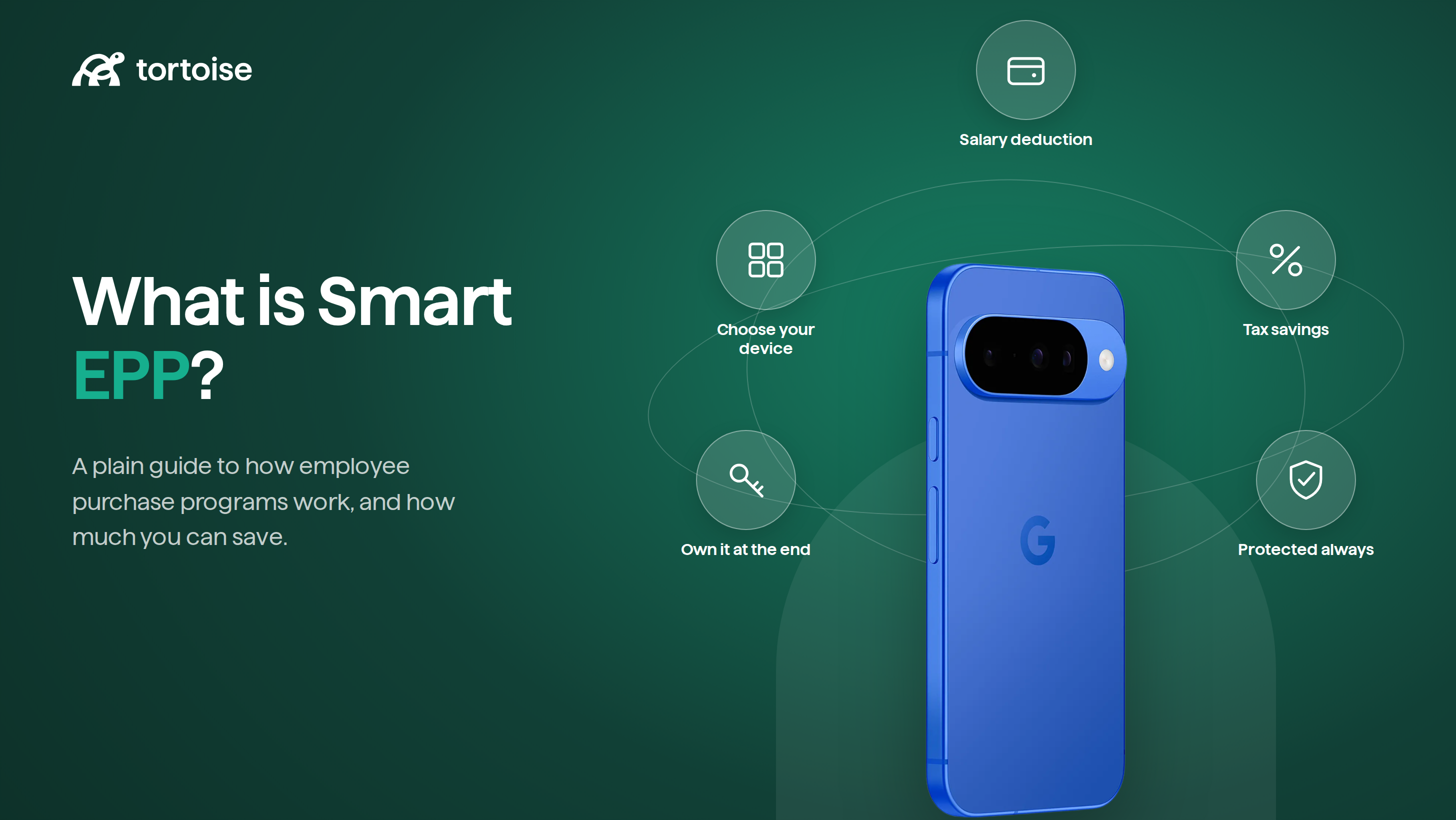
Smart EPP is a structured corporate employee purchase program that helps employees access devices through employer-enabled leasing or payroll-linked purchase models. In India, it usually extends beyond simple discounts to include policy controls, salary deductions, compliance-aware structuring, and support services.
To understand what is employee purchase program in the enterprise context, it helps to separate older discount models from newer payroll-linked programs. A Smart EPP sits at the intersection of employee benefits, device access, and operational control.
Smart EPP vs standard employee purchase programs
Not every employee purchase program works in the same way. Some models operate as branded discount storefronts. Others depend on external financing where the employer acts mainly as a referral channel.
A true employee purchase program (EPP) in the Smart EPP sense is more structured. The employer defines policy, employees select from an approved catalog, and the program runs through payroll or CTC logic instead of informal reimbursement routes. That makes it meaningfully different from a basic employee discount purchase program.
For enterprise teams, that distinction matters. Discount portals may improve access, yet they usually do little to address approval workflows, deduction management, offboarding scenarios, or policy governance. A corporate employee purchase program should reduce administrative effort and strengthen consistency across the employee lifecycle.
Types of Employee Purchase Programs Compared
| Model | How it works | Employee payment | Employer involvement | Payroll integration | Ownership |
|---|---|---|---|---|---|
| Brand EPP | Employees access a brand's dedicated corporate store and purchase eligible products at special prices. | Employee pays, with EMI or other payment options depending on the program | Low | Usually no | Employee |
| Corporate discount | Employees receive a special price or discount on eligible products through an employer-enabled corporate program. | Employee pays the discounted price | Low | No | Employee |
| EMI-based purchase | An employee purchases a device using a financing or EMI option, which may also be combined with a corporate discount. | Monthly EMI payments | Low to medium | Usually no | Employee |
| Device leasing | A company or leasing provider makes a device available to the employee for a defined lease term, with payments spread over that period. | Lease payments, often through payroll deduction | Medium to high | Often | Depends on the lease structure |
| Smart EPP | A structured employee device benefit that can combine device access, employer policies, approvals, payroll integration and defined ownership or end-of-term options. | Typically payroll-linked | High | Yes | Defined by the program policy |
How an Employee Purchase Program Works in India
Effective programs work through structured workflows rather than side arrangements.
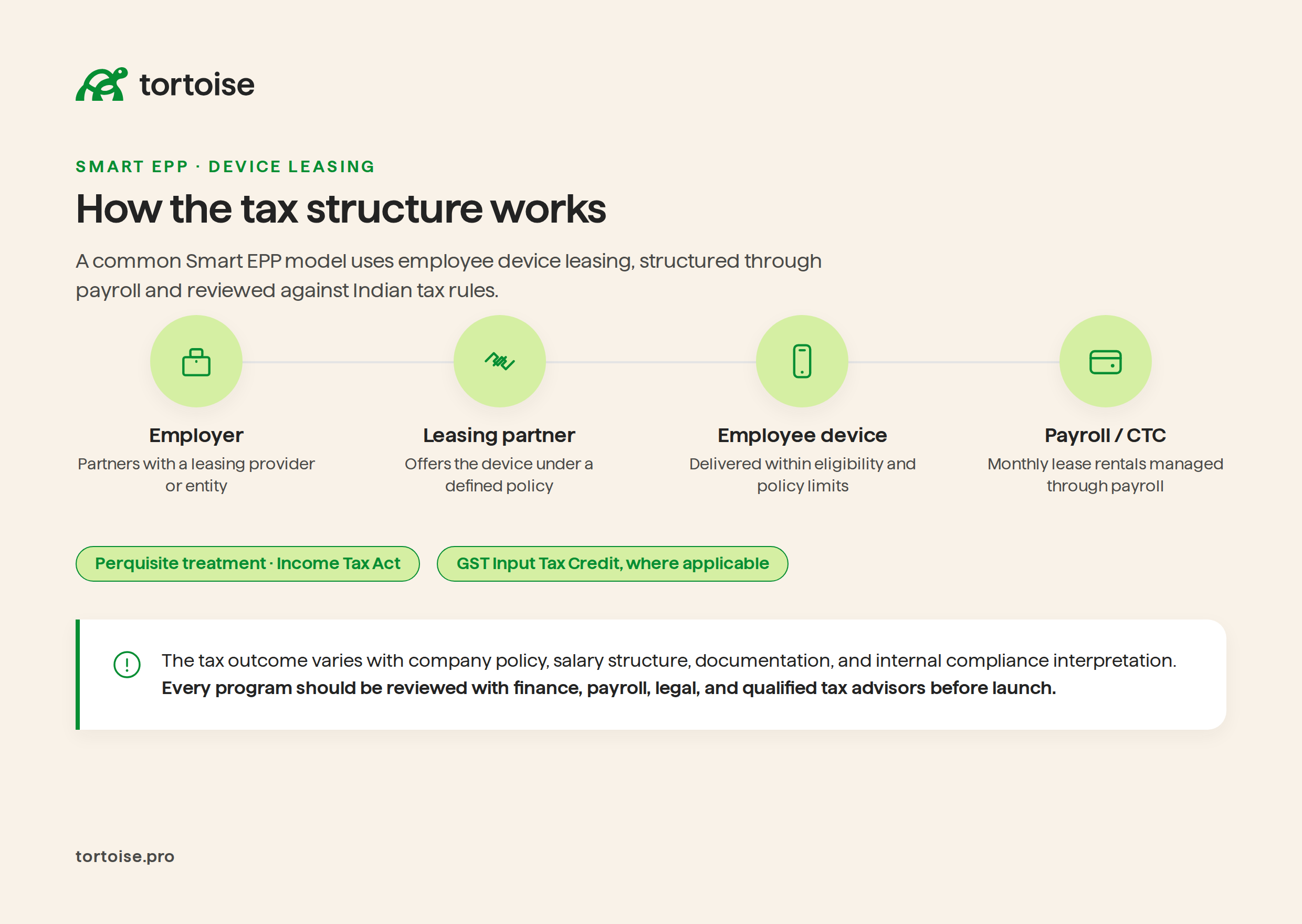
The process generally starts with policy design and ends with a defined outcome for the device at the close of the term. Between those points, the program should feel predictable for the employer and simple for the employee.
A common Smart EPP model uses employee device leasing. The employer partners with a provider or leasing entity, the device is offered under a defined policy, and monthly lease rentals are managed through payroll or CTC structuring.
That is why device leasing India and Smart EPP are closely linked. These programs are often evaluated through perquisite treatment under Indian tax rules, with GST Input Tax Credit also becoming relevant for employers in the appropriate structure.
The tax outcome will vary based on company policy, salary structure, documentation, and internal compliance interpretation. Every program should therefore be reviewed with finance, payroll, legal, and qualified tax advisors before launch.
The employee journey
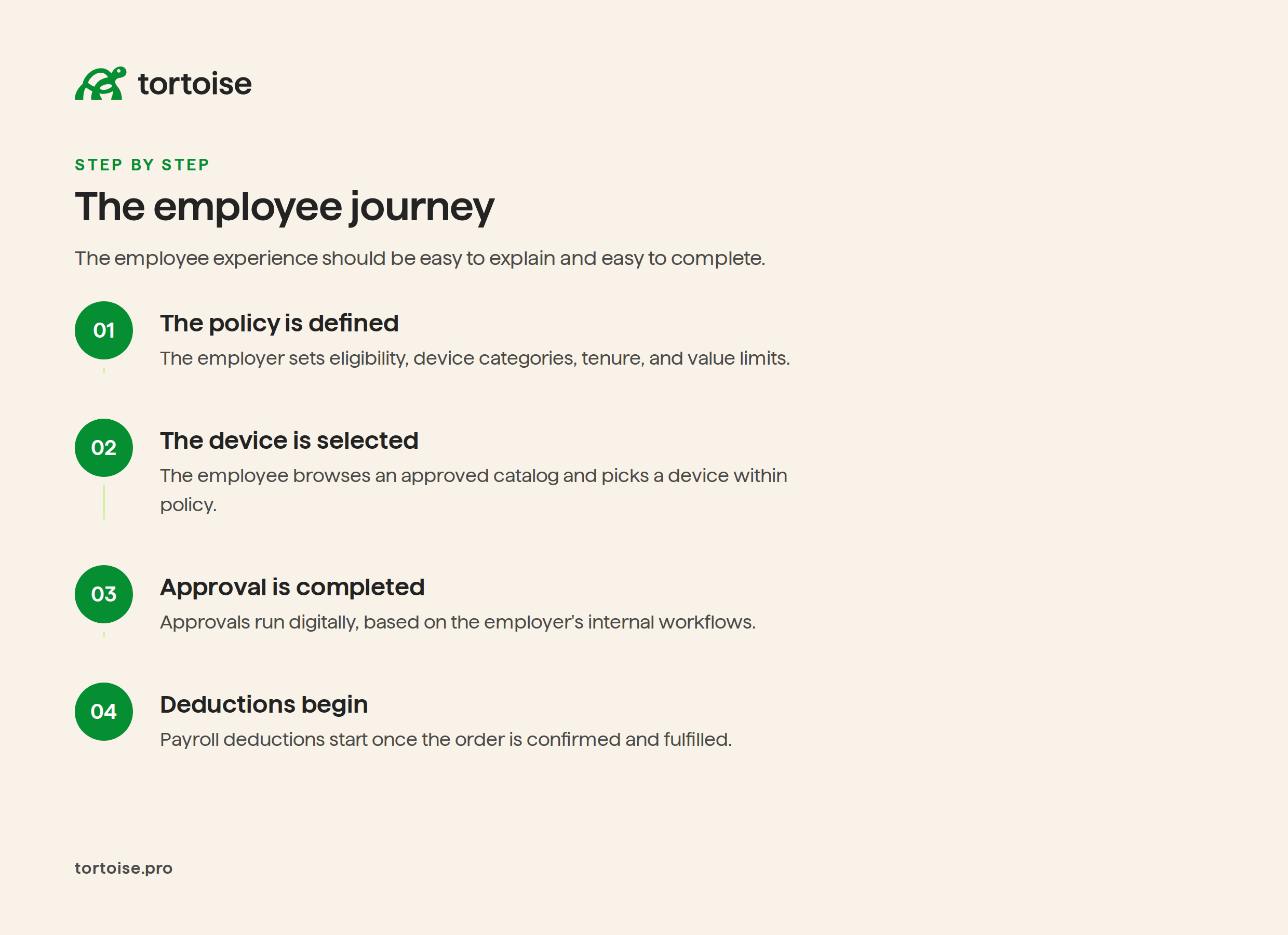
The employee experience should be easy to explain and easy to complete:
- The employer defines the policy such as eligibility, device categories, tenure, and value limits.
- The employee browses an approved catalog and selects a device within policy.
- Approvals are completed digitally based on internal workflows.
- Payroll deductions begin once the order is confirmed and fulfilled.
From the employee’s perspective, that is often easier than paying full retail cost upfront from post-tax income. Many modern programs are built around a self-serve digital flow, and the Tortoise Benefits app listing on the Apple App Store reflects the kind of catalog-led, mobile-first experience employees now expect.
The process should feel genuinely integrated into company systems rather than resembling a reimbursement scheme under a different label.
End-of-term outcomes
End-of-term design is one of the most important operating details. A well-run Smart EPP should define whether the employee returns the device, upgrades into a new cycle, or moves to ownership through a residual buyout or standard transfer process.
That clarity reduces confusion during resignations, internal transfers, and policy exceptions. It also helps companies manage fast-moving technology categories where refresh cycles need to reflect real usage rather than older asset policies.
A simple example helps. An employee may take a smartphone on a 24-month term and become eligible for renewal as a new role begins. With a documented return, upgrade, or transfer path already built into policy, HR and payroll can manage the transition without confusion or last-minute disputes.
Why do HR and finance leaders prefer Smart EPP over basic employee discounts?
Smart EPP works well when each stakeholder sees a clear operational benefit in the same program. HR sees employee experience. Finance sees structure and control. Operations sees smoother execution.
That matters because device benefits rarely succeed on employee savings alone. Enterprise adoption usually depends on whether the program is manageable at scale.
HR and people teams
For HR, Smart EPP is attractive because the value is visible and practical. Employees do not need a long explanation to understand the benefit of getting access to premium devices through an employer-backed program.
It also fits naturally into a broader benefits strategy. The program supports employee experience, strengthens attraction and retention conversations, and works well in hybrid or distributed setups where device quality affects day-to-day productivity. Administrative load also stays lower when approvals, deductions, and policy logic are built into the workflow from the start.
Finance teams
For Finance, the appeal is straightforward. A structured program can reduce the need for bulk procurement, avoid locking cash into rapidly depreciating hardware, and support a more predictable expense model where appropriate.
The compliance side matters just as much. Perquisite valuation, salary treatment, and GST considerations should be built into the design from the start. That is the difference between a scalable benefit and a recurring policy issue.
Payroll and operations
Payroll and operations teams usually judge the program by one standard: does it reduce manual work or create more of it? A good employee purchase program cuts down reimbursement claims, receipt validation, approval back-and-forth, and deduction errors.
This is where integrations often matter more than the catalog itself. Modern programs are increasingly designed as digital self-service workflows rather than paper-heavy processes. The operational value comes from reliable payroll execution, audit visibility, and dependable approval logic.
What to evaluate before launch
Before rollout, leadership teams need to test the model against policy, systems, and real-world risk. Affordability is only one part of the decision.
A stronger question is whether the program will remain compliant, manageable, and employee-friendly after launch. That is where enterprise-ready design becomes visible.
Policy and governance
The company should define eligibility, approved device categories, value caps, lease tenure, ownership rules, and the process that applies when an employee exits before the term ends.
It also helps to document how offboarding, deductions, exceptions, and approvals will work in practice.
Vendor messaging should not be treated as final compliance advice. Indian employers should validate payroll treatment, tax positioning, legal enforceability, and audit readiness internally or with qualified advisors before launch.
Integration and support
An enterprise-ready Smart EPP should connect to existing HRMS and payroll systems, automate deductions, support approval workflows, and give employees a self-service interface that is simple to use. When a workflow breaks every time a payroll file changes, the program will struggle to scale.
Support operations matter just as much as software. Leaders should ask about delivery, repair coordination, device protection plans, and replacement handling during downtime. Employees judge the benefit through the lived experience, not through the policy PDF.
Lifecycle risk and security
This is the section many buyers overlook and later revisit under pressure. Ask direct questions: What happens if a device is damaged? What happens if it is lost or stolen? How is the case handled when an employee resigns midway through the term?
A strong answer should cover insurance or care support, defined employee liabilities, documented exit handling, and secure data protection practices at end of life. The program should also explain how data wiping, recovery, and disposal are managed, because lifecycle risk extends beyond cost into operations and reputation.
If you have a launch on the horizon, our team would be glad to help you work through those questions.
Is Smart EPP right for your organisation?
Smart EPP is a structured employee purchase program that can improve access to smartphones, laptops, and tablets while supporting cost control, policy governance, and administrative simplicity.
Organisations that want to modernise device access without adding operational burden should give Smart EPP a serious place in their employee benefits strategy.
When evaluating a Smart EPP partner, choose one that can support policy design, payroll integration, compliance-conscious structuring, and end-to-end device lifecycle management through a single workflow.
Disclaimer: This guide is intended for general informational purposes only and should not be treated as legal, tax, payroll or accounting advice. Applicability of employee benefit laws in India depends on several factors, including the nature of the establishment, employee category, wage levels, location, headcount, employment terms and applicable central and state laws. Tax treatment of benefits may also vary depending on the structure adopted, documentation, payroll processing and the employee’s applicable tax regime. Employers should consult their legal, tax and payroll advisors before implementing or modifying any employee benefit programme.
Frequently asked questions
What is Smart EPP in India and how is it different from a standard employee purchase program?
Smart EPP is a structured corporate employee purchase program that lets employees access smartphones, laptops, and tablets through payroll‑linked leasing instead of ad hoc discounts. Unlike a basic employee discount purchase program, Smart EPP runs on clear policy rules, approvals, and payroll deductions so HR, finance, and payroll teams get control and compliance.
How does an employee purchase program (EPP) for devices actually work in India?
In a typical Smart EPP model, the employer partners with a device leasing provider, employees choose from an approved catalog, and monthly rentals are recovered through payroll. This turns device access into a formal employee purchase program (EPP) with GST and perquisite treatment handled upfront instead of loose reimbursements.
Why should companies in India use device leasing or employee device leasing instead of buying devices outright?
Device leasing in India helps companies avoid large upfront capex, reduce exposure to fast depreciation, and keep refresh cycles aligned with real usage. When bundled into an employee device leasing or Smart EPP structure, it also improves employee experience while letting finance teams manage cost and risk more predictably.
Is Smart EPP only for large enterprises or can smaller organisations also use a corporate employee purchase program?
Both large enterprises and mid‑market employers can run a corporate employee purchase program using Smart EPP. As long as payroll integration, eligibility rules, and end‑of‑term outcomes are defined, smaller organisations can offer an attractive employee purchase program without adding heavy operational overhead.
Written by
Founder & CEO
Vardhan Koshal is the Co Founder of Tortoise, India’s fastest growing employee device benefit platform. He has led India growth and product for companies like TripAdvisor and Udacity, and earlier founded Ridingo, a car pooling startup recognised by Forbes as one of the Hottest Global Startups and acquired by Carzonrent. At Tortoise he works with HR leaders, CFOs and tax experts to design compliant, high impact device benefit programs for Indian employers.