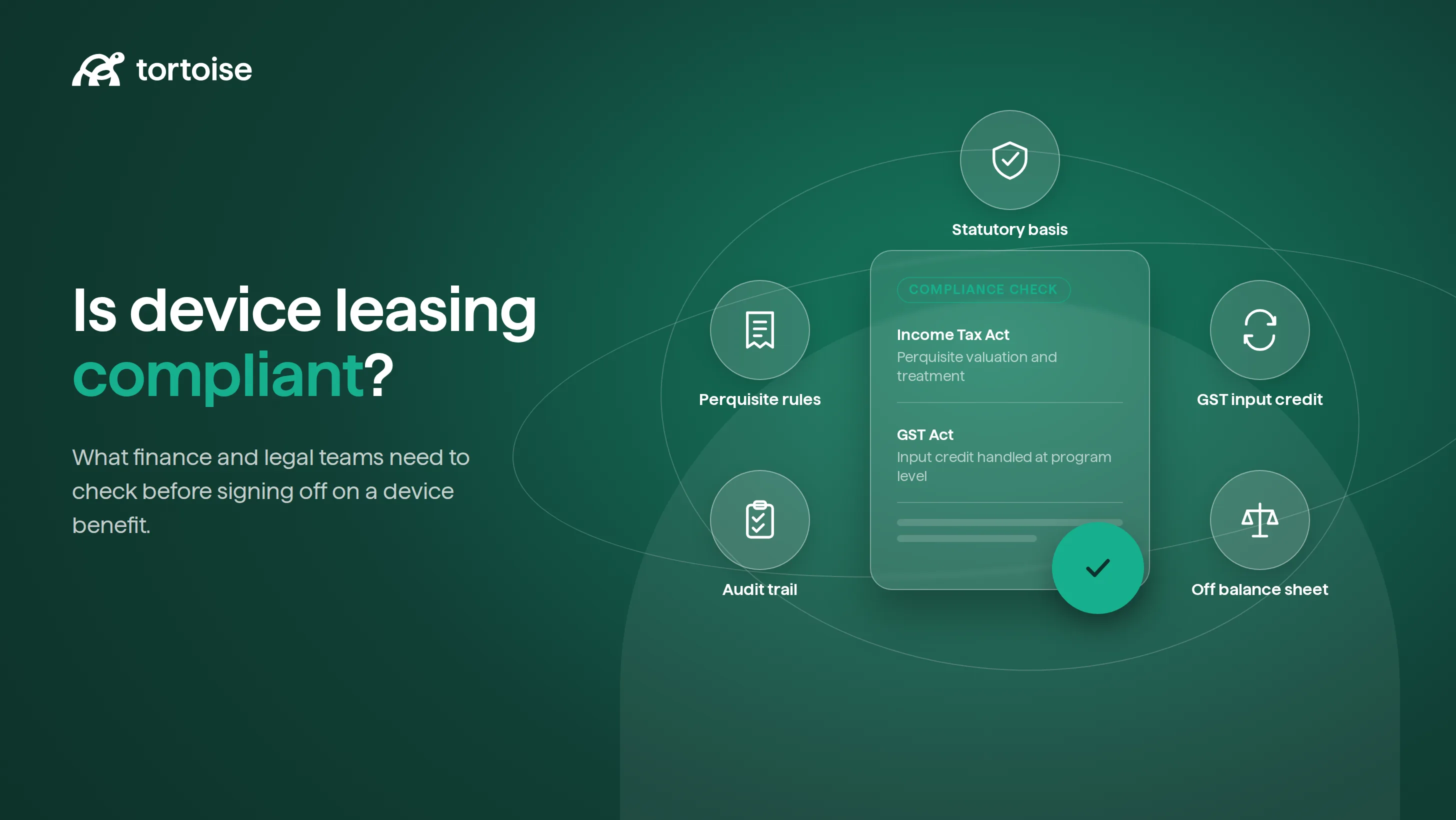
Is Employee Device Leasing Tax-Compliant in India? What Finance and Legal Teams Need to Know

Finance, HR, payroll, and legal teams usually reach the same point in this conversation. The business wants to offer better devices as an employee benefit, but nobody wants to create a payroll mess, a GST issue, or a future perquisite dispute. That tension is exactly why device leasing needs to be designed as a compliance program, not just a procurement option.
For employers in India, the answer is broadly yes. Employee device leasing can be tax-compliant when ownership, documentation, payroll treatment, and lease-end actions are structured properly. The challenge is that two programs can look similar to employees while producing very different tax outcomes for the employer.
TL;DR
Yes, employee device leasing can be tax-compliant in India when the arrangement is set up as a genuine lease and documented correctly. The cleanest structure keeps ownership with the lessor during the lease term, treats the device as a work-enablement benefit, applies salary deductions in line with the agreed policy, and handles any later purchase with care under Section 17 and the related perquisite valuation rules.
Employee device programs sit at the intersection of compensation design and tax treatment. A company may describe the benefit as leasing, yet the tax outcome will depend on what the contracts, payroll entries, invoices, and exit process actually show.
What a compliant lease looks like
A compliant employee device program has to do four things at once. It needs to preserve the legal character of a lease, support the intended tax treatment, keep payroll logic clean, and avoid confusion when the employee exits or wants to retain the device.
At a practical level, the strongest structure usually looks like this:
- The lessor owns the device during the lease term, which helps keep the arrangement distinct from a company asset transfer.
- The employer frames the device as a work-enablement benefit under a written policy, with clear eligibility, approved categories, and employee consent.
- Payroll deductions follow the actual commercial structure instead of being handled as an informal recovery line.
- The lease-end pathway, whether return, renewal, upgrade, or purchase, is defined before rollout.
The table below shows where compliant programs hold up and where weaker ones usually break.
| Compliance area | What strong structure looks like | What creates risk |
|---|---|---|
| Ownership | Lessor owns the device during the term | Employer ownership is unclear or shifts informally |
| Policy | Official-use framing, eligibility rules, tenure, and employee consent are documented | The program is described vaguely as a personal benefit |
| Payroll | Deductions match the agreed lease structure | Ad hoc recoveries or inconsistent payslip treatment |
| Invoicing | B2B documentation supports the lease and GST position | Invoice trail is incomplete or mismatched |
| Lease end | Return, upgrade, or purchase rules are defined in advance | Discounted transfer happens without valuation support |
Ownership during the lease
Ownership is the first issue finance and legal teams should settle. The cleanest structure keeps the device with the lessor while the employer facilitates access through policy and payroll. That separation matters because it helps distinguish a genuine lease from a disguised asset transfer.
This is also where reimbursement and capitalisation models start to diverge. Tortoise explains that once the employer owns the device and later passes it to the employee, the program can move closer to a taxable transfer scenario reimbursement, capitalisation, and renting.
Payroll and salary treatment
Payroll should reflect the legal and commercial design of the program. Where the company is claiming GST input tax credit on the lease invoice, many employer-structured models recover the GST-exclusive lease cost through payroll, though the exact treatment should follow the company's tax position, compensation design, and documentation.
This is one reason salary sacrifice devices India programs need stronger controls than a normal employee deduction. Payslips, offer documents, consent records, and finance entries should all support the same structure.
Lease-end actions
A lease program can stay clean for twelve or twenty-four months and still create problems at the finish line. Return, renewal, upgrade, and purchase routes each need to be defined at the start, because lease-end ambiguity is where many tax arguments begin.
Where the employer appears to sell a company-held asset to the employee at a concessional value, the analysis shifts. That shift is exactly why finance teams should treat lease-end mechanics as part of initial structuring rather than an operations detail to handle later.
Where Section 17 matters
The tax analysis becomes easier once the employer separates three situations clearly. The first is an employer-provided official-use device. The second is an employer-facilitated lease. The third is a later transfer of value to the employee through ownership or concessional purchase.
That distinction is central to any device leasing section 17 India review. The question is not whether devices are useful for work. The question is whether the structure stays within favorable treatment or slips into perquisite territory.
Laptops and computers
Laptops and computers are usually the strongest category for favorable treatment. Employer-provided laptops and computers used for official purposes are commonly read with Rule 3(7)(viii) of the perquisite rules, including situations where incidental personal use exists, as reflected in the Income Tax Department guidance on perquisites and employee benefits perquisites and employee benefits.
For employers, this is the foundation of the employee device tax benefit India argument. The more clearly the device sits inside an official-use framework, the stronger the position becomes.
Mobile phones and data
Mobile phones, telephone facilities, and work-related connectivity can also receive favorable treatment. Rule 3(7)(ix) is relevant here, and the same principle applies, the program needs policy support, business-use framing, and clean records, as discussed in Vinod Kothari's analysis of CTC-based device leasing device leasing mechanics.
That is why the question is employee device benefit tax free India rarely has a simple yes or no answer. The result depends on device category, use case, documentation, and how the employer has structured the benefit.
When perquisite tax applies
Tax risk increases when the arrangement starts looking less like a lease and more like a transfer of value. Where the employer owns the asset and later transfers it at a low price, the taxable amount can be based on original cost reduced by the prescribed valuation method, less the amount recovered from the employee, according to the Income Tax Department's employee benefit guidance employee benefits.
An illustrative example makes the exposure more concrete. Assume a laptop originally costs ₹1,00,000. After one year, the value for this purpose may reduce to ₹50,000 under the relevant valuation approach for computers. If the employee then acquires it for ₹10,000, the taxable perquisite can be ₹40,000, subject to the applicable facts and valuation method.
| Scenario | Likely treatment | Why it matters |
|---|---|---|
| Lessor owns laptop during lease | Usually cleaner from a perquisite perspective | Ownership does not sit with the employer during the term |
| Employer provides laptop for official use | Often exempt | The device functions as a work facility |
| Employer transfers device at discount | Perquisite valuation may apply | The employee is receiving measurable value |
| Reimbursement without clean structure | Risk depends on facts and records | Ownership and official-use support may be weaker |
Why GST changes the economics
The legal answer is only half of the decision. CFOs also want to know whether a compliant program is materially better than asking employees to buy devices with post-tax income. In many cases, the answer is yes, because gst on employee device leasing india treatment can improve the economics for both employer and employee.
Lease invoices for devices generally attract 18 percent GST. Where the arrangement satisfies the relevant GST conditions, employers may be able to claim input tax credit on those lease rentals, a point discussed in Vinod Kothari's review of the issue device leasing mechanics.
Input tax credit position
The commercial advantage comes from the fact that laptops, computers, and similar work devices do not sit in the same blocked-credit category as passenger vehicles. GST recovery is still not automatic. The structure simply creates a stronger pathway for input tax credit where business-use position, invoicing flow, and records support the claim.
For finance teams, that means GST is not a back-office footnote. It affects the effective cost base of the program and the payroll logic that follows from it.
Salary sacrifice math
The savings case becomes easier to understand when you compare a retail purchase with an employer-structured lease. In a standard retail scenario, the employee buys the device with post-tax income. In a structured program, part of the device cost may be built into compensation and recovered through payroll, which can lower the effective outflow where the structure and records support that treatment.
Here is an illustrative comparison using a laptop with a base value of ₹1,00,000.
| Item | Post-tax purchase | Employer-structured lease |
|---|---|---|
| Device base value | ₹1,00,000 | ₹1,00,000 |
| GST at 18% | ₹18,000 | ₹18,000 on invoice |
| Retail or billed value | ₹1,18,000 | ₹1,18,000 |
| Employer GST credit | Not available to employee | ₹18,000 may be claimable by employer |
| Amount flowing through salary logic | Employee needs post-tax cash of ₹1,18,000 | Payroll may recover about ₹1,00,000 where the employer is taking GST credit |
| Gross salary impact at about 31.2% example effective tax | About ₹1,71,511 of gross earnings needed to net ₹1,18,000 | About ₹1,00,000 of gross salary aligned to the device cost in this illustration |
In that example, the structured lease route is lower by ₹71,511, or about 41.7 percent, compared with a post-tax purchase. That does not mean every employee sees the same number. The outcome depends on tax slab, compensation structure, invoice handling, and the underlying device category.
What finance teams must verify
Before anyone presents savings numbers internally, four checks should be complete:
- The GST position should be validated against the actual invoicing chain and business-use position.
- Payroll recovery should match the commercial structure and the company's compensation documents.
- The device category should support the intended tax treatment.
- Employee communication should explain the deduction logic and lease-end path clearly.
The fastest way to lose trust in a device program is to market it as tax efficient before the payroll, finance, and legal positions are fully aligned.
How to keep the program audit-ready
A compliant structure becomes defensible through documents, controls, and handoffs. Legal teams care about policy language, finance teams care about invoice and tax treatment, payroll teams care about recovery logic, and HR teams care about employee communication and exits. All of those pieces have to line up.
Core policy controls
A written policy should cover eligibility, approved device categories, tenure, official-use framing, payroll treatment, unpaid leave scenarios, insurance, damage handling, exit process, and lease-end options. The language should be specific enough to explain the structure without implying that the employee is receiving an immediate personal asset.
A good policy set usually includes:
- the lease agreement or linked commercial terms
- tax invoice support
- employee election or consent
- payroll deduction records
- exit and final settlement process
- support for any GST credit position being taken
Final structuring should still be validated with internal tax and legal counsel.
Reimbursement and capex risks
Reimbursement often feels simpler because the company avoids a formal leasing program. The problem is that ownership, GST flow, and perquisite analysis can become harder to defend later, especially when the device moves into mixed use or the employer tries to transfer value at exit.
Direct capitalisation creates a different kind of friction. Cash is locked in upfront, depreciation has to be tracked, and disposal turns into an administrative and tax event rather than a straightforward lease-end step.
Exit and transfer controls
Employee exits expose weak design very quickly. A strong policy should explain whether the employee can return the device, settle remaining obligations, continue the arrangement under revised terms, or move into a purchase route under the agreed framework.
The key point is consistency. HR, payroll, finance, and the leasing partner should all follow the same exit path so there is no confusion on deductions, ownership, or tax treatment at the last mile.
The Tortoise operating model
Once the policy is sound, the next challenge is administration. Companies still need device selection, payroll integration, insurance support, repair handling, and lease-end coordination. That is where a managed operating model can reduce internal complexity.
Tortoise is built around that execution layer. For employers, the practical value is not only the financing structure. It is the ability to run the full program without stitching together multiple vendors and internal teams manually Tortoise.
What the platform handles
A managed device benefit workflow typically needs the following pieces to stay connected:
- policy setup with HR, finance, and legal alignment
- employee device selection within company rules
- payroll and HRMS integration for deductions
- insurance and care packages across the device lifecycle
- repair and replacement coordination
- end-of-lease transition support
Tortoise also states that it supports post-purchase care across 27,000 pincodes in India, alongside replacement support during repair periods Tortoise.
Final takeaway
Employee device leasing can be tax-compliant in India, and it can also be financially efficient, when the structure is designed properly. The employers that get this right do not treat it as a gadget perk. They treat it as a compensation, tax, payroll, and policy workflow that needs disciplined execution.
The most useful rollout checklist is simple: confirm who owns the device during the term, how Section 17 exposure is being managed, whether GST treatment is supportable, how payroll will recover cost, and what happens at lease end. Once those answers are clear, a managed platform model can make execution much easier.
Disclaimer: This guide is intended for general informational purposes only and should not be treated as legal, tax, payroll or accounting advice. Applicability of employee benefit laws in India depends on several factors, including the nature of the establishment, employee category, wage levels, location, headcount, employment terms and applicable central and state laws. Tax treatment of benefits may also vary depending on the structure adopted, documentation, payroll processing and the employee’s applicable tax regime. Employers should consult their legal, tax and payroll advisors before implementing or modifying any employee benefit programme.
Frequently asked questions
Does salary sacrifice cut take-home?
It changes take-home because part of the employee's compensation is redirected toward the lease. Where the compensation structure, payroll treatment, and documents support that position, the arrangement can reduce the effective cost compared with buying the same device using post-tax income.
Can employees buy the device later?
They often can, though the exact route depends on the lease terms and who owns the device at the time. Finance and legal teams should make sure any later purchase is documented properly because concessional transfer mechanics can change the tax result.
What happens after resignation?
The policy should define this before launch. Common paths include device return, direct settlement, continuation under revised terms, or a purchase route handled under the agreed lease framework.
Are all devices treated the same way?
No. Laptops, computers, mobile phones, and related facilities can each have different practical and tax considerations. The cleanest treatment is usually available where the device is clearly linked to official use and supported by proper records.
Can startups offer this benefit?
Yes, provided the startup has the payroll discipline, documentation, and partner support needed to run the program correctly. A smaller team often benefits from managed administration because internal HR and finance bandwidth is usually limited.
Written by
Founder & CEO
Vardhan Koshal is the Co Founder of Tortoise, India’s fastest growing employee device benefit platform. He has led India growth and product for companies like TripAdvisor and Udacity, and earlier founded Ridingo, a car pooling startup recognised by Forbes as one of the Hottest Global Startups and acquired by Carzonrent. At Tortoise he works with HR leaders, CFOs and tax experts to design compliant, high impact device benefit programs for Indian employers.