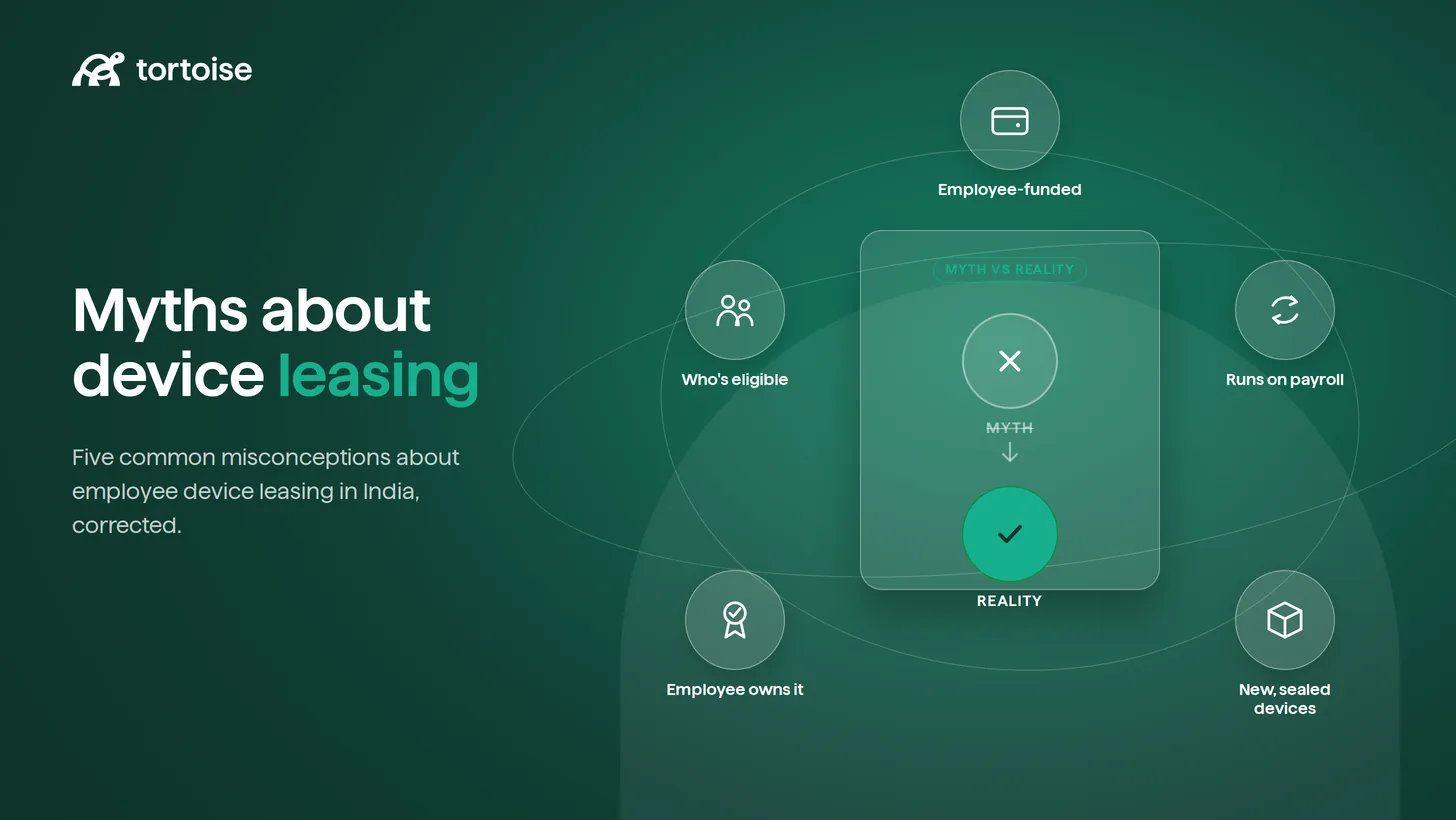
5 Myths About Employee Device Leasing in India

Employee device leasing in India is a company-enabled benefit that lets eligible employees access a new laptop, phone, tablet, or accessory through a structured lease and payroll deductions. It is often misunderstood as a leadership-only perk, a hidden employer cost, or a cumbersome HR project. In practice, the outcome depends on the policy, payroll design, tax treatment, and provider, not on the myths below.
For a step-by-step explanation of the model, including payroll and tax considerations, read our article on how employee device leasing works in India.
In this article, we will address the most common Myths about employee device leasing.
Myth 1: It's a perk for senior managers only
Reality: Employee device leasing can be offered to a broad employee population; it is not limited to leadership. Each employer decides eligibility, device categories, value limits, and approval rules. A company may open the program to all full-time employees or begin with a defined group, such as field teams or employees due for a device refresh. The important point is a clear policy, not a particular designation.
Myth 2: It costs the company money
Reality: In payroll-linked device leasing, the employee’s lease rental is generally recovered through the agreed salary or CTC structure, rather than paid as an unbudgeted employee perk. That can reduce upfront procurement and asset-management pressure for the employer.
Whether a program is cost-neutral, and how it is treated for accounting, GST, and tax purposes, depends on the commercial structure and should be validated by the company’s finance and tax teams. “Zero cost” should describe a properly designed model, not replace that review.
Myth 3: It's complicated to administer
Reality: A device benefit program does require setup work: eligibility rules, approvals, payroll cut-offs, delivery, insurance, and exit scenarios need to be agreed in advance.
After launch, a managed platform and HRMS/payroll integration can make recurring deductions, reconciliation, and employee communication far more consistent than ad hoc reimbursements. The best test is whether the process clearly handles exceptions such as a role change, a damaged device, or an employee leaving mid-tenure.
If you are deciding between models, our comparison of device reimbursement vs. leasing explains where each approach fits.
Myth 4: Employees get used or refurbished devices
Reality: Device leasing for employees describes the financing and lifecycle model; it does not mean employees will receive pre-owned devices. Employee device leasing platforms usually state the device condition and sourcing standard clearly.
Tortoise programs can provide new, sealed devices through authorised channels, with employees choosing from an employer-approved catalogue of phones, laptops, tablets, and accessories. That distinction matters: device selection, warranty, protection cover, and support terms should be visible before an employee accepts the lease.
Myth 5: Employees have to return the device at the end
Reality: End-of-lease ownership is set by the agreement and company policy. In many device-leasing arrangements, ownership transfers to the employee for a nominal residual amount, often with a sale invoice.
Other programs may offer return or upgrade paths. Employees should know the applicable buyout amount, ownership-transfer process, and what happens on resignation before they enrol. A transparent end-of-lease policy prevents one of the most common sources of confusion.
Employee device leasing myths: a quick comparison
| Myth | What to verify instead |
|---|---|
| Only for senior managers | Eligibility, device tiers, and spend limits in the company policy |
| It automatically costs the employer money | The lease structure, payroll recovery, and finance/tax treatment |
| It is hard to administer | HRMS/payroll integration, monthly reconciliation, and exception handling |
| Devices are used or refurbished | Catalogue, sourcing, warranty, insurance, and support terms |
| Employees must return the device | End-of-lease ownership, residual value, upgrade, and exit rules |
The bigger pattern behind all five myths is that employee benefits fail when the employee journey is unclear.
Clear documentation matters as much as a compelling catalogue: employees need to understand eligibility, the estimated payroll impact, delivery, protection, and what happens at the end of the term. For broader benefit-design context, see our employee benefits in India guide.
Tortoise helps Indian employers run an employee device benefit program through a structured leasing workflow, with policy controls, payroll integration, device protection, and lifecycle support.
If any of these myths have come up in your own discussions, we'd be glad to help you test them against the details.
Frequently asked questions
Is employee device leasing only available to senior employees?
No. An employer can make the program available to different employee groups, including a broad full-time population, based on its eligibility policy, device categories, value limits, and approval rules.
Does employee device leasing automatically cost the employer money?
Not necessarily. A payroll-linked lease can recover rentals through the agreed salary or CTC structure and reduce upfront procurement pressure. The employer should confirm the commercial, accounting, GST, and tax treatment for its own program with its advisers.
Do employees receive new devices through a leasing program?
Leasing does not determine device condition. The program policy and supplier terms should clearly state whether devices are new, how they are sourced, and what warranty, insurance, repair, or support cover applies. Tortoise programs can provide new, sealed devices through authorised channels.
Do employees keep the device after the lease ends?
It depends on the lease agreement and company policy. Many arrangements provide for ownership transfer at an agreed residual value, while others may offer return or upgrade options. Employees should review the end-of-lease and resignation terms before enrolling.
How much can employees save through device leasing?
Potential tax efficiency and the employee’s net cost depend on the salary structure, tax regime, device category, tenure, and the employer’s program design. Employees should use the program’s approved estimate and seek personal tax advice where needed.
Written by
Founder & CEO
Vardhan Koshal is the Co Founder of Tortoise, India’s fastest growing employee device benefit platform. He has led India growth and product for companies like TripAdvisor and Udacity, and earlier founded Ridingo, a car pooling startup recognised by Forbes as one of the Hottest Global Startups and acquired by Carzonrent. At Tortoise he works with HR leaders, CFOs and tax experts to design compliant, high impact device benefit programs for Indian employers.