What are fringe benefits? How device benefits fit India's tax framework

Fringe benefits are non-cash benefits provided in addition to salary, and device benefits can fit a tax-efficient structure in India when they are set up correctly. For employers, the real issue is not whether laptops or phones are useful. It is whether the benefit fits payroll, tax, GST, reporting, and ownership rules without creating avoidable admin or liability.
That is why structure matters more than intent. A device program can improve employee value without increasing fixed compensation, but only if it is designed for compliance with the Income Tax Act and GST Act.
What are fringe benefits for employees in India, and why do they matter to employers?
Fringe benefits employee programs are non-cash or employer-supported benefits offered alongside salary. For employers, they matter because they shape the total rewards package, influence retention, and can improve employee take-home value when structured properly.
In practice, not all benefits work the same way. Some fit neatly into payroll and policy. Others create perquisite exposure, documentation burden, and tax complexity that only becomes visible during payroll processing or audit review.
This matters more now because device access is no longer a niche perk. Laptops, phones, and tablets are core work tools in hybrid and distributed teams, so employers increasingly have to decide whether to treat them as reimbursements, company assets, or part of a flexible benefits plan.
How are fringe benefits different from salary?
Salary is direct cash compensation paid to an employee. Fringe benefits are additional value provided through employment, often in non-cash form or through structured access to a service or product.
For employers, that distinction is operational as much as legal. Salary is straightforward to process, while benefits depend on how they are offered, documented, taxed, and reported. A poorly structured benefit can look attractive on paper and still create payroll friction later.
Where do device benefits fit in a flexible benefits plan?
Device benefits can sit inside a flexible benefits plan as an optional, structured benefit rather than a one-off exception. That makes them easier to govern, easier to explain, and more consistent across employee groups.
For employers trying to improve the value of compensation without increasing fixed cash payouts, device benefits are especially practical. A compliant device benefit platform can turn what is usually an ad hoc procurement issue into a standardized policy.
How does salary sacrifice reduce income tax in India for employee device benefits?
A salary-sacrifice lease reduces taxable salary because the monthly lease rental is deducted from the employee’s gross pre-tax salary. That lowers taxable income and can improve the employee’s effective take-home value without requiring the employer to increase CTC.
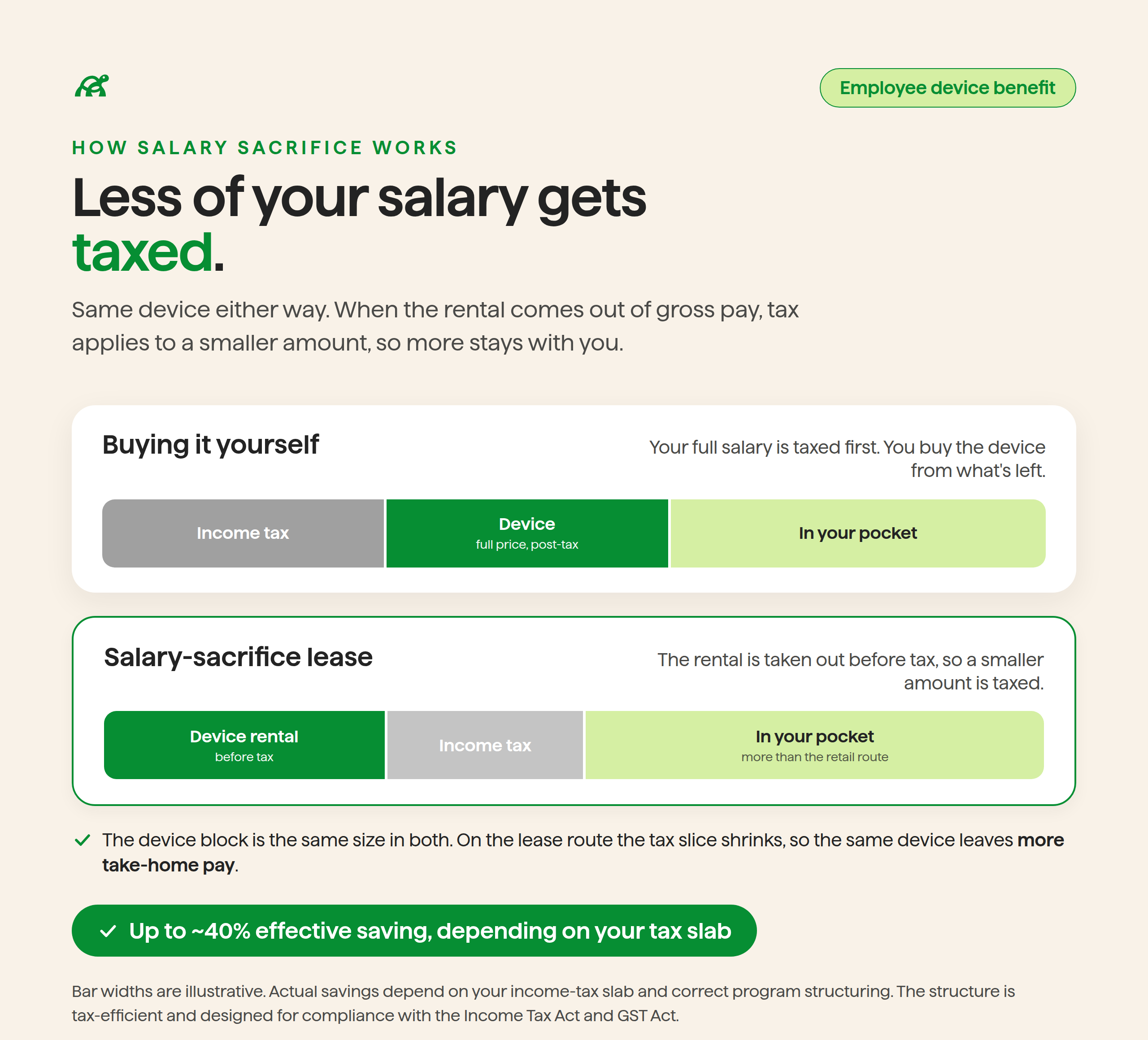
The structure is straightforward. The employee opts into the program, the employer facilitates the arrangement with a third-party lessor, and payroll applies the monthly deduction before tax. During the lease period, the device remains owned by the lessor, not the employee or employer.
When designed correctly, this model is tax-efficient and designed for compliance with the Income Tax Act and GST Act. Employees may save up to ~40% depending on their income-tax slab, as reflected in Tortoise’s platform overview, but that should never be communicated as a guaranteed outcome.
Ownership is a key part of the logic. Because the device stays with the lessor during the lease term, the structure avoids looking like a direct employer reimbursement or immediate asset transfer. At the end of the lease, the employee can purchase the device directly from the lessor.
Why are reimbursements usually less tax-efficient?
Reimbursements are usually less tax-efficient because they can be treated as taxable perquisites under Section 17(2). As Tortoise’s analysis of reimbursement, capitalization, and leasing models explains, reimbursing a personal device purchase can increase the employee’s tax burden and TDS exposure.
On the employer side, reimbursements also create policy inconsistency. Finance has to validate receipts, payroll has to classify the amount correctly, and legal or tax teams may still be left explaining the treatment later.
Why does lessor ownership matter in a salary-sacrifice lease?
Lessor ownership matters because it separates employee use from direct employer asset transfer during the lease term. That distinction helps keep the program aligned to a salary-sacrifice lease rather than a disguised reimbursement or gift.
It also removes the need for the employer to hold the device as its own asset. That is one reason many employers view this structure as cleaner than buying devices first and deciding what to do with them later.
How should employers communicate this benefit responsibly?
Employers should describe the program as optional, policy-led, and tax-efficient. They should also use the approved wording: up to ~40% savings, depending on their income-tax slab.
Just as important, employers should avoid saying the benefit is tax-free. The right message is that the structure is designed for compliance with the Income Tax Act and GST Act and that outcomes depend on payroll setup and employee tax position.
How do reimbursement, capitalization, and salary-sacrifice lease models compare?
The right model depends on tax treatment, ownership, GST impact, and operating effort. Procurement convenience alone is not a good decision rule, especially when the program will touch payroll, finance, and employee communication.
For most employer-side teams, the cleanest way to compare options is to look at the structure line by line. The table below focuses on the points that usually decide whether a model scales smoothly.
Comparison table: Which device benefit model creates the least friction?
| Model | Employee tax treatment | Balance-sheet impact | GST treatment | Ownership during program | Admin overhead | End-of-term transfer |
|---|---|---|---|---|---|---|
| Cash reimbursement | Taxable perquisite under Section 17(2) | Off balance sheet | Limited GST advantage to employer in this structure | Employee | Medium | Not applicable |
| Capitalization as company asset | Perquisite complexity can arise on transfer | On balance sheet with depreciation tracking | GST ITC can stay tied up for about 60 months; transfer may trigger 5% quarterly reversal | Employer | High | Employer transfers asset |
| Salary-sacrifice lease (Smart EPP) | Tax-efficient; employee may save up to ~40% depending on slab | Off balance sheet | Lease rentals treated as operating expense with ongoing GST input treatment | Third-party lessor | Lower | Employee buys directly from lessor |
Why does capitalization create finance and compliance drag?
Capitalization creates drag because the device becomes a company asset, not just a benefit. That means depreciation tracking, asset controls, and end-of-life accounting all stay with the employer.
It also brings a long GST tail. As noted in Tortoise’s breakdown of corporate device models, GST Input Tax Credit can remain tied to the asset for roughly 60 months, and transferring ownership to the employee may trigger a 5% GST reversal for each remaining quarter of asset life.
Why do many employers prefer a Smart EPP structure?
Many employers prefer a Smart EPP structure because it aligns the benefit to payroll rather than asset ownership. That keeps the employer focused on policy and administration, instead of long-tail accounting and transfer mechanics.
It also supports a stronger value proposition without adding cost or balance-sheet liability. A device benefit platform can automate policy enforcement, payroll deductions, and employee access through tools such as the Employer Dashboard and Employee Benefits App.
How do India’s Income Tax and GST rules affect employee device benefits?
The tax outcome depends less on the device itself and more on how the program is structured. Employers need to assess both income tax and GST treatment before calling any device program efficient.
That means looking at two separate questions. First, does the structure create a taxable perquisite or valuation issue for the employee? Second, does it create GST credit, reversal, or transfer obligations for the employer?
The 2026 rules context makes this review more relevant, not less. For example, ClearTax’s summary of the draft Income Tax Rules 2026 notes an increase in the annual non-cash gift exemption threshold to INR 15,000, while Vialto Partners’ 2026 employment tax update highlights the need for employers to revisit payroll and compensation design as thresholds and reporting expectations evolve.
What should employers know about perquisite treatment?
If the company reimburses a personal device purchase, the amount can be treated as a taxable perquisite. If the company owns the device and later transfers it, valuation becomes more involved and can create extra review for payroll and tax teams.
A salary-sacrifice lease is often used to avoid those friction points because the employer is not gifting or directly transferring the asset during the lease term. The legal and payroll structure does the heavy lifting.
What should employers know about GST on device ownership and transfer?
GST treatment becomes more complex when the employer capitalizes the device. The company then has to track credit over the asset life and deal with potential reversal if ownership later changes hands.
Under a leasing structure, the economics are cleaner for many employers. Lease rentals are treated as operating expense, and the end-of-lease purchase happens directly between the lessor and employee, which helps the employer avoid GST reversal obligations linked to asset transfer.
How can employers stay compliance-first?
Employers should start with a clear internal policy that covers eligibility, salary-sacrifice consent, payroll treatment, approved device categories, and the end-of-lease process. That policy should be aligned across HR, payroll, finance, tax, legal, and IT before launch.
Platform selection matters too. A provider evaluated for compliance and security can reduce execution risk, especially when payroll integrations and documentation controls are built in. Tortoise’s structure has been evaluated by Deloitte India and Lakshmikumaran & Sridharan, and the platform is ISO 27001 and SOC 2 certified.
What should employers look for in a compliant device benefit platform?
Employers should evaluate a device benefit platform on compliance design, payroll fit, operational simplicity, and lifecycle support. A broad device catalog is useful, but it is rarely the deciding factor for HR, finance, or legal teams.
The more important question is whether the platform can run the benefit cleanly at scale. If the structure fails at payroll or policy level, employee demand will not save it.
Which features matter most for HR, finance, and legal teams?
Payroll and HRMS integration: Gross-salary deductions need to run accurately every month. Manual workarounds usually break at scale.
A clear lessor structure: Ownership during the lease and the end-of-term purchase flow should be easy to explain and document.
Policy and approval support: HR and legal teams need templates, controls, and a process that fits internal governance.
Low finance overhead: The model should avoid unnecessary balance-sheet work, receipt review, and transfer complexity.
Security and compliance controls: Employers should expect transparent standards around data handling, certifications, and audit readiness.
Why do employers use a device benefit platform instead of buying devices directly?
Employers use a device benefit platform to avoid balance-sheet ownership, reduce admin, automate payroll deductions, and support compliance-first execution. It also gives HR, finance, and legal teams a more consistent structure than one-off purchases or reimbursement exceptions.
A well-designed fringe benefits employee strategy should improve employee value without creating hidden tax or finance problems. For many Indian employers, device benefits work best when they sit inside a structured salary-sacrifice lease model that is tax-efficient, designed for compliance with the Income Tax Act and GST Act, and supported by strong policy and operational controls.
If your team is evaluating a compliant device benefit platform with Smart EPP, payroll integrations, and lifecycle support such as Tortoise Corporate Care, Book a demo.
Disclaimer: This guide is intended for general informational purposes only and should not be treated as legal, tax, payroll or accounting advice. Applicability of employee benefit laws in India depends on several factors, including the nature of the establishment, employee category, wage levels, location, headcount, employment terms and applicable central and state laws. Tax treatment of benefits may also vary depending on the structure adopted, documentation, payroll processing and the employee’s applicable tax regime. Employers should consult their legal, tax and payroll advisors before implementing or modifying any employee benefit programme.
Written by
Founder & CEO
Vardhan Koshal is the Co Founder of Tortoise, India’s fastest growing employee device benefit platform. He has led India growth and product for companies like TripAdvisor and Udacity, and earlier founded Ridingo, a car pooling startup recognised by Forbes as one of the Hottest Global Startups and acquired by Carzonrent. At Tortoise he works with HR leaders, CFOs and tax experts to design compliant, high impact device benefit programs for Indian employers.