
Best Employee Benefits Platform in India: What to Look for When Evaluating in 2026

Employee benefits in India are being evaluated with a much sharper operational lens now. Employees still expect core protection, yet they also want benefits that are visible, easy to access, and useful in daily life. Teams reviewing options like Tortoise are often responding to that shift, especially when they want benefits that support work as well as wellbeing. When a benefit stays invisible until a claim event, it rarely shapes how employees feel about the company in ordinary moments.
That is why choosing an employee benefits platform has become a more serious decision for founders, CHROs, rewards leaders, and HR teams. In 2026, the strongest platforms are the ones employees actually use and the ones HR can run smoothly within Indian payroll, tax, and compliance realities. That puts more attention on practical, work-enabling benefits such as device access, alongside health cover, meal benefits, and tax-saving categories.
Why platforms look different in 2026
A benefits strategy that felt adequate a few years ago can now feel distant from what employees actually value. In 2026, the conversation has shifted toward usability, visibility, and operational fit. HR leaders are being asked to make benefits easier to understand, easier to access, and easier to manage across growing teams.
1. Employees want visible benefits
Traditional benefits still matter, especially insurance and statutory-linked support. The challenge is that many of these remain passive in the employee experience. People may appreciate them in principle, yet they do not interact with them often enough for those benefits to influence day-to-day sentiment.
Visible benefits work in a different way. Food, mobility, learning, wellness, and work-enabling technology create regular touchpoints. When a benefit shows up in everyday life, employees are far more likely to connect it with employer intent and value.
2. Retention and productivity are linked
Benefits decisions now sit closer to retention, productivity, and employer brand than they used to. A modern platform should help employees work better while giving HR a cleaner way to manage policy, cost, and support.
This is where device access has become especially relevant in India. A structured device benefit can support productivity, improve employee satisfaction, and create personal value without simply pushing up fixed compensation. For many companies, that makes it more meaningful than a benefit employees rarely notice after enrollment.
3. Consolidation is gaining attention
Running separate vendors for insurance, vouchers, reimbursements, and hardware can look manageable during procurement. The strain usually appears later, when HR, payroll, finance, and IT are all pulled into reconciling multiple systems, service paths, and exception cases.
Consolidation matters because it gives HR one operational view of cost, utilization, and policy control. It also creates a more coherent employee experience. Decision-makers should bring that lens into every platform evaluation, especially when they are comparing newer tools with established employee benefits platform providers.
What to look for in an employee benefits platform
Before comparing brand names, it helps to start with the evaluation logic. The right framework usually rules out poor fits quickly. In practice, the decision often comes down to employee adoption, administrative simplicity, and whether the benefit mix reflects real employee needs in India.
1. Login and access matter
Adoption starts with access. A confusing or unreliable employee benefits platform login is often enough to reduce engagement before an employee uses a single benefit. That is why mobile-first design, single sign-on, clear navigation, and real-time status visibility now carry real weight in platform reviews.
Employees should be able to browse options, make selections, track approvals, and understand deductions or claims with the same level of confidence they expect from consumer apps. Access friction tends to show up quickly in support tickets, delayed adoption, and low trust in the platform.
This becomes even more important when the benefit involves a transaction over time. A device lease, reimbursement workflow, or approval trail needs transparency at each step. Once employees cannot see where something stands, confidence drops fast.
2. Benefit mix should feel useful
A good platform should not rely on one category alone. It should combine protection benefits with lifestyle and work-enabling benefits that employees actually interact with. Adoption is what turns a benefit from budget allocation into perceived value.
This is also where many evaluations become more honest. HR teams may start with a broad category checklist, then realise that employees engage more deeply with a smaller set of benefits that are easy to understand and easy to use. Device benefits stand out because they are tangible and highly visible. An employee may not think about travel benefit each week, but they notice the phone or laptop they use every day.
3. Admin load needs scrutiny
A platform can look polished during a demo and still create hidden work after rollout. Ask whether it reduces effort for HR, payroll, finance, and IT in real operating conditions. Centralized dashboards, audit logs, rule-based controls, support SLAs, and pricing clarity usually tell you more than a feature tour.
It also helps to ask how success is measured. Utilization, employee satisfaction, resolution speed, and category-level ROI are more useful indicators than raw feature count. For teams reviewing practical, visible benefits like device programs, this is the right stage to ask for a walkthrough of how the model works in payroll, approvals, service handling, and employee support. A short working session with stakeholders across HR, payroll, finance, and IT often reveals whether the platform will actually hold up after launch.
India-specific evaluation criteria
This is where many platform decisions succeed or struggle. A platform can look strong in theory and still create friction in an Indian payroll environment when the workflows are too generic. Local fit matters because tax treatment, deductions, approvals, and audit readiness sit at the center of day-to-day administration.
1. Payroll integration must be native
For India-based employers, integration is non-negotiable. The platform should connect cleanly with payroll calendars, salary structures, onboarding and offboarding workflows, and reimbursement logic. Once deductions and updates rely on manual handling, errors begin to multiply.
This matters even more for salary-linked benefits such as device programs. These only work well when deduction logic, approval flows, and employee records stay aligned across systems. That is often the difference between an attractive concept and a program that can be sustained at scale.
2. Compliance has to be practical
Indian benefits design must align with payroll treatment, internal controls, and applicable tax logic. The right platform reduces compliance risk through approval histories, eligibility rules, audit trails, and workflow automation. It should support governance rather than shift interpretation work back onto HR after implementation.
This is also where internal discipline matters. Any salary-linked or tax-optimized program should be reviewed with payroll, finance, and legal or tax stakeholders before rollout. A platform can support compliance well, though it cannot replace internal ownership.
3. Enterprise readiness shows up later
Edge cases expose weak operating models very quickly. Decision-makers should ask how the system handles mid-month exits, unpaid leave, rehires, policy changes, damaged devices, claim disputes, and partial-month payroll impacts. These situations determine whether the platform saves time or creates escalations.
For device-related programs, enterprise readiness means lifecycle management is already part of the model. Insurance, care support, maintenance coordination, and payroll sync should be built into the operating design. That is one reason specialists such as Tortoise come up in serious evaluation conversations, especially for teams looking at visible benefits that require very little manual intervention from HR after setup.
Let’s give your workforce the best benefits experience!
Over 50,000 employees are already enjoying their new devices with heavy savings. Get it for your workforce too
Comparing provider models
Not every platform is solving the same problem. Some grew out of meal and voucher administration, some from insurance, and some from broader HR tech. The right comparison is less about feature matching and more about operating model, local execution, and workforce fit.
1. Voucher models versus unified platforms
Many buyers still benchmark newer tools against familiar meal-benefit models because that category has long been part of the benefits landscape. That comparison is useful, though voucher-first systems can feel narrow for organizations that want broader flexibility, unified reporting, and a more current employee experience.
A consolidated platform can reduce vendor sprawl and improve visibility across categories. The real question is whether service quality, support handling, and back-end workflows are strong enough to sustain that promise once employees start using the platform at scale. This is also the point where some teams revisit options they had parked earlier, including Tortoise, when they want a benefit layer that feels relevant to employees and manageable for internal teams.
2. Global versus India-native platforms
A global employee benefits platform can make sense for multinational organizations that need cross-border consistency. For teams spread across several countries, centralized governance and shared reporting can be useful at the group level.
Availability in India is not the same as being built for India. Many global tools still struggle with local payroll logic, salary structures, tax-saving expectations, and implementation nuances. When reviewing employee benefits companies in India, local execution quality usually deserves more weight than global branding.
Why device providers matter
Benefits stacks still tend to over-index on financial and health categories while underweighting tangible, everyday benefits. That leaves a gap in how employees experience value. Reimbursements may be appreciated, yet a benefit that improves the tools people use for work and daily life often lands more clearly.
Think about a new joiner receiving access to a premium smartphone through a salary-linked program in the first month, tracking the plan digitally, and knowing that damage cover is already included. That kind of benefit is easy to understand and easy to feel. For HR and rewards teams, the appeal is straightforward. It improves employee value without automatically increasing fixed pay, and it avoids turning IT into the owner of another manual process.
How to choose in 2026
The final choice should reflect workforce strategy rather than a provider product sheet. A high-growth startup, a distributed services team, and a mature enterprise may all need different benefit design choices. The right decision aligns employee relevance with operational control and internal capacity.
Match the platform to reality
Start with the workforce you actually have. Consider role mix, location spread, hybrid work patterns, and the kinds of benefits employees are likely to use. A benefit that is easy to appreciate and easy to access will often outperform a wider menu that employees barely engage with.
That is why the best employee benefits platform is usually the one that fits your talent strategy, payroll maturity, and ability to run the program cleanly over time. An honest review often narrows the field faster than a long feature comparison.
Questions worth asking providers
Final-stage discussions should pressure-test the platform beyond the demo. The right questions tend to reveal where the operating model is strong and where hidden complexity sits.
- Which benefits see steady usage, and how is utilization measured?
- How does the platform handle payroll deductions, tax workflows, and HRMS sync in India?
- What does implementation require from HR, payroll, finance, and IT?
- How are support issues, claims, disputes, or device-related incidents managed?
- Where do fees increase over time, and what costs are commonly overlooked?
- How is employee data protected, and how does the system align with enterprise compliance requirements?
- How are exits, unpaid leave, rehires, and policy changes handled in practice?
Closing thoughts for India teams
The strongest employee benefits platform providers in India combine employee relevance, payroll and compliance readiness, and low operational friction. Visible, high-utility benefits deserve a place in that evaluation alongside traditional categories because they shape how employees experience value throughout the year.
The useful question is not which platform sounds the largest on paper. It is which one your employees will actually use and which one your HR, payroll, finance, and IT teams can run with confidence.
FAQs
What is an employee benefits platform and how does it work in India?
An employee benefits platform is a single system where employees can see, choose, and use benefits in one place. In India it should integrate with payroll and HRMS, handle tax logic, and support both protection benefits and visible benefits like meals, wellness, and device programs. Many teams use a core platform and plug in specialists like Tortoise for salary‑linked device benefits.
How do I choose the best employee benefits platform for my company in 2026?
Look for India‑native payroll integration, strong compliance workflows, high employee usage, and low admin load on HR, payroll, finance, and IT. The best employee benefits platform fits your salary structures, supports tax‑saving categories, and makes high‑utility benefits like device access easy to run.
How does a device benefit provider like Tortoise reduce HR and IT workload?
Tortoise handles the full device lifecycle: acquisition, insurance, accidental damage and theft cover, repairs, replacements, and end‑of‑life logistics. Deductions sync with payroll and HRMS. HR only sets policy and eligibility. IT does not need to manage procurement or support for these devices, which keeps the program scalable.
Disclaimer: This guide is intended for general informational purposes only and should not be treated as legal, tax, payroll or accounting advice. Applicability of employee benefit laws in India depends on several factors, including the nature of the establishment, employee category, wage levels, location, headcount, employment terms and applicable central and state laws. Tax treatment of benefits may also vary depending on the structure adopted, documentation, payroll processing and the employee’s applicable tax regime. Employers should consult their legal, tax and payroll advisors before implementing or modifying any employee benefit programme.
Written by
Founder & CEO
Vardhan Koshal is the Co Founder of Tortoise, India’s fastest growing employee device benefit platform. He has led India growth and product for companies like TripAdvisor and Udacity, and earlier founded Ridingo, a car pooling startup recognised by Forbes as one of the Hottest Global Startups and acquired by Carzonrent. At Tortoise he works with HR leaders, CFOs and tax experts to design compliant, high impact device benefit programs for Indian employers.
RELATED READS
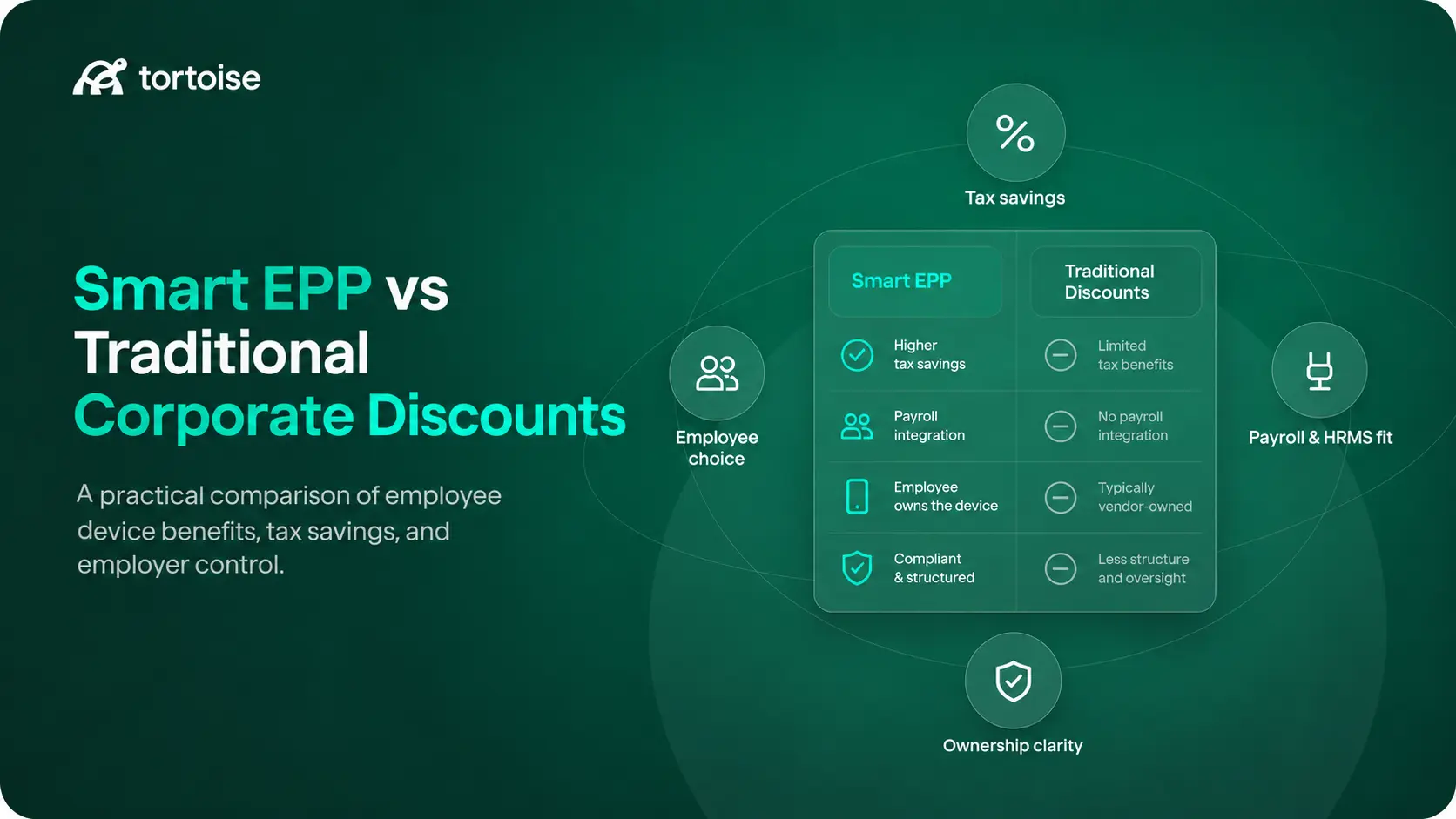
Smart EPP vs Traditional Corporate Discounts: What Employers Should Know
Vardhan KoshalSep 10, 202610 min read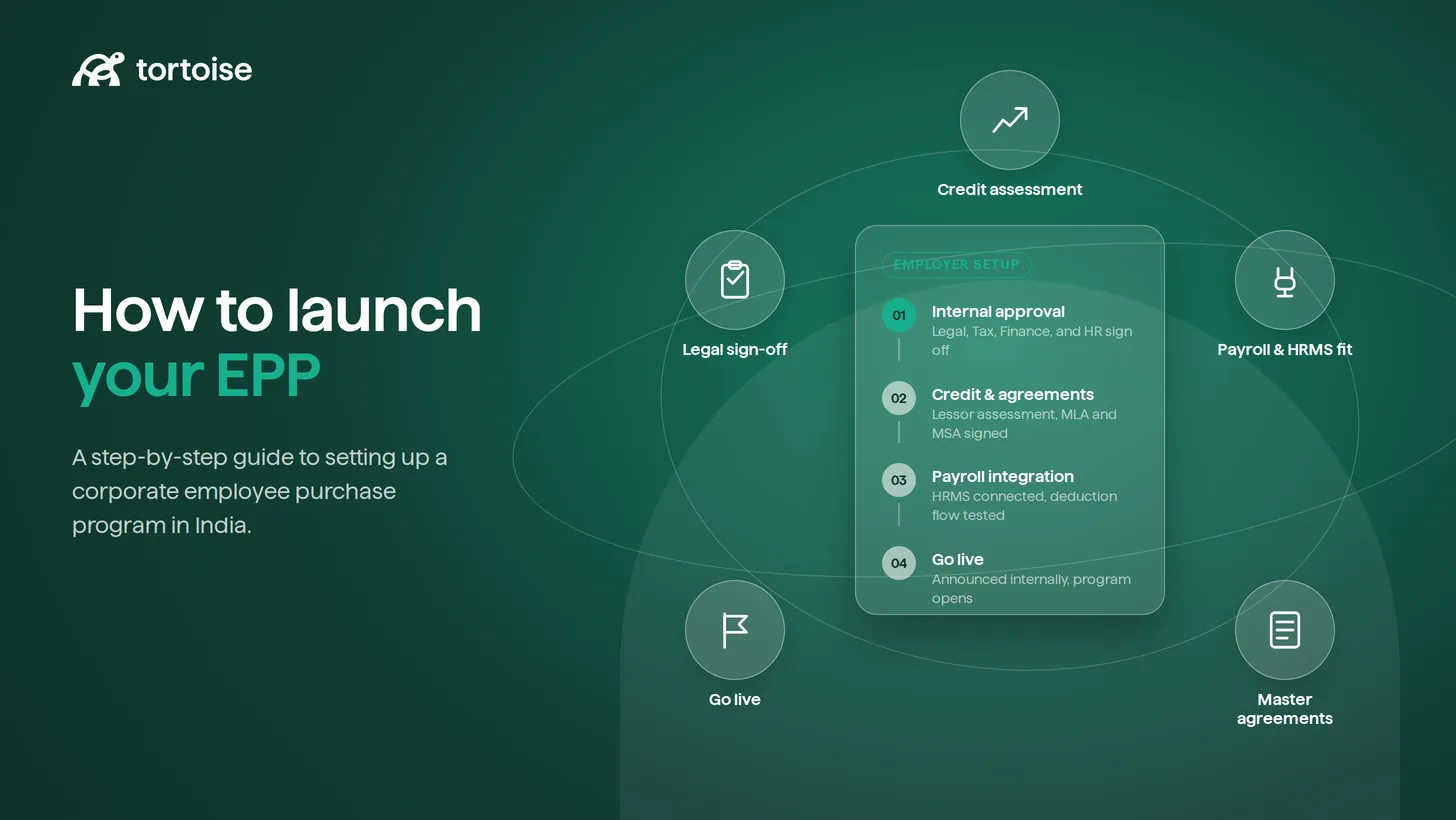
How to Set Up a Corporate Employee Purchase Program in India: Step-by-Step Guide
Vardhan KoshalSep 9, 202611 min read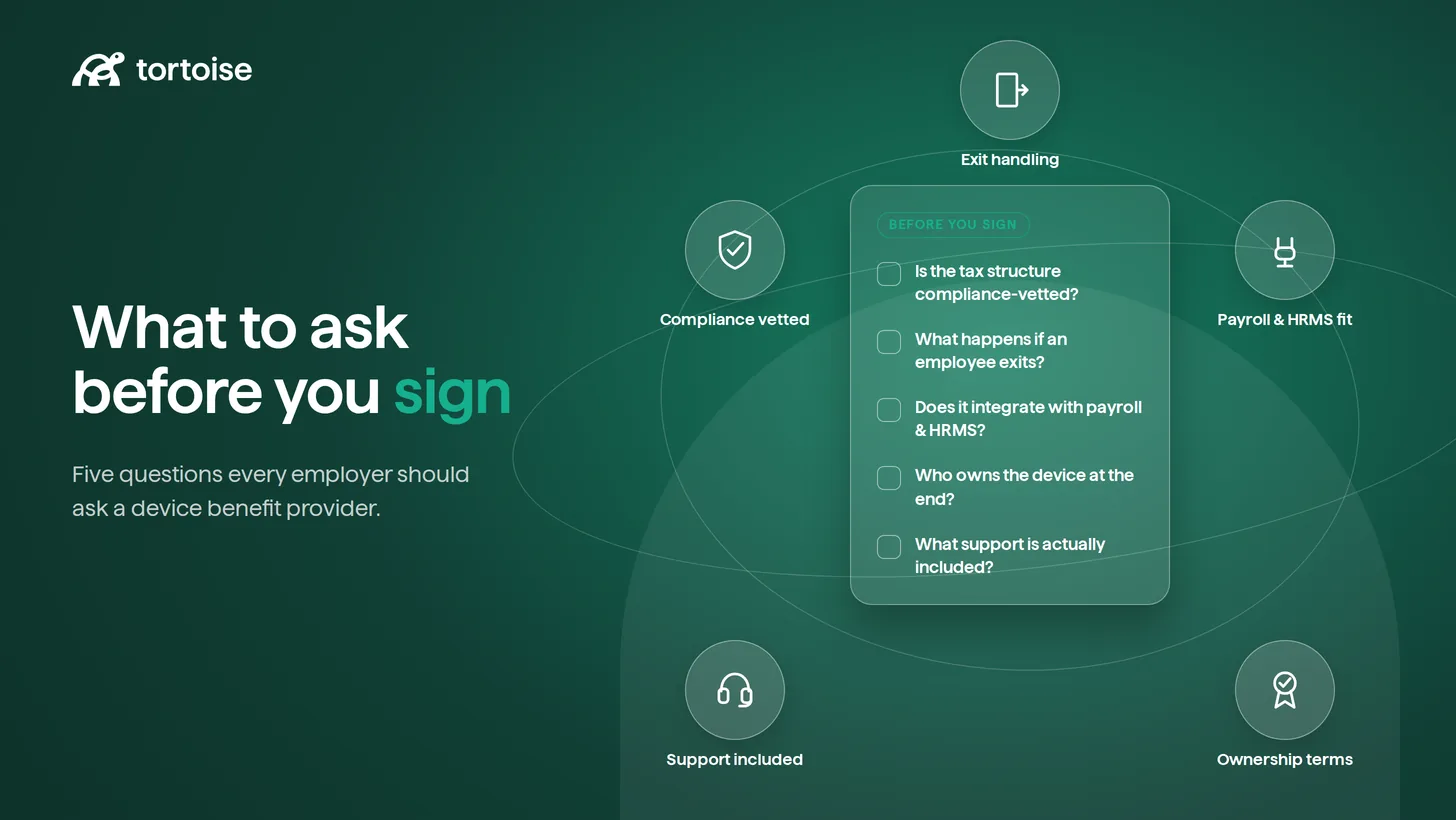
What to ask a device benefit provider before you sign
Vardhan KoshalSep 7, 20269 min read