
How to Set Up a Corporate Employee Purchase Program in India: Step-by-Step Guide

A corporate Employee Purchase Program can be one of the most visible benefits an Indian employer offers. Employees get access to devices they already need without paying the full amount upfront. Employers get a structured benefit that can improve employee satisfaction without turning HR into a device procurement desk.
The setup has to be right. An EPP touches payroll, tax, finance, HRMS data, device suppliers, insurance, employee exits, support, and reporting. If these pieces are not planned before launch, a good benefit can quickly become a monthly operations problem.
This step-by-step guide explains how to set up an employee purchase program in India with the controls that HR, payroll, finance, legal, and IT teams need. It also highlights how Tortoise helps HR leaders and organizations manage the entire process in one place, all under a zero-cost-to-employer model.
What is an Employee Purchase Program in India?
An Employee Purchase Program in India is a company-enabled benefit that allows employees to access approved devices through a structured purchase or leasing arrangement. In device-led EPPs, employees typically choose from eligible and approved devices, and payments are recovered through payroll deductions over a defined tenure.
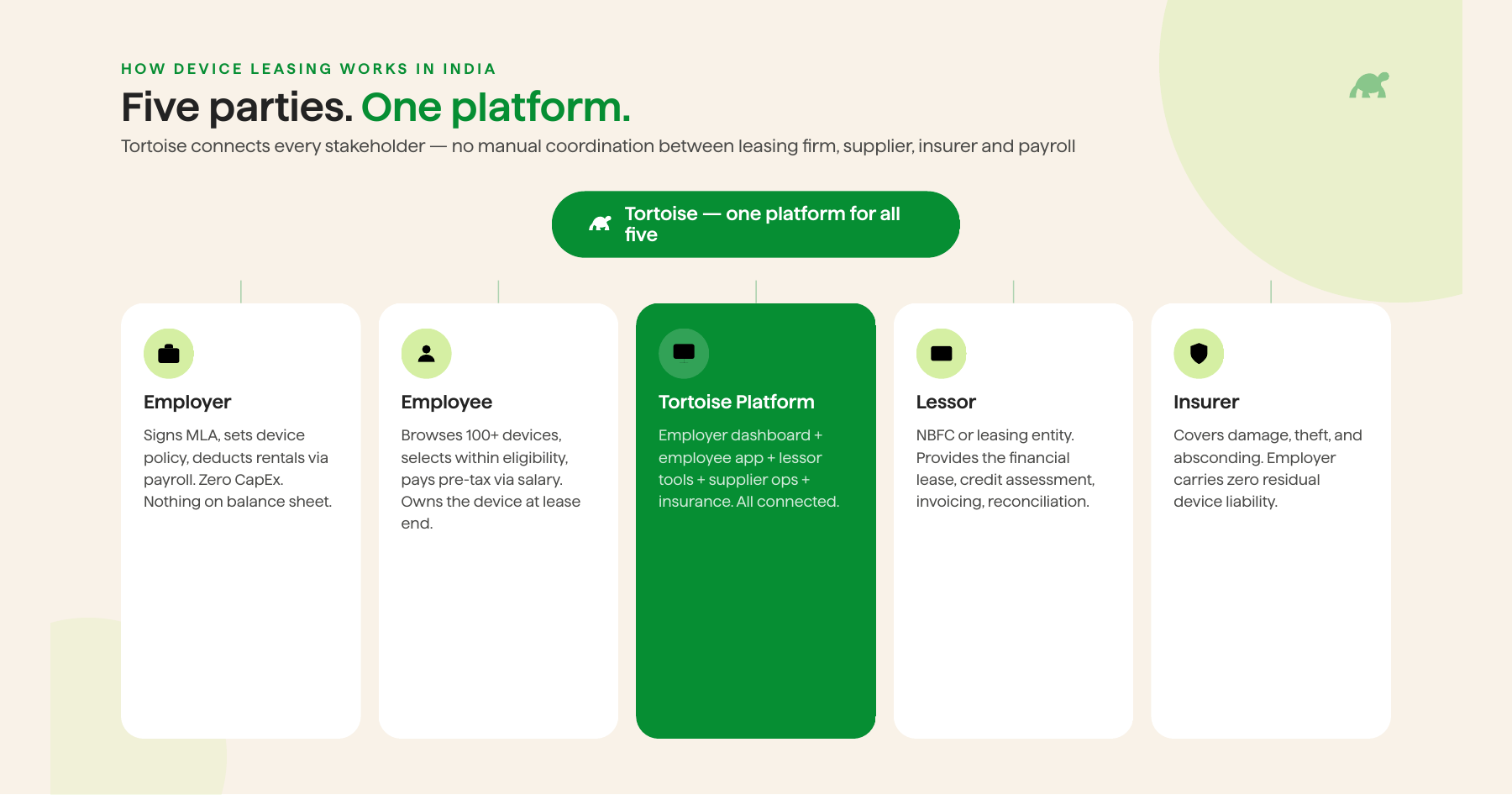
Many Indian EPPs are designed around employee device leasing, payroll deduction device leasing, or CTC device leasing. In these models, the employer enables the program, the leasing partner funds the device, the supplier delivers it, the insurer or care partner covers defined risks, and the platform manages the workflow between employees, HR, payroll, finance, and support teams.
Unlike a retail EMI, where the employee buys directly using post-tax income, a well-run employee device leasing program gives employees a simpler path from device selection to salary deduction and end-of-lease ownership.
It also avoids the friction of reimbursement, where employees pay first and claim later, and the admin load of company-owned procurement, where the employer buys, tracks, depreciates, retrieves, and refreshes devices.
How do you set up a corporate EPP in India?
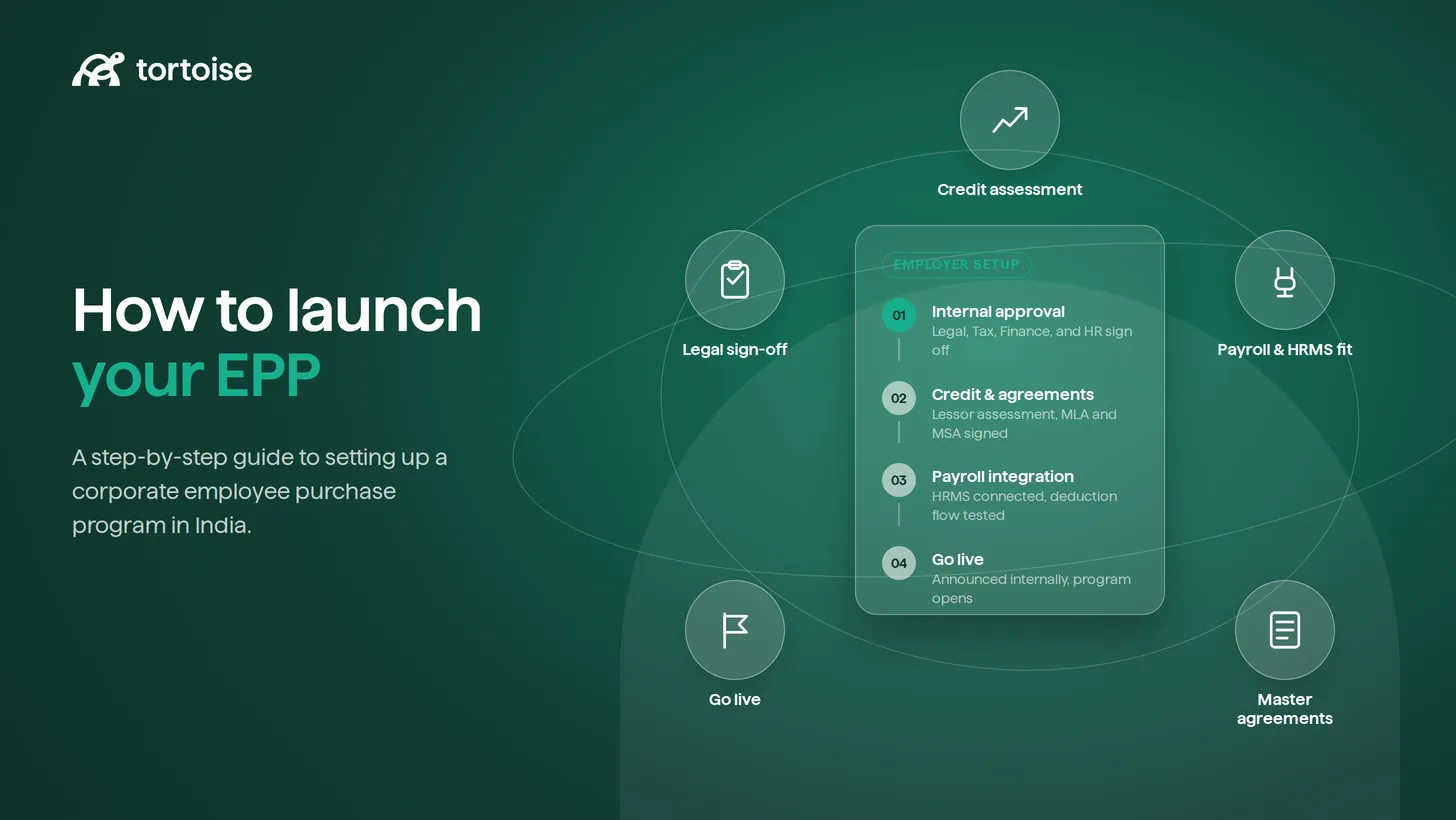
To set up a corporate Employee Purchase Program in India, align HR, payroll, finance, tax, legal, procurement, and IT first. Then choose the operating model, define eligibility rules, select device categories, review tax and compliance treatment, choose an EPP provider, finalize lease and service agreements, configure HRMS and payroll workflows, set up insurance and support, communicate the benefit to employees, launch a controlled pilot, reconcile deductions monthly, and document exit and end-of-lease processes before scaling company-wide.
Step 1: Build the business case and align internal stakeholders
Start with the reason for launching the EPP. Some companies use it to improve retention. Some use it to help employees access better devices for work and productivity. Others want to replace ad hoc reimbursements with a cleaner, policy-led benefit.
Define the first eligible employee segments before discussing vendors. Your first rollout may focus on developers, sales teams, managers, remote employees, or employees above a certain CTC threshold. Savings can vary depending on income-tax slab, device cost, tenure, salary structure, and final program design, so avoid promising one universal saving to all employees.
Bring the internal stakeholders together early. HR owns the policy and employee communication. Payroll owns deduction logic, cut-off dates, and reconciliation. Finance reviews invoices, accounting, and credit limits. Tax and legal review perquisite treatment, GST handling, ownership, recovery, and documentation. Procurement reviews commercial terms. IT and security review employee data access, platform controls, and vendor data sharing.
The Income Tax Department’s perquisites guidance treats employer-provided benefits and movable assets as relevant areas for tax review, while noting that use of an employer’s computer or laptop owned by the employer is not chargeable to tax. CTC device leasing also involves structure-specific questions around salary treatment, GST input credit, and residual-value purchase that should be reviewed case by case.
Step 2: Choose the right EPP operating model
There is no single EPP structure that fits every employer. The right model depends on what the company wants to optimize: employee savings, low employer liability, simple administration, device control, or long-term asset management.
A direct employee purchase model gives employees access to partner pricing or benefits, but the employee remains close to a retail purchase journey. A reimbursement model is familiar, but it often creates invoice checks, approval delays, tax ambiguity, and manual HR work. A company-owned device model gives the employer more control, but it also creates CapEx, asset tracking, depreciation, retrieval, and refresh-cycle work.
For device-led EPPs in India, employer-sponsored employee device leasing is often the cleaner route. The employee chooses an approved device, payroll deductions recover the lease rental, and the program can include insurance, support, reporting, and end-of-lease ownership.
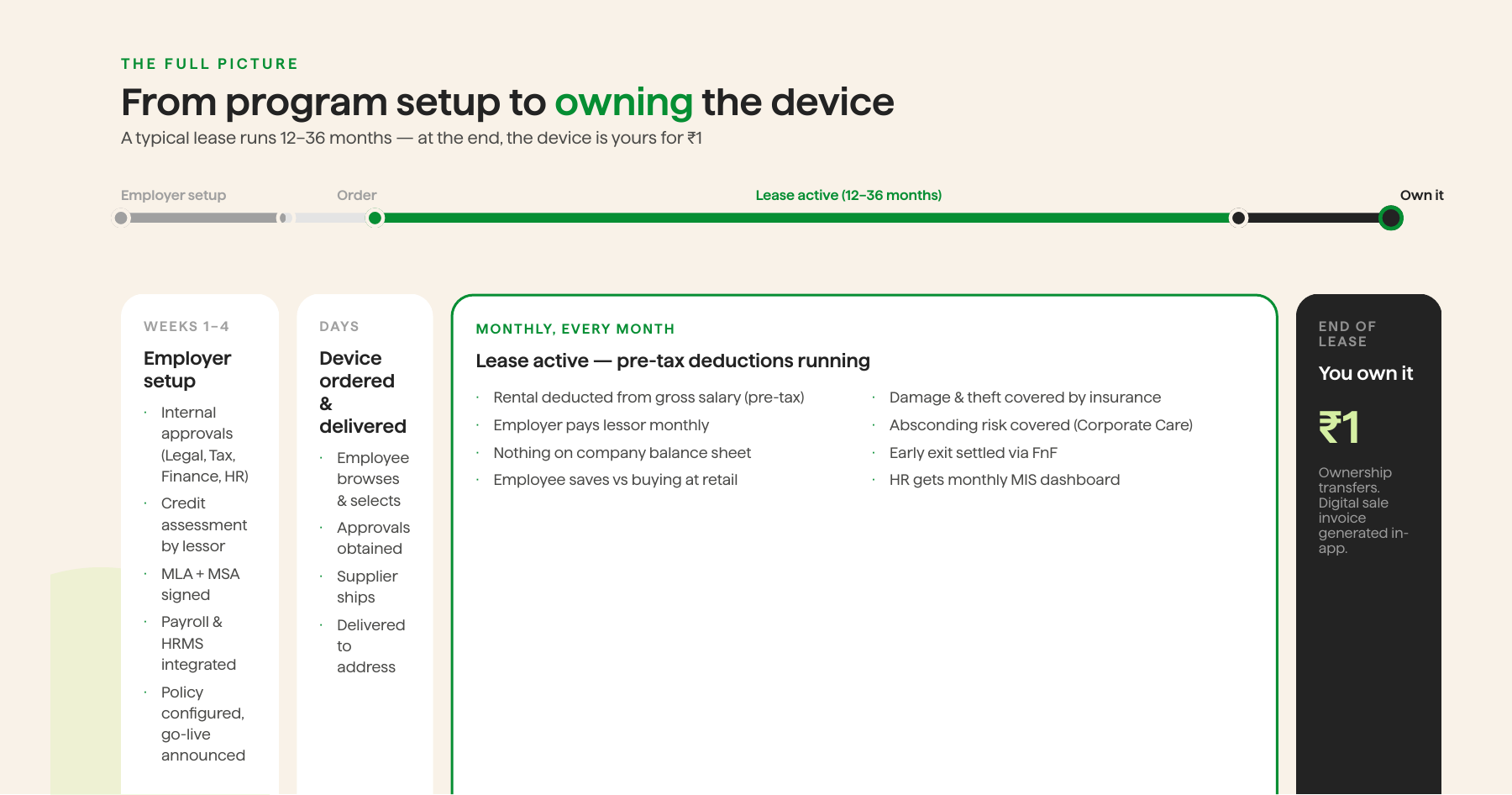
Before choosing the model, document ownership during the lease, who pays whom, when deductions start, what happens after resignation, and how the device transfers at the end.
Step 3: Design the employee device policy
Your device policy is the operating manual for the program. It should answer the questions employees and payroll teams will ask later.
Start with eligibility. Define which employees can use the EPP, whether eligibility depends on grade, tenure, role, salary band, employment type, or location. Then define device categories, such as smartphones, laptops, tablets, and accessories. Set value limits by grade or policy group, and decide whether employees can hold more than one active device lease at a time.
The policy should also define approval flows. Some companies need only HR approval. Others may require manager, finance, or business-unit approval for higher-value devices. Keep the flow simple enough for employees to use but controlled enough for finance to trust.
Document tenure, monthly deduction treatment, device delivery timelines, ownership transfer, end-of-lease purchase terms, upgrade rules, return options, and device substitution rules. Include clauses for resignation, absconding, long leave, role change, termination, damaged devices, lost devices, stolen devices, and exceptions.
Before an employee places an order, they should digitally acknowledge the policy. This acknowledgement should cover salary deduction consent, device care, insurance exclusions, exit recovery, and end-of-lease terms. Without this, HR may have to resolve disputes after the device has already been delivered.
Step 4: Select the EPP provider and finalize documentation
Evaluate the provider on more than catalogue size or discount percentage. A corporate employee purchase program needs a provider that can run compliance, payroll, approvals, device supply, care, support, and reporting as one managed workflow.
Ask whether the provider can support India-specific tax and compliance review, HRMS and payroll integration, device catalogue management, authorized supplier relationships, leasing partner coordination, insurance and care coverage, support SLAs, audit-ready reports, and clear commercial exclusions.
Security should be part of provider selection, not a late-stage checklist.
Once the provider is selected, finalize the documents before the first order goes live. These typically include the Master Lease Agreement, Master Servicer Agreement, employee device policy, data-sharing terms, insurance terms, support responsibilities, invoicing process, employer credit assessment, active lease limit, exit recovery process, and end-of-lease transfer documents.
Step 5: Configure HRMS, approvals, payroll deductions, and reconciliation
The most important EPP setup work happens inside HRMS and payroll operations. Start by mapping eligible employees, grade-wise limits, cost centers, approval flows, payroll IDs, and reporting fields. If eligibility changes because of promotion, transfer, exit, or role change, the EPP platform should receive that update without manual chasing.
Next, define the deduction trigger. In a well-controlled device leasing program, payroll deductions should begin only after device delivery and lease activation. This avoids charging the employee before the device arrives. Payroll also needs cut-off dates, exception handling, correction windows, and a process for employees whose order is approved after the monthly payroll lock.
Monthly reconciliation should connect four things: active leases, invoices from the leasing partner or provider, employee deduction files, and payroll confirmation. If the numbers do not match, payroll needs a documented correction process.
A scalable employee purchase program setup should give payroll and finance teams clean deduction files, exception reports, and month-end summaries.
Step 6: Set up insurance, service, support, and exit controls
Device programs fail when support is unclear. Employees will judge the benefit by what happens when a screen breaks, a device is stolen, or a repair takes too long.
Define coverage for accidental damage, liquid damage, theft, screen repair, replacement devices, pickup and repair, claim documentation, deductibles, exclusions, and repair turnaround time.
Tortoise Corporate Care includes accidental damage, liquid damage, theft, broken-glass screen repairs, pickup and repair support, replacement devices during repair, and support through toll-free, WhatsApp, and email channels within its managed device leasing program.
Exit controls are equally important. The policy should state what happens when an employee resigns, absconds, is terminated, moves to a different role, or leaves before the lease ends. Define foreclosure calculations, full-and-final recovery, whether the employee can retain the device, and what happens to open claims during exit.
A good EPP protects both sides. Employees know what they owe and what support they get. Employers know how risk is covered and how recovery works.
Let’s give your workforce the best benefits experience!
Over 50,000 employees are already enjoying their new devices with heavy savings. Get it for your workforce too
Step 7: Launch the pilot and communicate the benefit clearly
Do not launch the EPP with a vague announcement. Employees need to understand the benefit before they place an order.
Your launch communication should explain who is eligible, which devices are available, how monthly salary impact is calculated, what savings are estimated, when deductions begin, how approvals work, how delivery is handled, what insurance covers, what happens after resignation, and how ownership transfers at the end of the lease.
Keep savings language careful. Say that savings depend on tax slab, salary structure, device cost, tenure, and final program design. Avoid promising that every employee will save the same percentage.
Start with a pilot group before opening the program to the full company. A pilot with one or two segments, such as senior managers or laptop-heavy teams, helps HR test device demand, payroll deductions, support tickets, approval speed, delivery timelines, and employee questions. After one or two payroll cycles, adjust the policy and communication before scaling.
Step 8: Run monthly operations and measure adoption
After launch, the EPP becomes a monthly operating rhythm. HR monitors requests and approvals. Payroll processes deductions. Finance reconciles invoices. The provider manages device supply, claims, support, and end-of-lease workflows. Legal and IT may get involved when policy exceptions, data issues, or exit cases come up.
Track adoption rate, average device value, device categories chosen, estimated employee savings, approval turnaround time, delivery time, payroll accuracy, claim closure time, ticket resolution time, exit recovery, and employee satisfaction. These metrics show whether the EPP is working as a benefit and as an operating process.
Review the program every quarter. Update device limits, catalogue options, communication, insurance terms, and support workflows based on usage. An EPP for employees should not be a one-time launch. It should become a well-governed benefit that improves with every cycle.
Common mistakes to avoid while setting up an EPP
The most common mistake is launching on the strength of savings claims before payroll, tax, legal, and exit processes are ready. Other mistakes include unclear ownership transfer, weak insurance coverage, no full-and-final recovery process, hidden support or delivery fees, no employee policy acknowledgement, and poor reporting.
Do not treat EPP as a procurement project alone. It is a payroll-linked employee device benefit program, and it needs controls that work after launch.
Where Tortoise fits in the EPP setup journey
Tortoise is a trusted employee device leasing platform for Indian enterprises. It brings device selection, payroll deductions, insurance and care, support, HRMS and payroll workflows, and end-of-lease ownership into one managed program.
For companies evaluating employee device leasing in India, Tortoise can help HR, payroll, finance, tax, legal, IT, and leadership align on the core pieces of the program before launch: policy design, operating model, payroll deduction readiness, tax and legal review inputs, insurance terms, support workflows, exit recovery, reporting cadence, and employee communication.
Book an Demo with Tortoise to understand what your team needs before rollout.
Frequently asked questions
What is an Employee Purchase Program in India?
An Employee Purchase Program in India is a company-enabled benefit that lets employees access approved products, commonly devices such as laptops, smartphones, tablets, or accessories, through a structured purchase or leasing arrangement. In device-led EPPs, payments are often recovered through payroll deductions over a defined tenure.
How does payroll deduction work in an EPP?
In a payroll-linked EPP, the employee selects an approved device, accepts the policy terms, and the monthly deduction is processed through payroll according to the agreed schedule. In a well-controlled device leasing program, deductions should begin only after device delivery and lease activation.
Is an Employee Purchase Program taxable in India?
The tax treatment of an Employee Purchase Program in India depends on the final structure, asset ownership, documentation, payroll treatment, device category, and applicable tax rules. Employers should review the program with their finance, tax, and legal advisers before launch.
What devices can be included in a corporate EPP?
A corporate EPP can include approved devices such as laptops, smartphones, tablets, and accessories, depending on the employer’s policy and provider catalogue. Many companies set grade-wise limits, tenure rules, and approval workflows for different device categories.
How long does it take to launch an employee device leasing program?
Launch timelines depend on provider onboarding, legal and tax review, HRMS and payroll configuration, device policy approval, and employee communication. A practical rollout often starts with a controlled pilot before opening the EPP to the full company.
Why use Tortoise for an Employee Purchase Program in India?
Tortoise is an ISO 27001 and SOC 2 certified employee device leasing platform for Indian enterprises. It helps companies manage device selection, payroll deductions, insurance and care, support, HRMS and payroll workflows, and end-of-lease ownership in one managed program.
Written by
Founder & CEO
Vardhan Koshal is the Co Founder of Tortoise, India’s fastest growing employee device benefit platform. He has led India growth and product for companies like TripAdvisor and Udacity, and earlier founded Ridingo, a car pooling startup recognised by Forbes as one of the Hottest Global Startups and acquired by Carzonrent. At Tortoise he works with HR leaders, CFOs and tax experts to design compliant, high impact device benefit programs for Indian employers.
RELATED READS
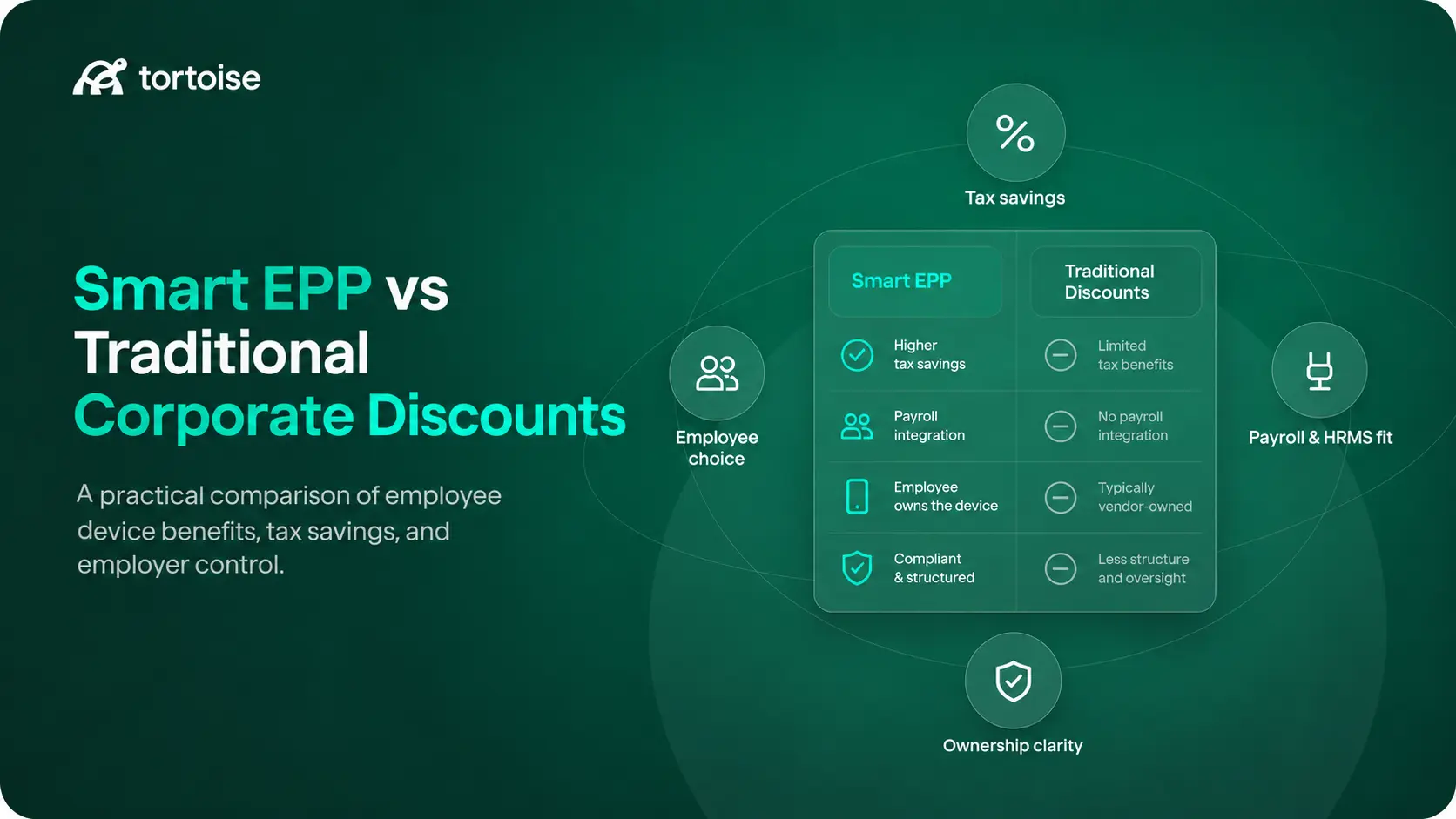
Smart EPP vs Traditional Corporate Discounts: What Employers Should Know
Vardhan KoshalSep 10, 202610 min read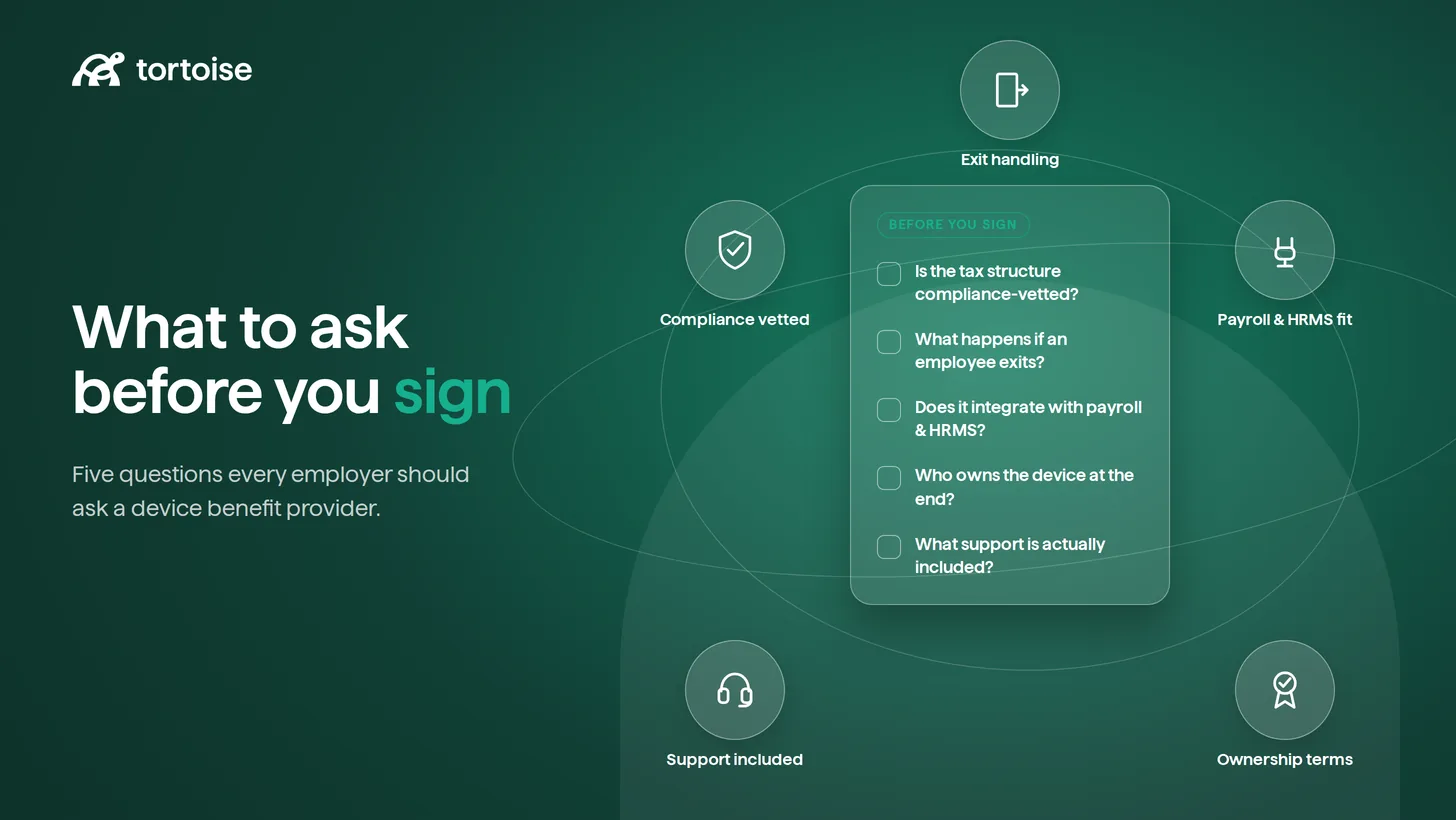
What to ask a device benefit provider before you sign
Vardhan KoshalSep 7, 20269 min read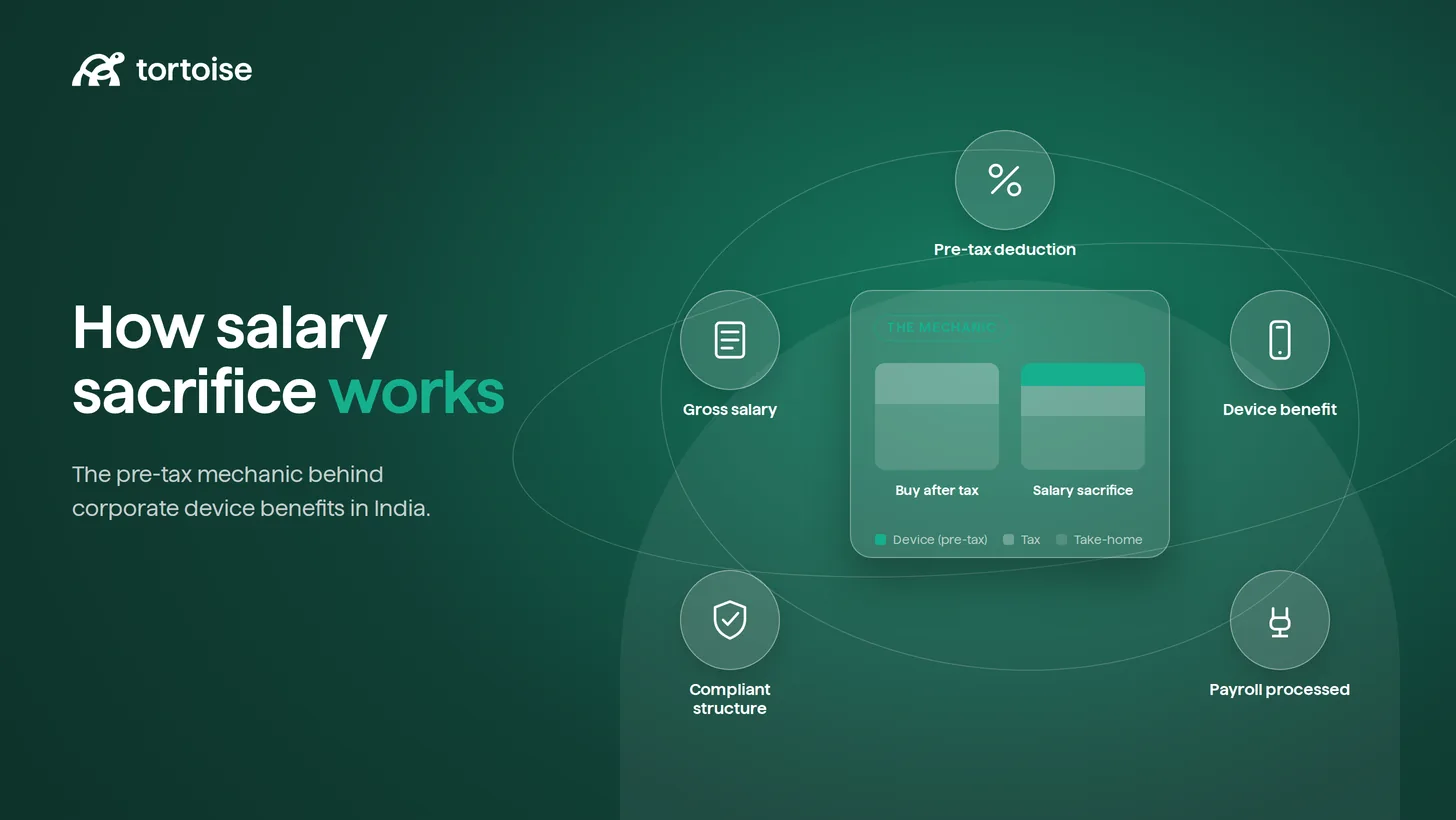
Salary sacrifice for corporate electronic devices in India: how it works
Vardhan KoshalSep 3, 20269 min read