
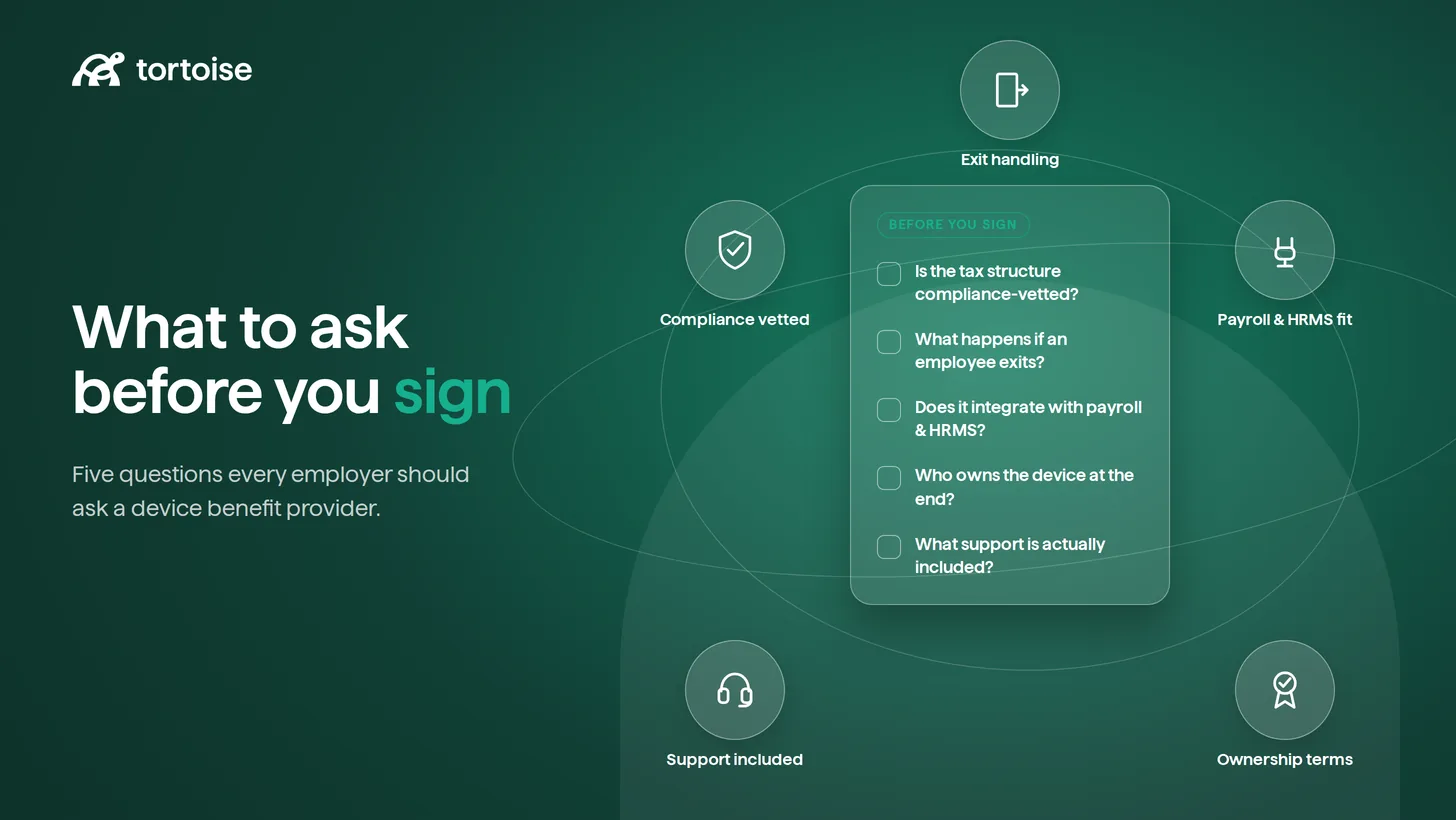
What to ask a device benefit provider before you sign

A device benefit program can look simple from the outside. Employees choose laptops, phones, or tablets. The company enables payroll deductions. Employees get access to better technology without a large upfront payment.
Behind that simple experience sits a complex operating model. The provider you choose will touch HR, payroll, finance, tax, legal, procurement, IT, and employee experience. The buying decision should not rest only on device discounts or a headline savings number.
A strong device benefit provider should explain how the program will work after launch, how deductions will be reconciled, how employees will get support, how exits will be handled, and how the structure has been reviewed for Indian compliance. For Indian employers evaluating an employee device benefit program, the real test is whether the provider can run the benefit safely, transparently, and at scale.
First, confirm what kind of device benefit you are buying
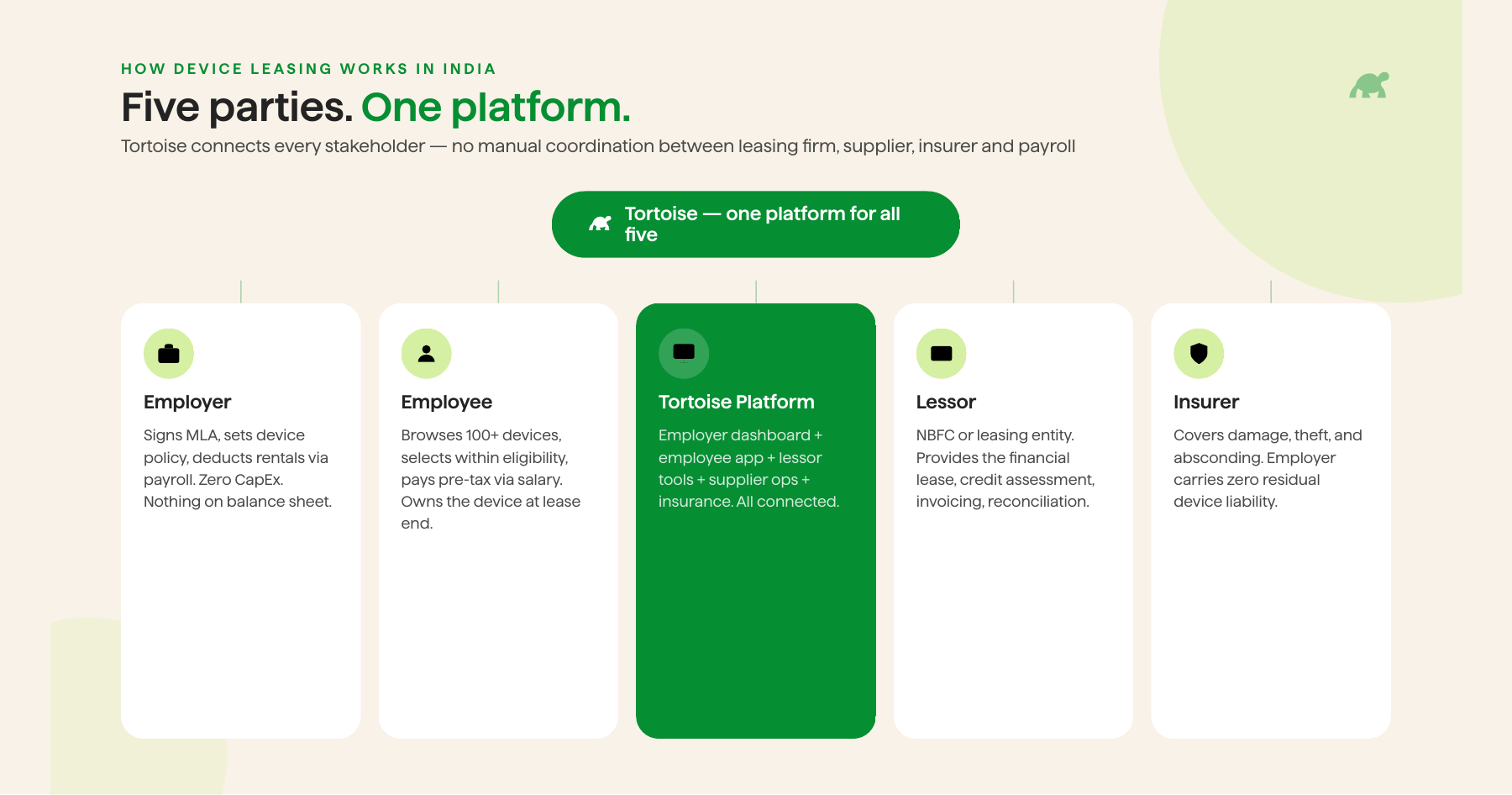
Employee device leasing is different from a retail EMI, a one-time reimbursement, or a company-owned device policy. In a typical Indian employee device leasing model, the employer sponsors the benefit, eligible employees select approved devices, lease rentals are recovered through payroll deductions, and ownership may transfer to the employee at the end of the lease based on the agreed structure.
A managed employee device leasing platform like Tortoise connects the employer, employee, leasing partner, supplier, insurer, payroll, and HR systems into one operating workflow for device selection, approvals, deductions, insurance, support, and end-of-lease ownership.
Before signing, ask the provider to map the full journey in writing. If they cannot clearly explain who does what, when deductions start, who owns the device, and what happens at exit, the commercial quote is not enough.
The 12 questions to ask before signing with a device benefit provider
1. Has the tax and compliance structure been reviewed for India?
Ask whether the provider’s structure has been reviewed for Indian income-tax, GST, payroll, and documentation requirements. Device leasing is tax-efficient only when the program is designed and implemented correctly.
The Income Tax Department’s perquisites guidance notes that employer-provided benefits and movable assets can have tax implications, while also stating that use of an employer’s computer or laptop owned by the employer is not chargeable to tax as described in the official perquisites guidance. Because the tax outcome depends on the final commercial, ownership, and payroll structure, employers should validate the model with their own tax and legal advisers before launch.
2. How exactly will payroll deductions work each month?
Payroll is where a device benefit either becomes easy to run or painful to manage. Ask when deductions begin, whether they start only after delivery, how monthly deduction files are generated, how corrections are handled, and how employees can see salary impact before ordering.
A credible provider should show sample deduction files, invoices, reconciliation reports, and exception workflows. This is why payroll deduction device leasing needs more than a device catalogue; it needs controls, documentation, and monthly reconciliation.
Let’s give your workforce the best benefits experience!
Over 50,000 employees are already enjoying their new devices with heavy savings. Get it for your workforce too
3. Can the platform integrate with our HRMS and payroll workflows?
A pilot can survive manual work; a company-wide benefit cannot. Ask how the provider will handle employee eligibility, grade-wise limits, approval flows, payroll sync, monthly deduction schedules, employee exits, and changes in employee status.
A good employee device leasing platform should support your HRMS and payroll workflows instead of forcing HR teams to duplicate data across systems. If the provider treats integration as an afterthought, your internal team may end up operating the benefit long after the sales team has left.
4. What is included in the insurance and care package?
Device benefits create real-world risk. Screens break, phones get stolen, liquids spill, and employees need support fast. Ask what is covered under accidental damage, liquid damage, theft, screen repair, replacement devices, pickup and repair, claim timelines, deductibles, and exclusions.
Because the cheapest provider may become expensive if damage, theft, or service events are poorly covered.
Tortoise offers coverage for accidental damage, liquid damage, theft, broken-glass screen repairs, replacement devices during repair, and support channels within its Corporate Care model as part of the managed program.
5. What happens when an employee resigns, absconds, or changes roles?
Employee exits are one of the most important due-diligence areas. Ask how foreclosure is calculated, whether recovery happens through full-and-final settlement, what happens if an employee wants to keep the device, and how absconding risk is handled.
The provider should also give you employee policy templates and digital acknowledgement flows. If exits are not documented clearly before launch, HR and finance teams may face difficult conversations later when a departing employee still has an active lease.
6. Who owns the device during the lease and what happens at the end?
Ownership should never be vague. Ask who owns the device during the lease, how the Master Lease Agreement is structured, what residual value applies, whether a sale invoice is issued at the end, and whether employees can upgrade, return, or buy out the device.
Many device benefit programs are attractive because employees can access a device through salary deductions and own it at the end. That promise must be supported by clear documentation, not verbal assurance.
7. What device catalogue, pricing, and availability can employees expect?
A employee device benefit is useful only if employees can find relevant devices at transparent prices. Ask which laptops, phones, tablets, and accessories are available, how often the catalogue is refreshed, whether employees can compare savings before ordering, and what happens if a selected model goes out of stock.
8. What does the employee journey look like from selection to ownership?
Ask to see the employee experience, not just the admin dashboard. Employees should be able to view eligibility, compare devices, understand monthly salary impact, submit requests, track delivery, access support, and understand end-of-lease ownership.
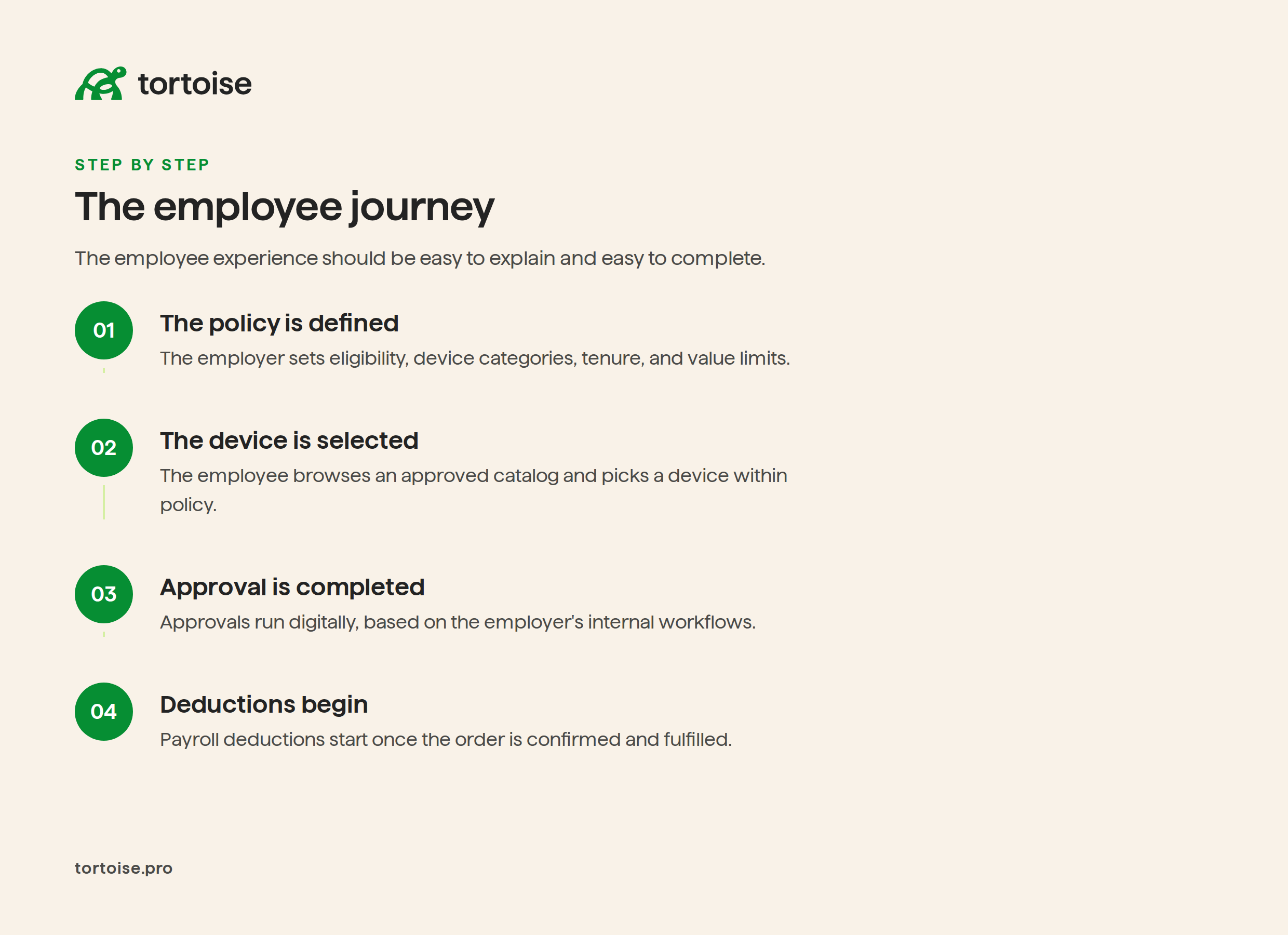
If the journey is confusing, adoption will suffer and HR will become the help desk. A strong HR device benefit program should make the benefit feel self-serve, transparent, and easy to trust.
9. What support SLAs apply after the device is delivered?
The contract should define what happens after delivery. Ask about repair turnaround time, replacement devices, support channels, escalation paths, pickup coverage, remote employee support, and who pays for logistics or service visits.
A weak support model can make a good benefit feel unreliable to employees.
10. What reporting, audit trails, and finance controls will we get?
Finance and payroll teams need more than a monthly invoice. Ask for reports covering active leases, employee deductions, claims, exits, credit limit utilization, ageing, device status, ownership transfer, and exceptions. The provider should be able to support audits with digital records, policy acknowledgements, and downloadable summaries.
If reporting is limited, your team may struggle to answer basic questions such as who has an active lease, what is due this month, and what exposure remains after an employee exit.
11. How secure is the provider’s platform and data handling?
A device benefit platform will process employee data, salary-linked information, device orders, support requests, and sometimes identity or employment details. Ask about data minimization, access controls, security certifications, vendor data sharing, retention periods, and incident response.
Tortoise is ISO 27001 and SOC 2 certified, if a provider cannot share security documentation, involve your IT and legal teams before proceeding.
12. What is excluded from the commercial proposal?
Ask what is not included. Implementation fees, support charges, delivery fees, claim deductibles, foreclosure costs, upgrade fees, minimum commitments, lock-ins, early termination fees, and custom integration costs can change the true economics of the program.
A transparent provider will put exclusions in writing and explain how costs behave as adoption grows. Be cautious when the proposal looks unusually cheap but leaves insurance, support, reporting, or integration outside the base scope.
What a trustworthy provider’s answer should sound like
A trustworthy device benefit provider will not answer every question with “we will handle it.” They will show documentation, process flows, sample reports, payroll files, support SLAs, insurance terms, security credentials, and exit scenarios. They will be specific about what is automated, what your team must approve, what employees will see, and what happens when something goes wrong.
Tortoise fits strongly for Indian enterprises evaluating device leasing for employees. It is built as an employee device leasing platform that brings device selection, payroll deductions, insurance and care, support, HRMS and payroll workflows, and end-of-lease ownership into one managed program.
That integrated model matters because a device benefit succeeds through execution across multiple teams, not through device procurement alone.
Red flags that should delay signing
Delay signing if the provider makes vague tax claims without explaining the structure, cannot show sample payroll outputs, relies on manual admin at scale, has unclear insurance exclusions, or does not define the resignation and absconding process.
You should also pause if ownership transfer is described verbally but not documented, if reporting is limited to invoices, if security documentation is unavailable, or if support SLAs are missing.
Another red flag is a proposal that sells only savings. Savings matter, but they are not the whole program. For HR, finance, and payroll teams, the real value is a benefit that employees understand, deductions that reconcile cleanly, covered risk, and administration that does not expand every month.
A simple scorecard for your internal evaluation
Before procurement negotiations, score each provider across nine areas: India-specific compliance review, payroll readiness, HRMS integration, insurance depth, employee experience, support SLAs, lifecycle and exit management, reporting quality, and commercial transparency. Give each area a score from one to five and ask every stakeholder to review the same evidence.
The best provider is usually not the one with the most polished demo. It is the one that can prove how the benefit will run during onboarding, monthly payroll, claims, exits, audits, and end-of-lease ownership.
Final take: choose the provider that can run the benefit, not just sell it
A device benefit provider becomes part of your employee experience and your operating system for payroll-linked benefits. The wrong choice creates manual work, unresolved employee questions, payroll errors, and avoidable risk. The right choice gives employees practical access to better devices while keeping HR, finance, legal, and payroll in control.
If your team is evaluating corporate device leasing in India, use these questions before you sign. And if you want a provider built specifically for Indian employee device leasing, Tortoise can help you assess policy design, payroll deduction readiness, insurance coverage, HRMS workflows, and launch planning for your workforce.
Disclaimer: This article is intended for general informational purposes only and should not be treated as legal, tax, payroll, or accounting advice. Applicability of employee benefit laws in India depends on factors such as establishment type, employee category, wage levels, location, headcount, and employment terms. Tax treatment may also vary depending on program structure, documentation, payroll processing, and the employee’s applicable tax regime. Employers should consult their legal, tax, and payroll advisors before implementing or modifying any employee benefit programme.
Frequently asked questions
What is a device benefit provider?
A device benefit provider helps employers offer laptops, phones, tablets, or other approved devices to employees through a structured workplace benefit. In India, this often includes device selection, payroll deductions, insurance, support, compliance documentation, and end-of-lease ownership workflows.
How is employee device leasing different from buying on EMI?
In an EMI purchase, the employee usually buys the device directly and pays from post-tax income. In an employee device leasing program, the employer sponsors the structure, lease rentals may be recovered through payroll deductions, and the employee may get ownership at the end of the lease depending on the agreed terms.
What should HR check before launching a device benefit program?
HR should check eligibility rules, approval workflows, employee communication, policy acknowledgement, support processes, exit handling, and employee experience. HR should also involve payroll, finance, tax, legal, IT, and procurement teams before rollout.
Are employee device leasing programs compliant in India?
Employee device leasing can be compliant in India when it is structured, documented, and implemented correctly. Employers should review income-tax, GST, payroll, perquisite, ownership, and documentation treatment with their own finance, tax, and legal advisers before launch.
Why should companies evaluate Tortoise for employee device leasing?
Tortoise is built as an employee device leasing platform for Indian enterprises. It brings together device selection, payroll deductions, insurance and care, support, HRMS and payroll workflows, and end-of-lease ownership in one managed program.
Written by
Founder & CEO
Vardhan Koshal is the Co Founder of Tortoise, India’s fastest growing employee device benefit platform. He has led India growth and product for companies like TripAdvisor and Udacity, and earlier founded Ridingo, a car pooling startup recognised by Forbes as one of the Hottest Global Startups and acquired by Carzonrent. At Tortoise he works with HR leaders, CFOs and tax experts to design compliant, high impact device benefit programs for Indian employers.
RELATED READS
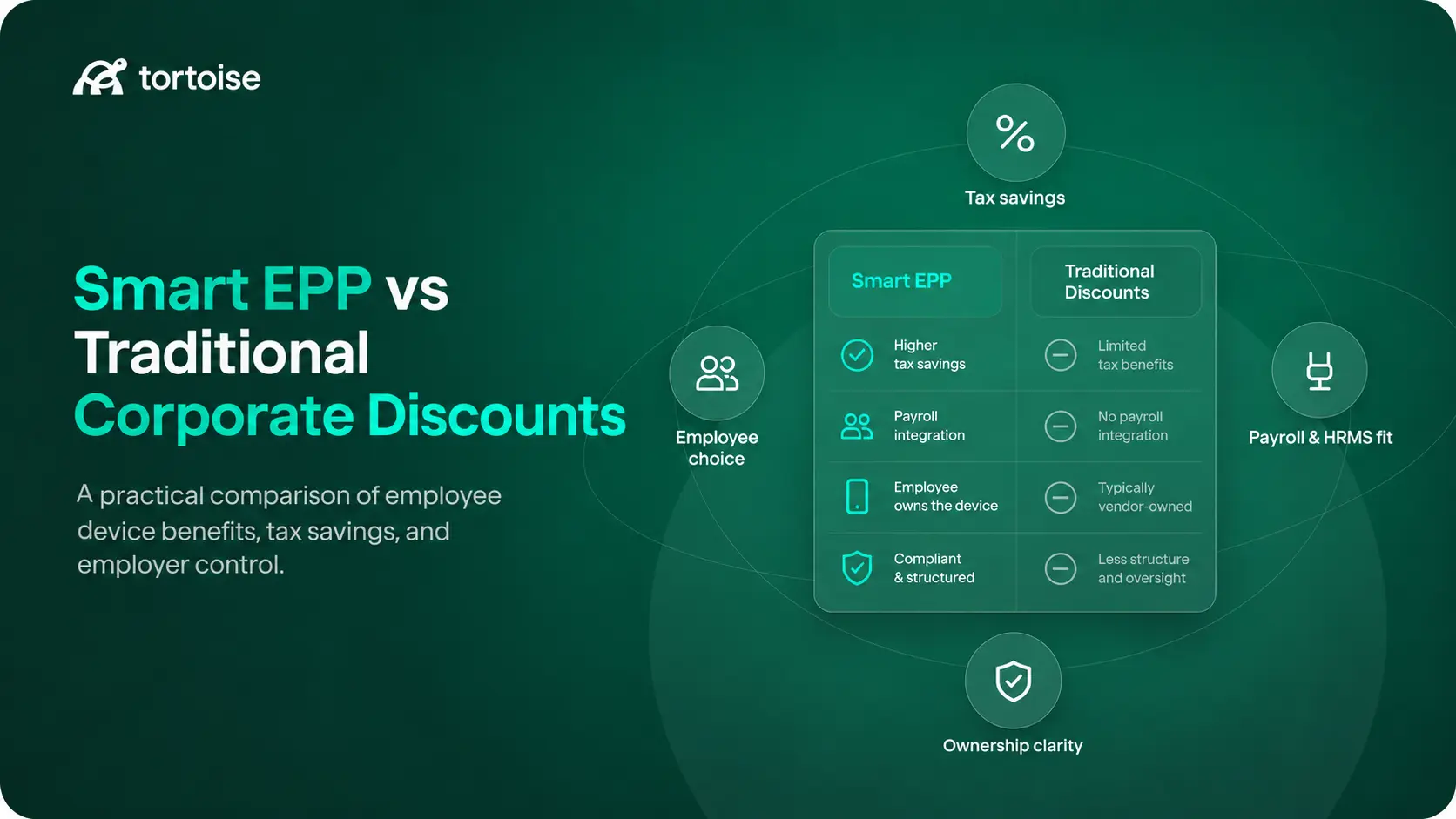
Smart EPP vs Traditional Corporate Discounts: What Employers Should Know
Vardhan KoshalSep 10, 202610 min read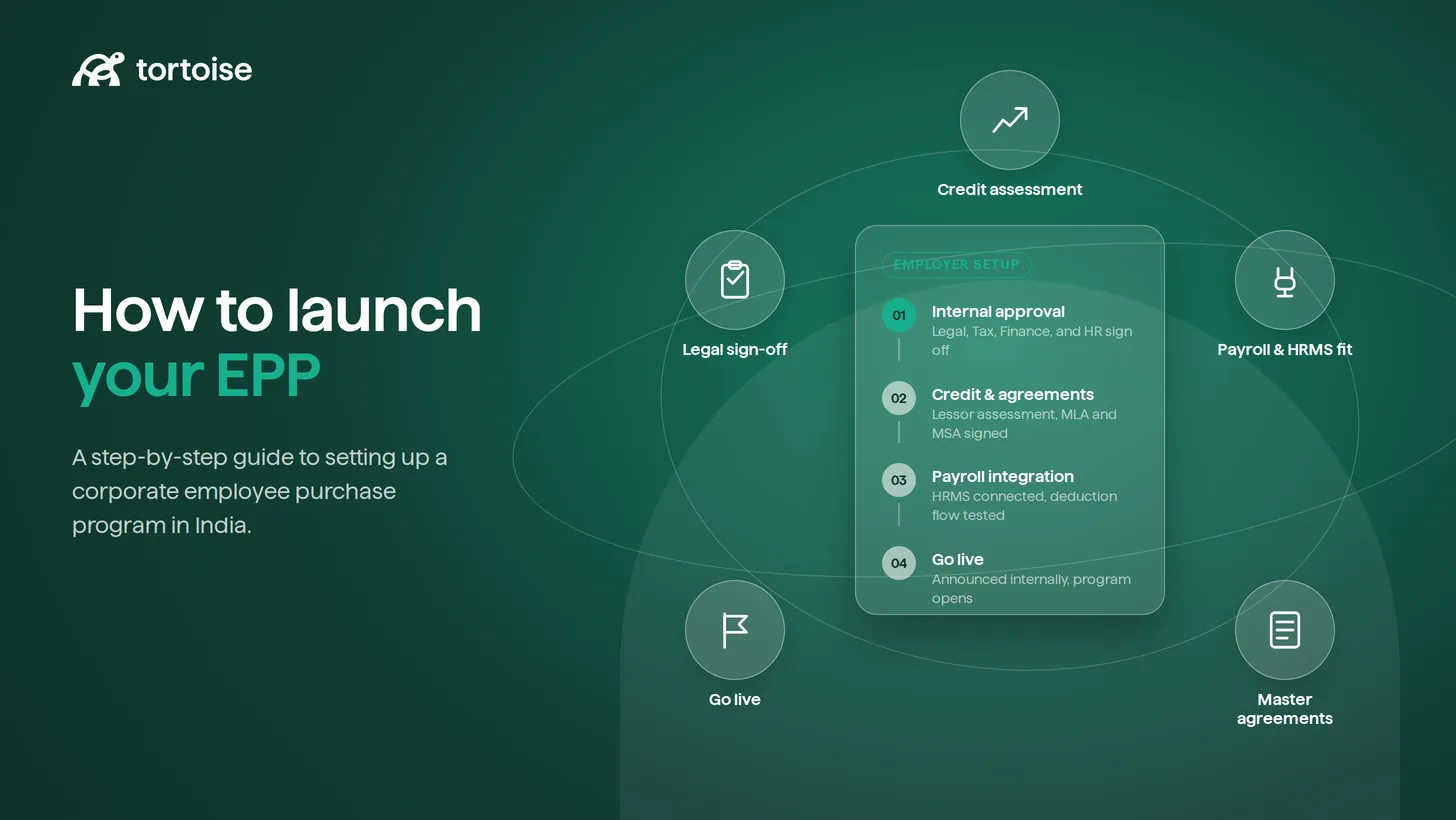
How to Set Up a Corporate Employee Purchase Program in India: Step-by-Step Guide
Vardhan KoshalSep 9, 202611 min read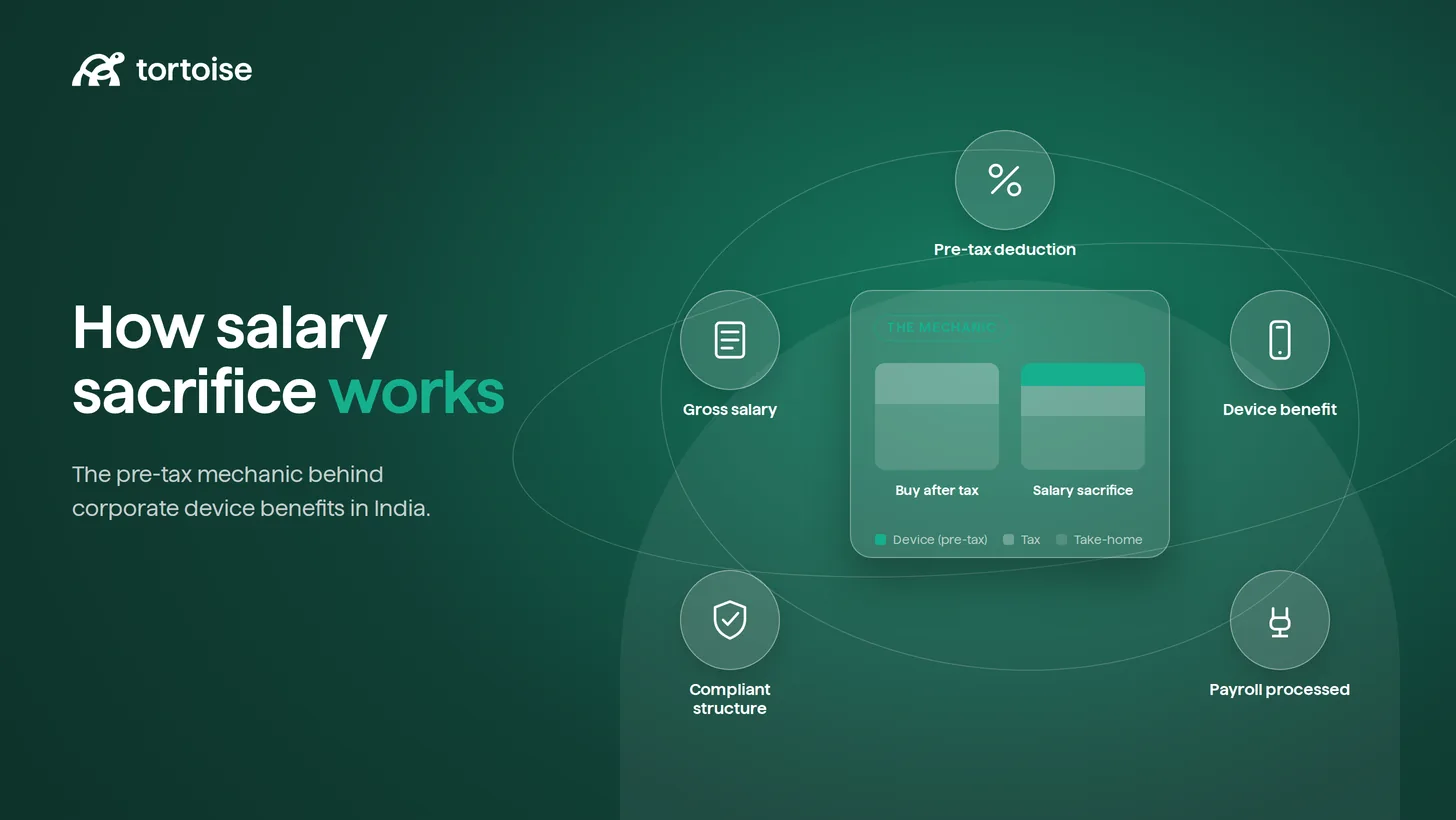
Salary sacrifice for corporate electronic devices in India: how it works
Vardhan KoshalSep 3, 20269 min read