Salary sacrifice for corporate electronic devices in India: how it works

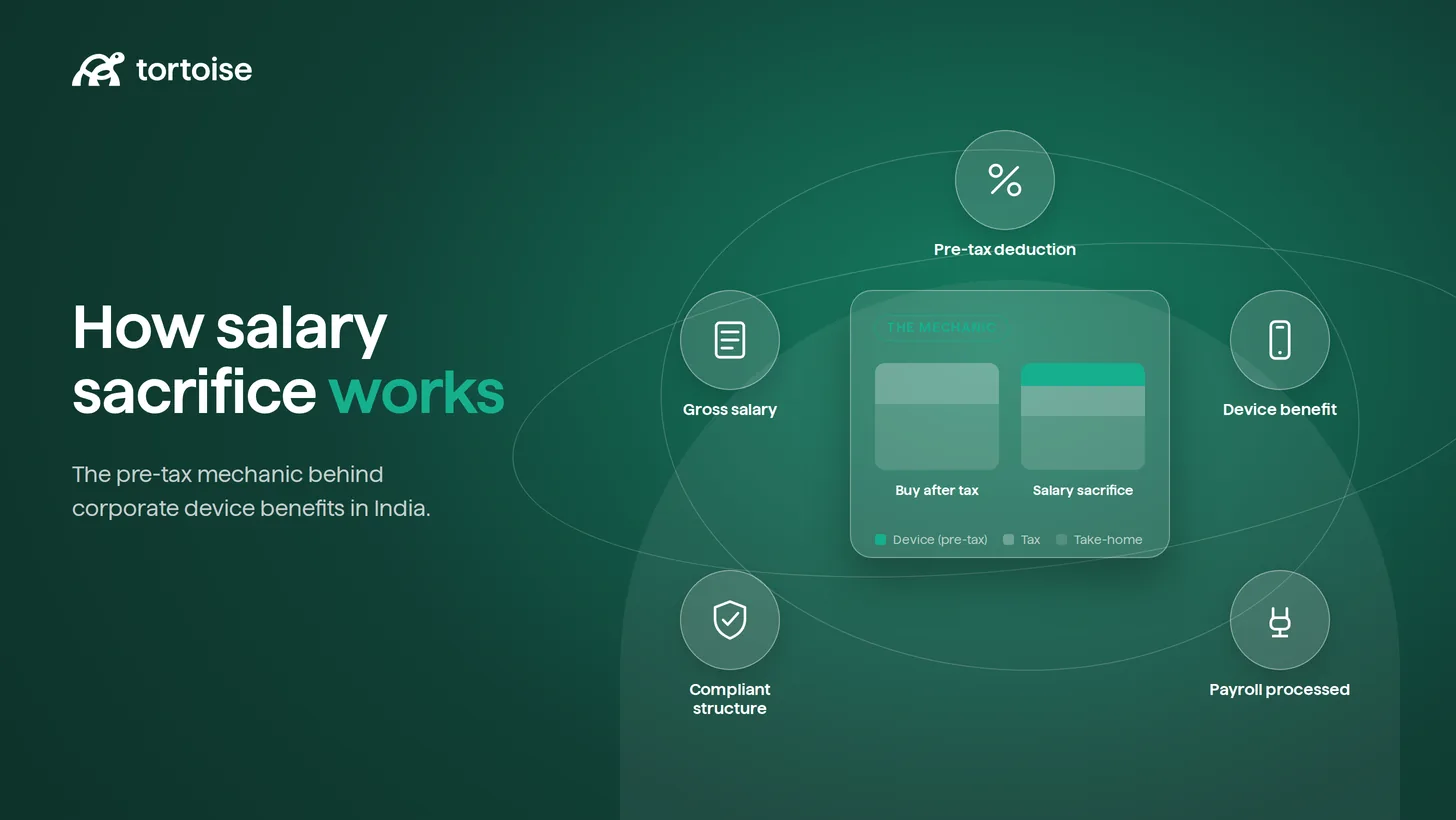
Salary sacrifice for corporate electronic devices in India is a CTC-linked arrangement where an employee gives up part of gross salary in exchange for an employer-linked device benefit.
For HR and payroll teams, the key distinction is clear: a cash gadget allowance is generally taxed as salary, while a properly documented employer-leasing model may be more tax-efficient depending on the device category, ownership or hiring structure, payroll treatment, and perquisite valuation.
In practical terms, the employee’s total CTC may stay the same, but part of that CTC is used to fund an approved device lease instead of being paid entirely as taxable cash salary. For employers, the value is not only tax efficiency. A well-run program can improve device affordability, create a visible retention benefit, and reduce the admin load that usually comes with reimbursements, claims, and ad hoc device approvals.
This article is an HR and payroll explainer, not tax advice. Employers should validate their structure with their finance, tax, legal, and payroll advisors before rollout.
What salary sacrifice means in a CTC structure
In an Indian CTC structure, salary sacrifice does not usually mean the employer spends more. It means the same total cost is arranged differently. A portion of the employee’s compensation package is allocated toward a defined benefit, such as a corporate device lease, instead of being paid out as cash salary.
For example, if an employee is eligible for a device lease rental of ₹10,000 per month, that amount can be mapped as a device lease component within CTC and recovered through payroll. The employee’s cash take-home may reduce by the lease amount, but their taxable salary may also reduce if the program is eligible and correctly documented.
This should never be run as an informal deduction. A salary sacrifice device program needs a written policy, employee consent, approved device categories, lease documentation, payroll configuration, and records that finance and payroll teams can audit later.
Cash gadget allowance vs structured employer-leasing model
A cash gadget allowance is easy to explain, but it is usually less tax-efficient. A structured employer-leasing model takes more setup, but it gives the employer more control over tax treatment, documentation, employee experience, and device lifecycle.
| Model | How it works | Income-tax treatment | Documentation required | Best fit |
|---|---|---|---|---|
| Cash gadget allowance | Employer pays a fixed amount to the employee | Generally taxable as salary unless a specific exemption applies | Salary structure and payroll record | Companies that want a simple but taxable benefit |
| Reimbursement | Employee buys a device and claims the cost | Depends on policy, business purpose, invoices, and tax review | Bills, claim approvals, policy records | Limited official-use reimbursement cases |
| EMI or direct purchase | Employee buys personally from post-tax income | No salary tax benefit | None for employer | Employees buying outside an employer program |
| Employer-owned device | Employer buys and issues a device | Perquisite treatment depends on device type and use; laptops/computers receive favourable treatment | Asset records, issue policy, return terms | Work devices that remain under employer control |
| Structured device lease | Employer links the device to a lease and recovers rentals through gross salary/CTC | May reduce taxable salary when eligible and correctly structured | Lease agreement, invoices, employee consent, payroll mapping, exit and end-of-lease records | Scalable employee device benefits with better tax efficiency |
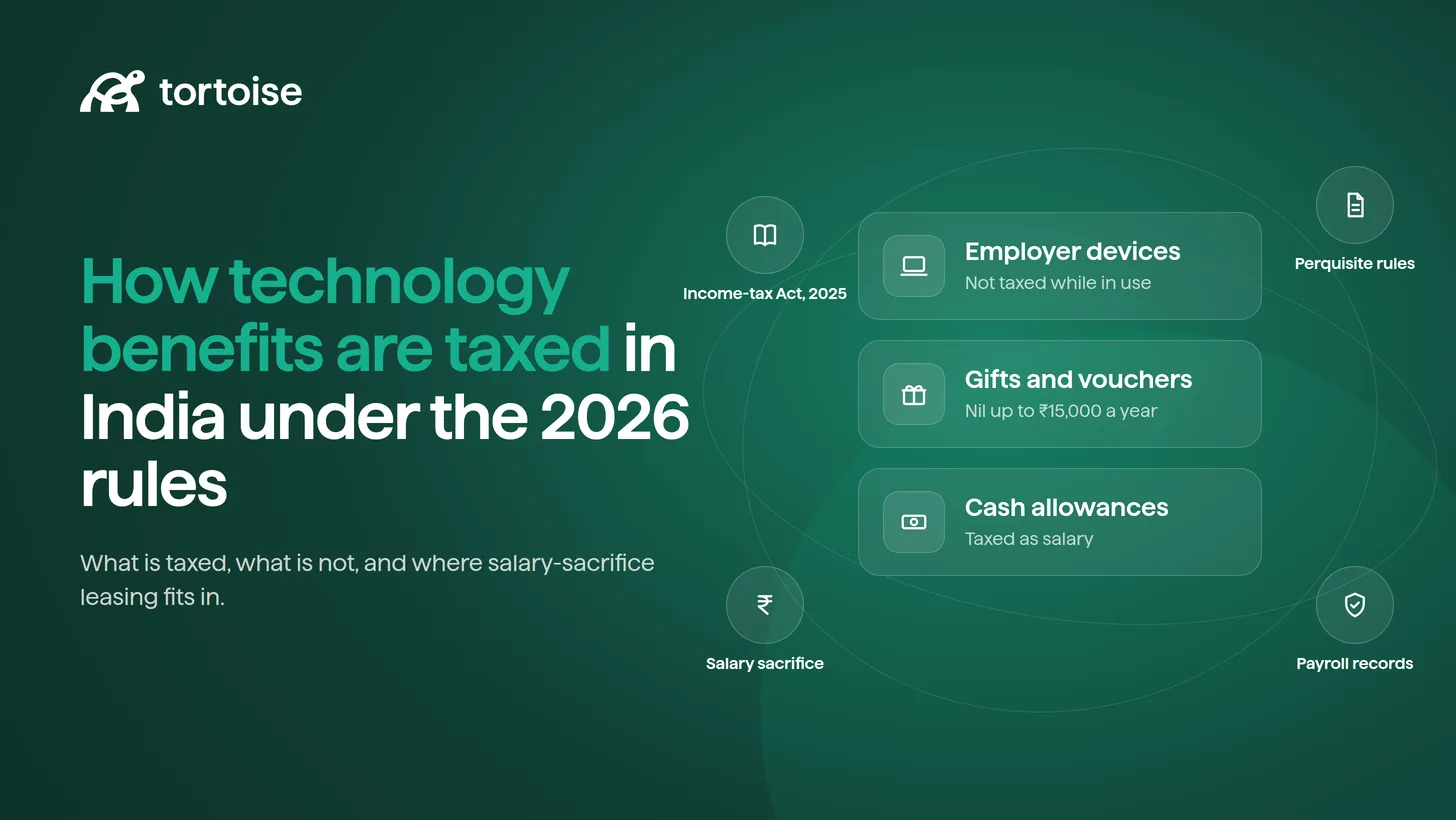
This is the core difference in device leasing vs gadget allowance in India. A gadget allowance pays cash. A structured employer leasing model for electronics provides the device through an employer-linked arrangement and documents how payroll, ownership, use, and end-of-lease treatment work.
Income-tax treatment: cash allowance, laptops, and other electronics
Cash gadget allowance
A fixed cash gadget allowance paid to an employee is generally treated as salary. The Income Tax Department’s income-source guidance lists several cash salary components and allowances as taxable, which supports the conservative payroll position that a cash device allowance should not be described as tax-free unless it qualifies under a specific exemption or valid reimbursement structure.
This makes a cash allowance simple but weak from a tax-efficiency standpoint. The employee receives the allowance, pays tax according to their slab, and then buys the device from post-tax income. For high-slab employees, that can materially increase the effective cost of the device.
Employer-provided laptops and computers
Employer-provided laptops and computers receive more favourable treatment under the Rule 3 perquisite framework. Rule 3(7)(vii) covers the valuation of employer-owned or employer-hired movable assets, but the official Income Tax Rule 3 text applies that movable-asset valuation rule to assets “other than laptops and computers.”
The Income Tax Department’s perquisite guidance also indicates that a computer or laptop provided by the employer is generally not taxable as a perquisite in the relevant employer-provided context.
That is why laptops and computers are the strongest categories for a salary sacrifice device leasing program. When the device is employer-owned or employer-hired, the lease is documented, and payroll treatment is correct, the benefit may reduce taxable salary without a corresponding taxable perquisite in qualifying laptop or computer cases.
Phones, tablets, and other electronics
Phones, tablets, accessories, and other electronics should be reviewed separately. They may need different perquisite, reimbursement, or valuation treatment depending on the device, purpose, documentation, and employer policy. Employers should avoid using the laptop/computer rule as a blanket rule for every gadget.
Payroll example: cash allowance vs eligible lease recovery
Assume an employee wants to buy an iPhone priced at ₹1,45,000 and the employer is comparing two benefit structures: a cash gadget allowance versus an eligible employer-linked device lease.
This example uses a 30% income-tax slab and 4% health and education cess, with no surcharge. It is a simplified illustration; actual payroll treatment for phones should be reviewed separately because phones do not automatically receive the same treatment as laptops or computers.
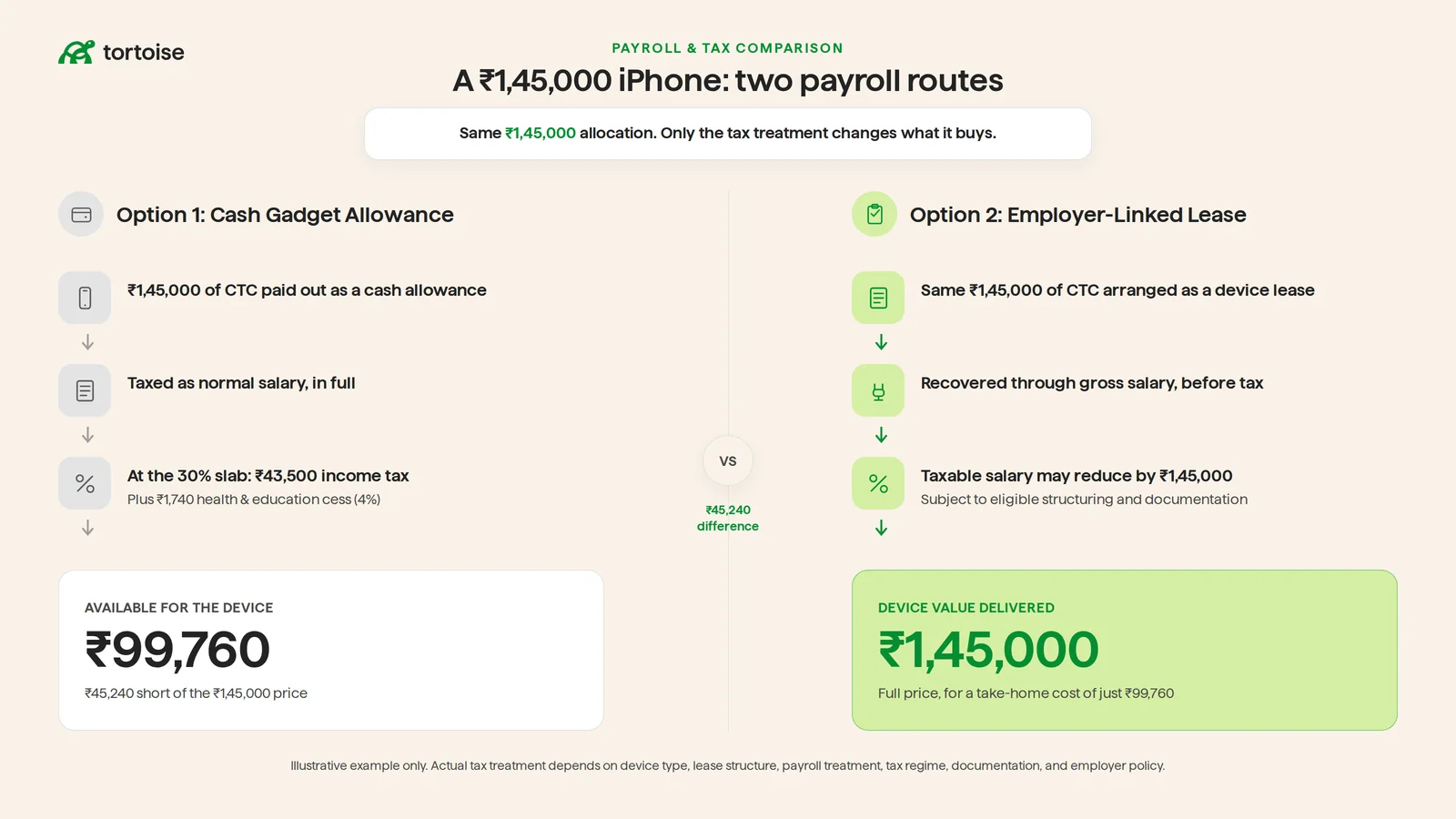
Under the cash gadget allowance option, the employer pays ₹1,45,000 as additional cash salary or allowance. That amount generally becomes taxable salary for the employee. At a 30% slab, the income-tax liability on this allowance is ₹43,500.
After 4% cess, the total tax impact becomes ₹45,240. In practical terms, the employee receives only about ₹99,760 after tax from the ₹1,45,000 allowance and still needs to fund the full iPhone purchase price from post-tax money.
Under an eligible employer-linked lease option, the ₹1,45,000 device value may be recovered through gross salary/CTC instead of being paid as taxable cash. If the device category, ownership or hiring structure, lease documentation, employee consent, residual-value terms, and payroll treatment are all correct, taxable salary may reduce by ₹1,45,000.
At a 30% slab, that can reduce income-tax liability by ₹43,500. After 4% cess, the possible tax saving is ₹45,240.
Put simply, the same ₹1,45,000 device cost may create a tax liability of about ₹45,240 under the cash allowance route, while a correctly structured eligible lease may reduce tax by about ₹45,240 instead.
This difference is the main reason HR and payroll teams evaluate salary sacrifice device leasing. The employee is not being given extra cash to buy a gadget. The device cost is being built into a documented employer-linked benefit and recovered through payroll.
However, this is not a guaranteed outcome. If the device is not eligible, if the documentation is weak, or if the phone is treated as a taxable perquisite, the benefit may reduce or disappear.
Old and new tax regime choices should also be reviewed separately from the employer’s perquisite and payroll treatment, because an employee’s final tax outcome depends on both personal tax facts and company-level benefit design.
Pre-launch checklist for HR and payroll teams
Before launching a salary sacrifice device program, employers should confirm five things:
- The policy should define eligible employees, device categories, value limits, approvals, exit handling, and end-of-lease terms.
- The tax position should be reviewed by qualified advisors for each device category, especially where the program includes phones, tablets, or non-laptop electronics.
- Payroll should be configured so lease recoveries, CTC mapping, and monthly reconciliation are consistent.
- Employees should give clear consent before deductions begin.
- Finance should maintain a clean audit trail with lease agreements, invoices, payroll records, device records, insurance documents, and transfer or residual-value records.
Step-by-step workflow for employers
A salary sacrifice program for corporate electronic devices should start with policy design. HR, finance, payroll, legal, and tax teams should agree which employees are eligible, which device categories are allowed, what value limits apply, and how approvals will work.
The employer then needs lease documentation, supplier or lessor invoices, employee consent, payroll mapping, and HRMS integration. Payroll should know when deductions begin, how monthly lease recoveries are recorded, how changes are handled, and how reconciliation will be done.
Exit and end-of-lease rules should be documented before launch. If an employee resigns during the lease, the policy should explain foreclosure, full-and-final recovery, device handover, or purchase options. At the end of the lease, the residual value and ownership transfer process should be clearly recorded.
A platform-led program helps because these steps are recurring, not one-time. Every device order, deduction, claim, repair, exit, and ownership transfer needs a reliable trail.
Common mistakes to avoid
The biggest mistake is treating all gadgets like laptops. Laptops and computers have a stronger position under the Rule 3 framework; phones, tablets, and other electronics need separate review.
Employers should also avoid calling the benefit “tax-free” without qualification. A safer and more accurate phrase is “tax-efficient when structured correctly.” Other mistakes include skipping employee consent, using weak residual-value terms, relying on manual payroll files, leaving exit recovery unclear, maintaining poor audit records, and launching without tax or legal review.
How Tortoise supports salary sacrifice device programs
Tortoise helps Indian employers run salary sacrifice device leasing programs with the controls HR and payroll teams need. The platform brings together policy rules, employee eligibility, a device marketplace, approvals, payroll and HRMS integration, insurance and care, support workflows, lifecycle records, and end-of-lease ownership handling.
Employees can see their eligible devices and estimated salary impact before they order. Employers get a managed process instead of separate vendor, payroll, claims, insurance, and exit workflows.
For a deeper operating view, read our guide on how employee device leasing works in India.
If you would rather see the payroll side for your own setup, our team is happy to go through it with you.
Make the device benefit efficient before making it visible
Salary sacrifice for corporate electronic devices in India works best when the benefit is designed with payroll and compliance in mind. A cash allowance is easy to launch, but it is usually taxed as salary. A structured employer-leasing model can give employees better economics and give employers a cleaner audit trail.
Disclaimer: This article is intended for general informational purposes only and should not be treated as legal, tax, payroll, or accounting advice. Applicability of employee benefit laws in India depends on factors such as establishment type, employee category, wage levels, location, headcount, and employment terms. Tax treatment may also vary depending on program structure, documentation, payroll processing, and the employee’s applicable tax regime. Employers should consult their legal, tax, and payroll advisors before implementing or modifying any employee benefit programme.
Frequently asked questions
Is salary sacrifice legal in India?
Salary sacrifice can be used in India as part of CTC design, but the tax result depends on how the benefit is structured, documented, and processed through payroll. Employers should take tax and legal advice before launch.
Is a cash gadget allowance taxable?
A fixed cash gadget allowance is generally taxable as salary unless it qualifies under a specific exemption or valid reimbursement structure.
Is a laptop lease taxable?
Employer-provided laptops and computers can receive favourable nil perquisite treatment when the employer-owned or employer-hired structure is properly documented. The lease recovery and payroll treatment should still be reviewed by the employer’s advisors.
What happens if the employee exits?
The employee device leasing policy should define foreclosure, full-and-final recovery, device return or purchase options, and the end-of-lease ownership process. If you use a platform like Tortoise, all of this is managed and available for you in one place.
Written by
Founder & CEO
Vardhan Koshal is the Co Founder of Tortoise, India’s fastest growing employee device benefit platform. He has led India growth and product for companies like TripAdvisor and Udacity, and earlier founded Ridingo, a car pooling startup recognised by Forbes as one of the Hottest Global Startups and acquired by Carzonrent. At Tortoise he works with HR leaders, CFOs and tax experts to design compliant, high impact device benefit programs for Indian employers.