Best Corporate Device Benefit Software in India (2026)

At a glance: The best corporate device benefit software in India runs the full programme, from the device catalogue and approvals to payroll deductions, insurance, exits, and the transfer of ownership. Providers differ most on payroll integration, risk cover, and tax review, so those three points decide most comparisons in 2026.
The best corporate device benefit software for an Indian employer is the one that runs every stage of the programme after the device is ordered. That means payroll deductions, insurance claims, exits, and the transfer of ownership at the end of the lease. Most providers look similar at the ordering stage, so a useful comparison starts with what happens after it.
The market in 2026 has five broad types of provider, each built for a different job. This guide compares them, sets out the features that separate strong platforms from weak ones, and gives HR, finance, and IT a scorecard they can use together.
We have grouped providers by type instead of ranking named companies. The right choice depends on what your company needs the programme to do. The same provider can be the best fit for one employer and the wrong fit for another.
The main types of device benefit software
Device benefit software in India falls into five types, and each one handles payment, risk, and ownership differently. The table below compares them on the points that matter most to employers:
| Provider type | Built for | How employees pay | Risk cover | Who owns the device at the end |
|---|---|---|---|---|
| Brand EPP portal | Discounts from one device maker | Full price from post-tax salary | Bought separately | Employee, from the day of purchase |
| Benefits suite with a device module | Companies that want devices inside a wider benefits or expense tool | Varies by provider | Varies by provider | Varies by provider |
| Protection-led EPP | Phones bought through the employer with device protection | Usually monthly salary deductions | Strong on damage and theft | Usually the employee |
| Rental or Device-as-a-Service | Company-controlled fleets that are returned at the end of a term | Usually funded by the company | Included in the service | The provider |
| Dedicated device benefit platform | A full device benefit run through payroll | Monthly rental from gross salary | Damage, theft, and often absconding | The employee, at the end of the lease |
Brand portals from device makers such as Apple, Samsung, Lenovo, and Dell are the simplest to offer, and our list of corporate EPPs in India covers them in detail. Benefits suites suit companies that want one login for many perks. Protection-led programmes are strongest for phones, and rental suits IT teams that want devices back. A dedicated platform is built for the case where employees choose and keep their devices, with the employer paying nothing.
The labels overlap in vendor pitches, so the same product can be called Smart EPP, device leasing, or device-as-a-benefit. Our explainer on Smart EPP, leasing, and DaaS sorts out what each term means.
Features that separate the best platforms
Most device benefit software lists the same features, so the useful question is how well each one works in practice. The table below shows what good looks like for each feature, and the warning sign to watch for in a demo:
| Feature | What good looks like | Warning sign |
|---|---|---|
| Payroll and HRMS integration | Eligibility checks and deduction data flow automatically each cycle | Monthly deduction files sent by email |
| Insurance and device care | Cover for accidental damage, theft, and absconding, with repairs arranged for the employee | Damage cover only, or cover the employee must buy separately |
| Exit handling | Remaining dues settled through full and final settlement, with a clear option to buy the device | No written process for resignations |
| Tax structure | Reviewed by named external tax advisors, with documents updated for the 2026 Rules | Savings claims with no review behind them |
| Employee app | A catalogue within policy limits and a calculator showing the monthly deduction and net saving | Prices shown without the deduction or saving |
| Reporting and audit trail | One record of orders, consent, deductions, and device status | Reports assembled by hand on request |
| Security | Recognised certifications, such as ISO 27001 and SOC 2, and a clear data agreement | No certifications, or vague answers about where data goes |
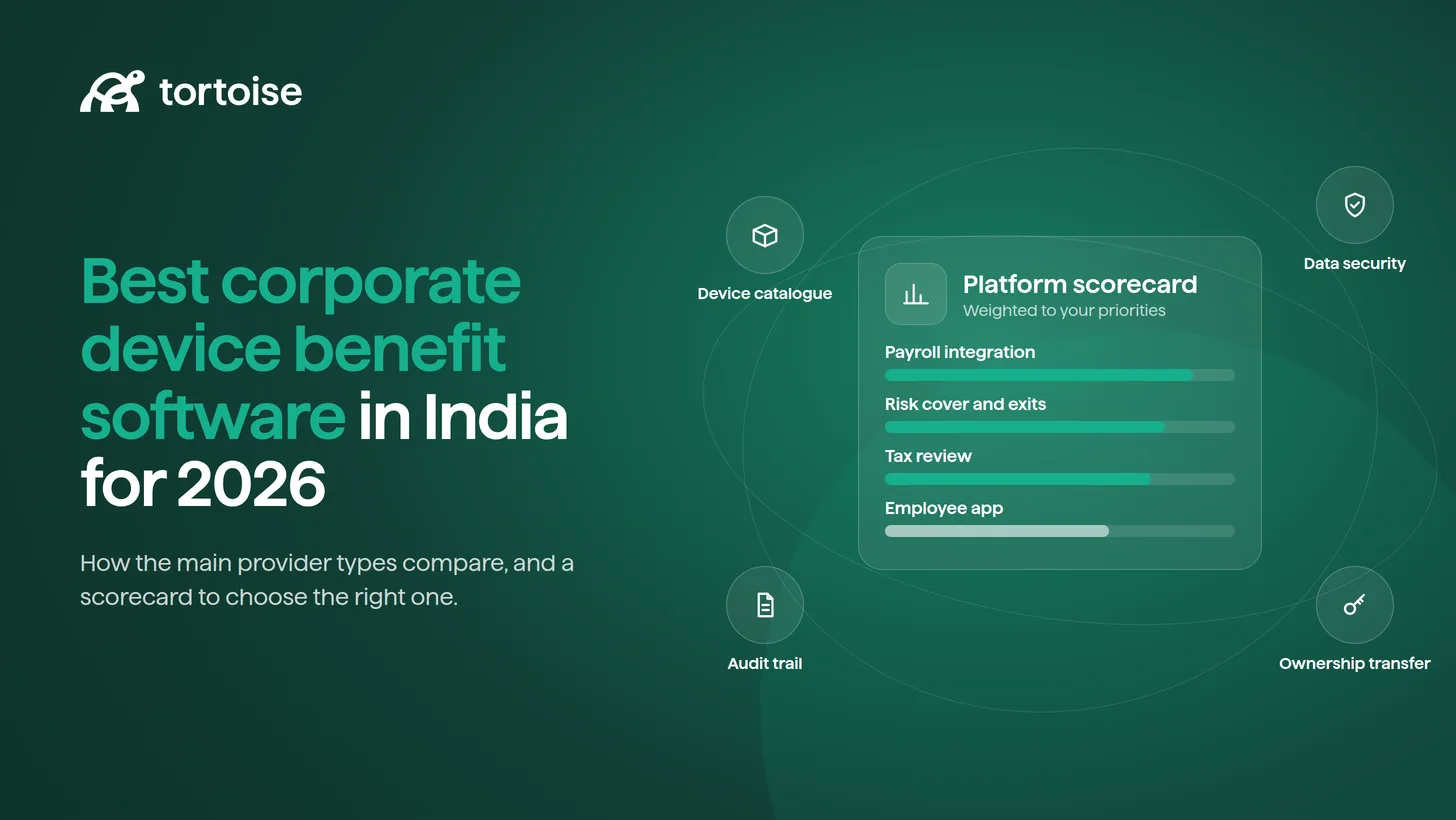
Payroll integration, risk cover, and the tax structure deserve the most weight. A platform that is weak on any of these three creates work for payroll, losses for finance, or questions from auditors long after launch.
How to score device benefit software
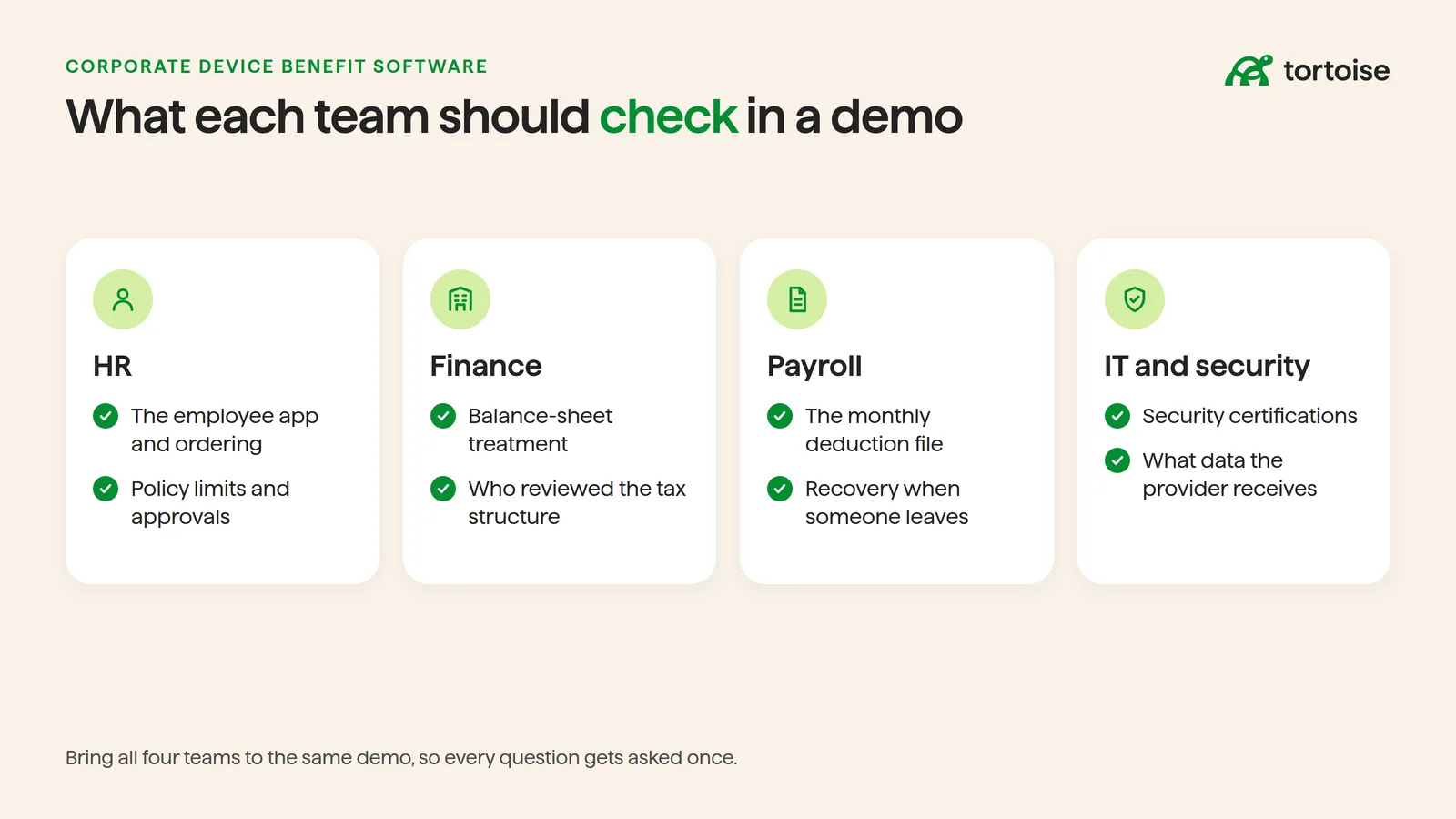
A simple weighted scorecard helps HR, finance, and IT compare providers on the same terms. Score each provider from 1 to 5 on these criteria, then multiply by the weight you want to associate with them:
| Criterion | Suggested weight | Who should score it |
|---|---|---|
| Payroll and HRMS integration | 20% | Payroll and HR |
| Risk cover and exit handling | 20% | Finance and HR |
| Tax structure and external review | 20% | Finance and tax |
| Employee experience | 15% | HR, with a few employees |
| Device catalogue and delivery | 10% | HR and IT |
| Security and data handling | 10% | IT and security |
| Reporting and audit trail | 5% | Finance |
Set the weights before the demos based on what matters most to your team. If employee experience is the priority, give it more weight. If audit readiness matters more, increase reporting. That way, your scores reflect your needs instead of the strongest sales pitch.
What 2026 changes for device benefit buyers
From 1 April 2026, employee perquisites are taxed under the Income-tax Act, 2025 and valued under the Income-tax Rules, 2026, which replaced the 1961 Act and the 1962 Rules. The government's stated aim was to simplify the law without changing the underlying tax policy, so the main treatment of device benefits has carried over.
What has changed is the numbering and the paperwork. Ask each provider whether its device policy, payroll setup, and tax review now refer to the 2025 Act and the 2026 Rules. A provider still quoting only the old sections may not have reviewed its structure since the change.
Tax outcomes depend on the structure and on each employee's situation, so confirm the treatment with your finance or tax team before you sign.
Which provider type suits which company
Each provider type suits different companies. Here is a rough guide to matching them:
- A small team that wants a quick perk with no payroll work can start with a brand EPP portal
- A company already using a benefits suite may find its device module enough for occasional purchases
- A company that mainly wants phones with strong protection can look at a protection-led programme
- An IT team that wants to own the fleet and take devices back should look at rental or Device-as-a-Service
- A company with a large salaried workforce that wants real savings, employee ownership, and no cost to run the programme is the case a dedicated device benefit platform is built for
Most mid-sized and large employers in India fall into the last group, which is why dedicated platforms have grown as a category. Our guide to what a device benefit platform is explains how one works from end to end.
Where Tortoise fits among the options
Tortoise is an employee device benefit platform built for Indian employers. It brings leasing, device supply, insurance, payroll and HRMS integration, and claims onto one platform, so HR, finance, and IT work from the same system.
Employees can save up to 40% on their devices, depending on their tax slab, and own the device at the end of the lease. The employer carries no running cost and no balance-sheet liability. Tortoise Corporate Care covers accidental and liquid damage, theft, and absconding, and early exits are settled through full and final settlement.
The tax structure was evaluated by Deloitte India and Lakshmikumaran & Sridharan, and the platform is ISO 27001 and SOC 2 certified. Tortoise focuses on devices alone, so it is not the right choice for a company that wants every benefit inside one tool.
If you are building a shortlist, our team would be glad to take you through how Tortoise handles each point on the scorecard.
Pick software that runs the whole lease
Device benefit software is easy to compare on the day of the demo and harder to judge two years later, when employees resign, devices break, and leases end. The scorecard above keeps attention on those later moments, which are where the differences between providers show.
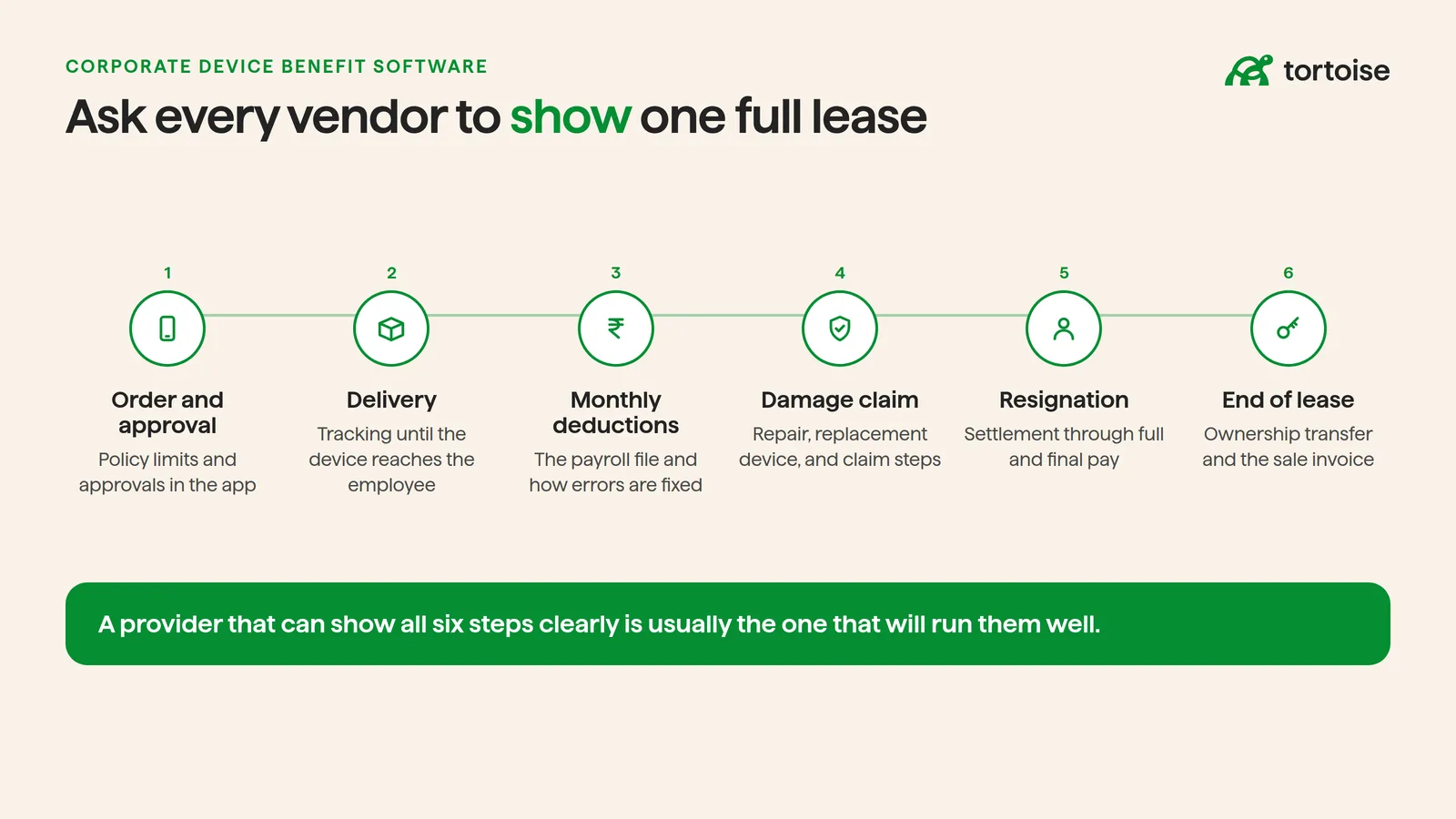
Before you sign, ask each shortlisted provider to walk through one complete lease, from the first order to the final deduction and the transfer of ownership. A provider that can show every step clearly is usually the one that will run them well. Our list of questions to ask a provider covers the rest of that conversation.
Disclaimer: This guide is intended for general informational purposes only and should not be treated as legal, tax, payroll or accounting advice. Applicability of employee benefit laws in India depends on several factors, including the nature of the establishment, employee category, wage levels, location, headcount, employment terms and applicable central and state laws. Tax treatment of benefits may also vary depending on the structure adopted, documentation, payroll processing and the employee's applicable tax regime. Employers should consult their legal, tax and payroll advisors before implementing or modifying any employee benefit programme.
Frequently asked questions
What is the best corporate device benefit software in India?
The best option is the one that runs the whole programme after the order, including payroll deductions, insurance, exits, and ownership transfer. For companies with a large salaried workforce that want employees to save and own their devices at no cost to the employer, a dedicated employee device benefit platform is usually the strongest fit. Smaller teams may start with a brand EPP portal.
How is device benefit software different from an employee benefits platform?
An employee benefits platform manages a broad menu of perks such as insurance, meal cards, and allowances. Device benefit software focuses on one benefit, letting employees lease phones, laptops, and tablets through salary deductions, with insurance, exits, and ownership transfer handled inside the programme. Many companies run both side by side.
Does corporate device benefit software cost the employer anything?
A managed device benefit platform has no running cost for the employer. Employees fund their devices through monthly salary deductions, the lease stays off the employer's balance sheet, and insurance covers damage, theft, and absconding. Brand EPP portals also cost the employer nothing, but employees pay the full price from post-tax salary.
Which features matter most when comparing device benefit platforms?
Payroll and HRMS integration, risk cover with clear exit handling, and an externally reviewed tax structure matter most, because weaknesses there create payroll work, losses for finance, or audit questions after launch. The employee app, the device catalogue, security certifications, and reporting come next in most comparisons.
Is device leasing through these platforms tax-free?
No. Device leasing through a salary-sacrifice structure is tax-efficient, not tax-free. The rental comes out of gross salary, which lowers taxable income, and GST is handled within the leasing structure. Employees can save up to 40%, depending on their tax slab, and the outcome depends on how the programme is structured.
Should startups and mid-size companies use a dedicated device benefit platform?
Dedicated platforms work best for companies with a large salaried workforce, usually 1,000 employees or more, because setup includes a credit assessment and lease agreements. Fast-scaling companies can use one if their payroll supports pre-tax deductions. Very small teams may find a brand EPP portal simpler to start with.
Written by
Founder & CEO
Vardhan Koshal is the Co Founder of Tortoise, India’s fastest growing employee device benefit platform. He has led India growth and product for companies like TripAdvisor and Udacity, and earlier founded Ridingo, a car pooling startup recognised by Forbes as one of the Hottest Global Startups and acquired by Carzonrent. At Tortoise he works with HR leaders, CFOs and tax experts to design compliant, high impact device benefit programs for Indian employers.