What Is an Employee Device Benefit Platform? Definition, Features, and Who Needs One

At a glance: An employee device benefit platform lets employers offer phones, laptops, and tablets as a salary-linked benefit. It costs the employer nothing to run and keeps devices off the balance sheet. Employees can save up to 40%, depending on their tax slab, and usually own the device at the end of the lease, typically for ₹1. It suits Indian employers with large salaried teams.
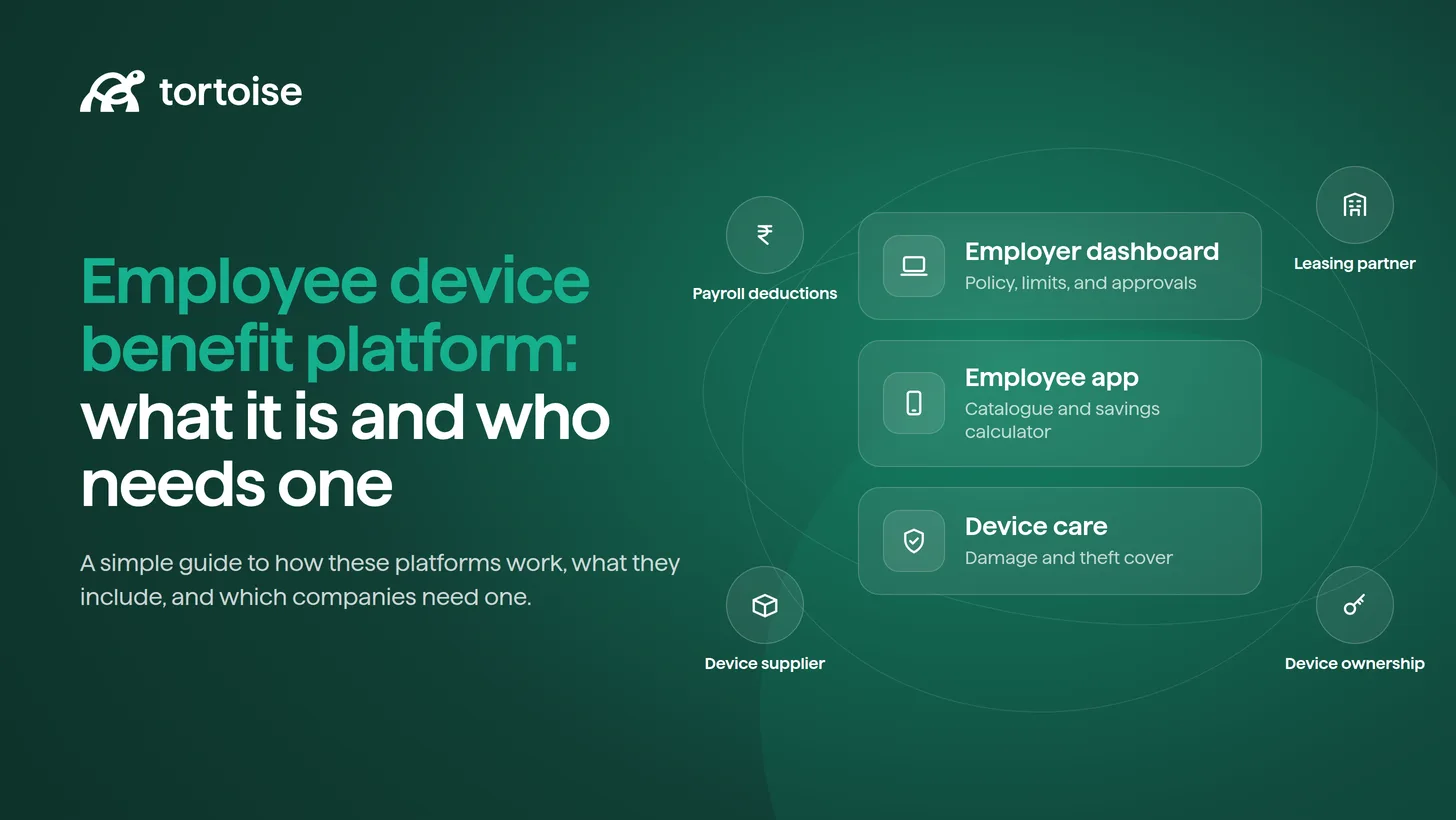
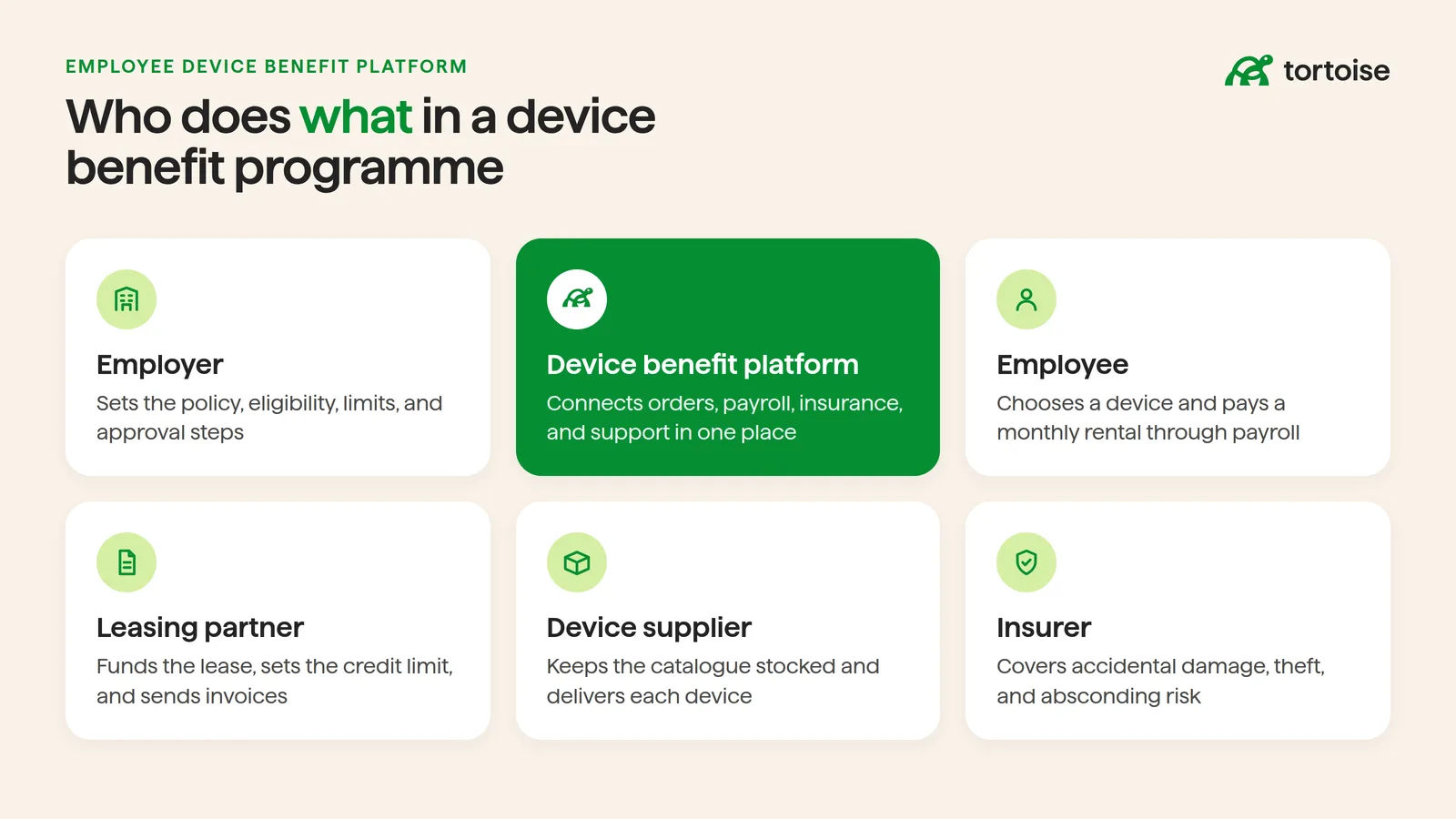
An employee device benefit platform is the system a company uses to run a device benefit from the first order to the final payroll deduction. It connects the employer, its employees, a leasing partner, device suppliers, and an insurer. Employees get the devices they want through salary deductions, while the employer pays nothing upfront and keeps the devices off its balance sheet.
This category is narrower than the employee benefits platforms most HR teams already use. Other platforms manage a broad menu of perks such as insurance, meal cards, and flexible allowances, and they do that job well. A device benefit platform focuses on one benefit in detail instead, turning a personal device purchase into a structured, tax-efficient programme that ends with the employee owning the device.
For employees, the appeal is a lower effective price and a wider choice of devices. The monthly rental is deducted from gross salary, so the effective cost of a device can fall by up to 40%, depending on the employee's tax slab. For employers, the appeal is a benefit employees can see and use, with no running cost and no long-tail device risk, because the leasing partner and insurer carry it.
Device benefit platforms vs general benefits platforms
A platform built for device benefits has to do three things that a general benefits portal usually does not:
- Let employees choose devices within limits set by company policy
- Recover the cost through payroll in a way that holds up to tax review
- Cover risk across the device's life, including damage, theft, and early exits
If any one of these is missing, the programme develops gaps that HR or finance end up handling by hand. A catalogue without payroll recovery works like a discount store. Payroll recovery without insurance means the employer pays for the loss when a device breaks or an employee stops showing up. Insurance without a clean exit process creates disputes every time someone resigns mid-lease.
So a device benefit platform is an operating model with software on top. The software gives HR a dashboard and employees an app, while most of the value comes from the partners and agreements behind it. A leasing partner provides the financing, suppliers deliver the devices, an insurer carries the risk, and contracts define who does what.
Vendors describe the same idea in different ways, including Smart EPP, device leasing, salary sacrifice devices, and device-as-a-benefit. Our explainer on Smart EPP, leasing, and DaaS explains what each of these labels means, which helps if you are comparing proposals that use different terms.
How an employee device benefit platform works
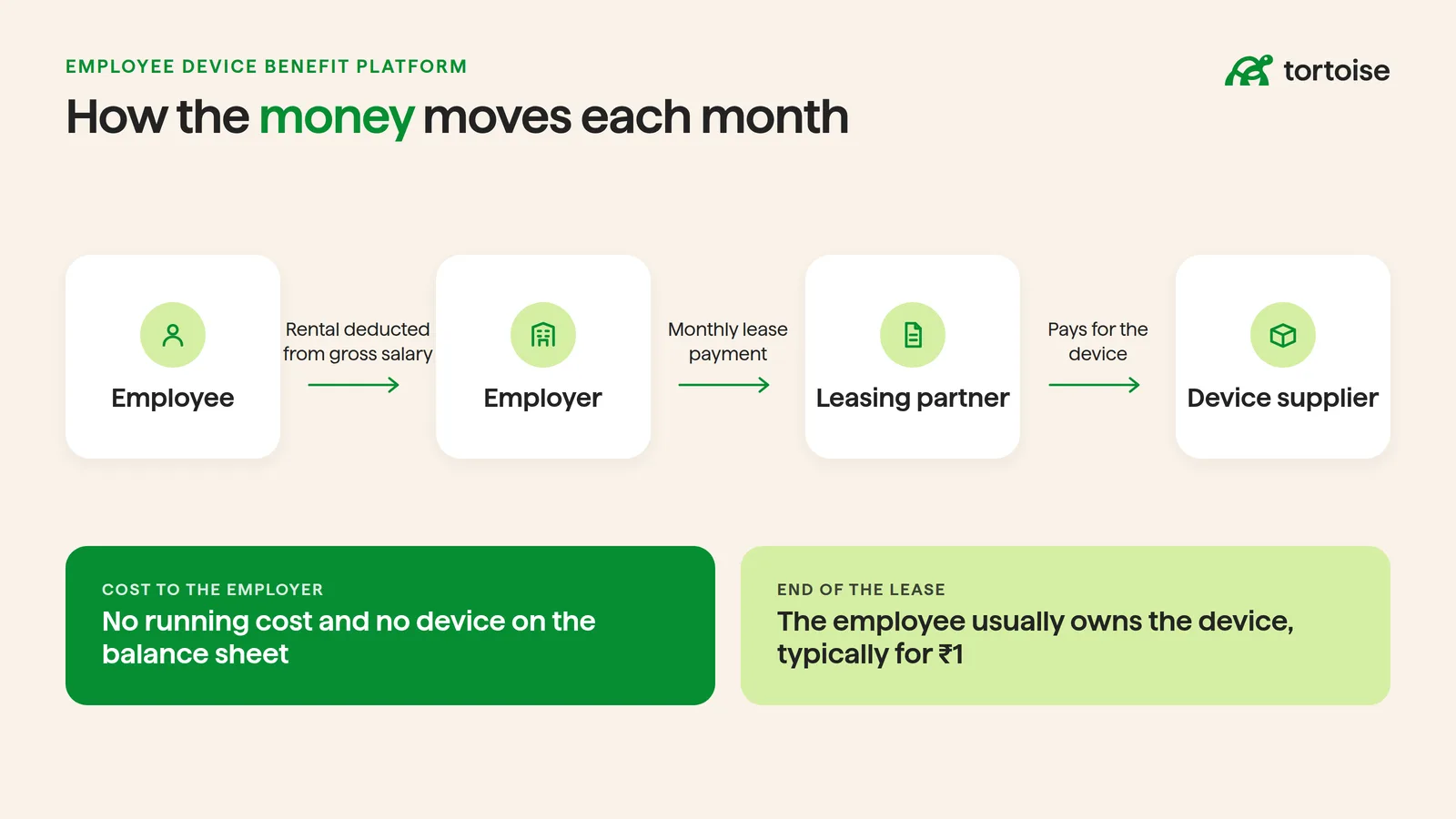
Most programmes follow the same four stages once the employer has signed up:
- The employer sets the policy, including who is eligible, which devices are allowed, and the spending limit for each grade
- An employee browses the catalogue, sees the monthly deduction and net saving, and places an order that goes through internal approval
- The leasing partner checks the order against the company's credit limit, the supplier delivers, and salary deductions begin after delivery
- At the end of the lease, ownership passes to the employee, typically for ₹1, with a sale invoice issued in the app
A few setup steps happen once, before the first order. The leasing partner assesses the company's financials and sets a credit limit. The employer then signs a lease agreement with the lessor and a service agreement with the platform, and payroll is aligned so deductions land in the right cycle. Our guide on how device leasing works walks through each stage in more detail.
Features every device benefit platform should have
Feature lists across vendors look similar at first glance, but how far each feature goes is different. The table below compares the features a complete platform should offer and the teams that rely on each one:
| Feature | What it does | Who relies on it |
|---|---|---|
| Employer dashboard | Sets policy, eligibility, limits, and approval workflows, with order tracking and reports | HR, finance, and IT |
| Employee app and catalogue | Lets employees browse eligible devices and accessories and order within their limit | Employees |
| Savings calculator | Shows the monthly deduction, effective price, and net salary impact before ordering | Employees and HR |
| Payroll and HRMS integration | Checks eligibility and sends deduction data automatically each cycle | Payroll and HR |
| Digital approvals and consent | Routes orders to managers or HR and stores signed policies with an audit trail | HR and legal |
| Insurance and device care | Covers accidental damage, liquid damage, theft, and repairs | Employees and finance |
| Exit handling | Settles remaining dues through full and final settlement and covers absconding risk | HR and finance |
| Reporting and audit trail | Gives finance and IT one record of orders, deductions, and device status | Finance and IT |
Payroll integration and exit handling separate strong platforms from weak ones. Manual deduction files create errors that grow with every new order, so a programme without real integration rarely scales past a pilot. Exits are where a weak programme turns into a loss, because when an employee resigns or absconds, someone has to cover the lease payments that are still due.
Device benefits vs EPPs, DaaS, and reimbursement
Most companies already handle work devices somehow, so the useful comparison is with what they do today. Each alternative has a place. Brand employee purchase programmes are quick to set up and cost nothing to administer. Device-as-a-Service suits IT teams that want to keep ownership and take devices back at the end of a term. Reimbursement is familiar and needs no new vendor.
The table below compares these options on payment, ownership, effort, and tax efficiency:
| Option | How employees pay | Who owns the device | Employer effort | Tax efficiency for employees |
|---|---|---|---|---|
| Brand EPP or corporate discount | Discounted price from post-tax income | Employee | Low | Limited |
| Reimbursement | Employee buys, then claims under policy | Varies by policy | High, through claims and checks | Depends on structure and records |
| Company-owned devices | No payment, as the company buys the device | Company | High, through CapEx and asset tracking | Not applicable |
| Device-as-a-Service | Usually funded by the company | Service provider | Medium | Not usually a goal |
| Employee device benefit platform | Monthly lease rental from gross salary | Lessor during the lease, employee at the end | Low once live | Up to 40%, depending on tax slab |
A device benefit platform is the better choice when the company wants employees to choose and own their devices without the employer funding them. It is the wrong fit when the company needs a fleet of identical machines that come back at the end of a term, which is the job Device-as-a-Service is built for. If reimbursement is your current model, our comparison of reimbursement and leasing covers the trade-offs in more depth.
Which companies need a device benefit platform?
These platforms are built for Indian employers, because the savings come from how Indian payroll and tax rules treat salary deductions. Within India, the strongest fit usually looks like this:
- Mid-sized and large companies, usually with 1,000 or more salaried white-collar employees
- Sectors where modern devices shape daily work, such as IT and ITeS, BFSI, consulting, professional services, GCCs, and pharma
- Companies competing for talent that want a visible benefit without adding to the benefits budget
- Finance teams wary of capital spend on devices or tired of reimbursement claims
- Employers whose payroll can support pre-tax deductions, with or without a connected HRMS
Hybrid and distributed teams are a natural fit as well, since a reliable personal device matters more when people are not working from one office.
The model fits poorly in a few cases. Very small teams often get more from a simple brand discount, because the setup steps, including a credit assessment and lease agreements, carry fixed effort. Workforces whose pay structure does not suit pre-tax salary deductions will see little of the saving, and companies outside India cannot use the Indian tax structure at all.
Benefits for HR, finance, IT, and employees
A device benefit touches several teams, and it should be judged differently for each one.
HR gets a benefit employees understand without a long explanation. It supports hiring and retention conversations, and the platform handles policy drafting, delivery, and support, so a small HR team does not take on another vendor to manage.
Finance gets a benefit with no CapEx, no device assets to depreciate, and predictable treatment. The lease is short-term, and the asset is not capitalised by the employer, so devices stay off the balance sheet, and every order and deduction leaves a digital record.
IT and security get a clear support model for devices they do not own. Repairs, replacements, and claims go through the platform's support team, and the questions for a vendor centre on security certifications and how integration data flows.
Employees get the device they want, a lower effective price, damage and theft cover, and ownership at the end of the lease. Many employees were planning to buy a phone or laptop anyway, which is why device benefits tend to see real use after launch.
How to choose a device benefit platform
Platforms tend to look alike in a demo, so it helps to test the parts that only matter later. These six checks catch most weak programmes:
- Ask whether credible external tax advisors have reviewed the structure
- Find out who the lessor is and what the lease agreement says about exits
- Check whether insurance covers absconding as well as damage and theft
- Confirm how deductions reach payroll and how errors get reconciled each month
- Try the employee app yourself, from browsing a device to seeing the monthly deduction
- Ask what happens at the end of the lease, including the transfer price and invoice
Of the six, exit handling tells you the most. A provider that answers clearly on resignations, foreclosure, and absconding has usually thought through the rest. Our list of questions to ask a provider goes further for teams close to signing.
How Tortoise runs employee device benefits
Tortoise is an employee device benefit platform built for Indian employers. It brings leasing, device supply, insurance, payroll integration, and claims onto one platform, so HR, finance, and IT work from the same system instead of spreadsheets and email.
Employees can save up to 40% on their devices, depending on their tax slab, and own the device at the end of the lease. The employer carries no running cost and no balance-sheet liability. Tortoise Corporate Care covers accidental and liquid damage, theft, and absconding, and early exits are settled through full and final settlement.
The tax structure was evaluated by Deloitte India and Lakshmikumaran & Sridharan, and the platform is ISO 27001 and SOC 2 certified. Tortoise focuses on devices alone, so companies that want a broad benefits menu would run it alongside their existing benefits platform rather than in place of it.
If your teams are starting to compare platforms, we're happy to help you work out what to prioritise.
Judging a platform by what it runs
The device benefit category is young, and the labels around it still shift from vendor to vendor. That makes the name on a proposal a weak guide to what you are buying. A better guide is what the platform runs on your behalf after launch, from payroll recovery and insurance to exits and ownership transfer.
For Indian employers with a large salaried workforce, a well-run device benefit platform is one of the few benefits that costs the company nothing and that employees can start using in the first month. Most of the effort goes into choosing a provider whose structure and operations keep working through every lease, from the first order to the last deduction.
Disclaimer: This guide is intended for general informational purposes only and should not be treated as legal, tax, payroll or accounting advice. Applicability of employee benefit laws in India depends on several factors, including the nature of the establishment, employee category, wage levels, location, headcount, employment terms and applicable central and state laws. Tax treatment of benefits may also vary depending on the structure adopted, documentation, payroll processing and the employee's applicable tax regime. Employers should consult their legal, tax and payroll advisors before implementing or modifying any employee benefit programme.
Frequently asked questions
Is an employee device benefit platform the same as an employee benefits platform?
No. An employee benefits platform manages a broad menu of perks such as insurance, meal cards, and flexible allowances. An employee device benefit platform focuses on one benefit, letting employees lease phones, laptops, and tablets through salary deductions and own them at the end of the lease. Many companies run both side by side.
Does a device benefit platform cost the employer anything?
With a managed programme, the employer has no running cost. The lease sits between a leasing partner and the programme, employees fund their devices through salary deductions, and leasing and insurance absorb device risk. There is no CapEx, and the devices stay off the employer's balance sheet.
How much can employees save through a device benefit platform?
Employees can save up to 40% on a device, depending on their income tax slab. The saving comes from paying the monthly rental out of gross salary, which lowers taxable income, and from GST being handled within the leasing structure. A savings calculator in the app shows each employee their exact net salary impact.
Are device benefits tax-free in India?
No. A device benefit can be tax-efficient when the programme is structured correctly, but the outcome depends on the employee's tax slab and on how the programme is set up and documented. Employers should confirm the treatment with their own finance and tax teams before launch.
What happens if an employee leaves before the lease ends?
Early exits are usually settled through foreclosure charges collected in the employee's full and final settlement, and the employee can often keep the device by paying the remaining amount. If an employee absconds, programmes with absconding cover use insurance to absorb the loss, so the employer is not left with the cost.
Is a device benefit platform only for large companies?
It works best for companies with 1,000 or more salaried white-collar employees, though fast-scaling companies can use one if their payroll supports pre-tax deductions. Setup includes a credit assessment and lease agreements, so very small teams may find a simple brand discount easier to run.
Written by
Founder & CEO
Vardhan Koshal is the Co Founder of Tortoise, India’s fastest growing employee device benefit platform. He has led India growth and product for companies like TripAdvisor and Udacity, and earlier founded Ridingo, a car pooling startup recognised by Forbes as one of the Hottest Global Startups and acquired by Carzonrent. At Tortoise he works with HR leaders, CFOs and tax experts to design compliant, high impact device benefit programs for Indian employers.