Which Employee Technology Benefits Are Tax-Free in India?

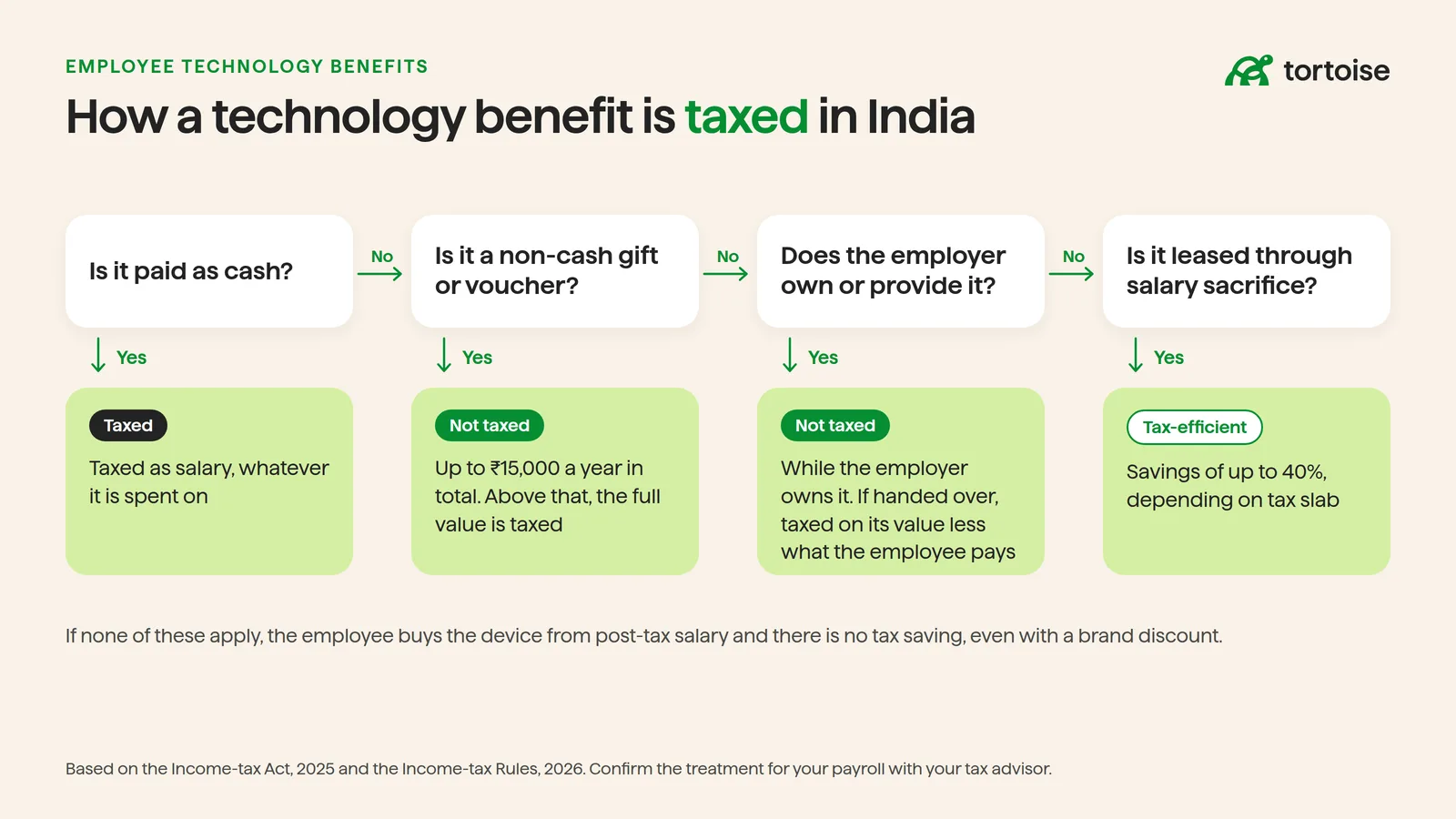
At a glance: Tax-free employee technology benefits in India rest on one condition: the employer owns or provides the device or service. A cash device allowance is taxed in full, a used device handed over to an employee is taxed on its value, and salary-sacrifice device leasing is tax-efficient rather than tax-free, with savings of up to 40%, depending on tax slab.
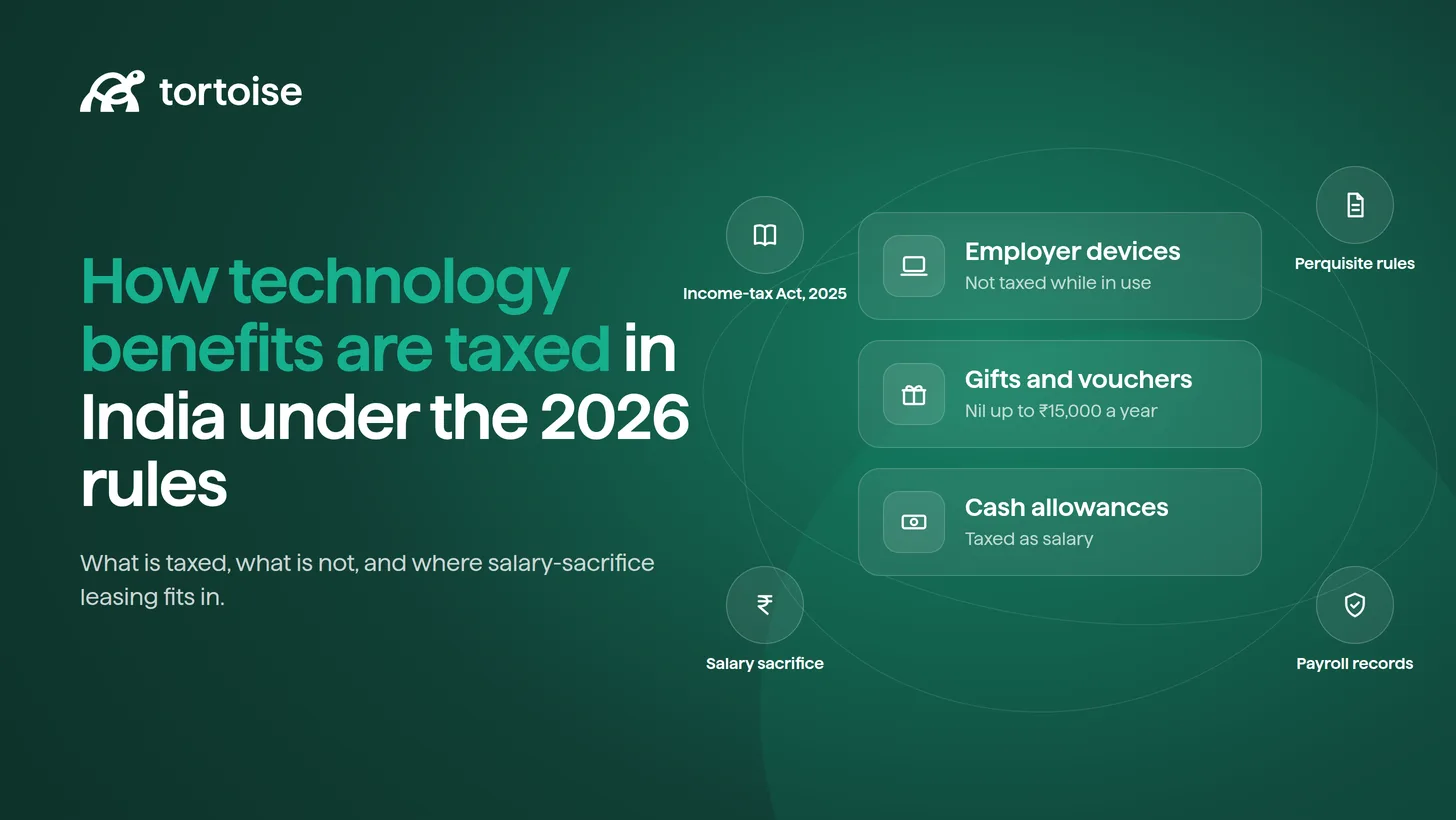
Three employee technology benefits are tax-free in India. An employee pays no tax on using a laptop or computer that the employer owns, or on a mobile or telephone facility the employer provides. Non-cash gifts, such as a gadget voucher, are also tax-free as long as they stay within ₹15,000 a year in total.
Most other ways of giving employees technology carry some tax. A cash allowance for a phone or laptop is taxed as salary, and so is the value of a used device that an employer hands over for free. Device leasing through salary sacrifice sits in between, because it is tax-efficient and the saving depends on the employee's tax slab.
These rules now sit under the Income-tax Act, 2025 and the Income-tax Rules, 2026, which replaced the 1961 Act and the 1962 Rules from 1 April 2026. The table below sums up how each common technology benefit is treated:
| Technology benefit | How it is taxed | Condition |
|---|---|---|
| Use of an employer-owned laptop or computer | Not taxed | The employer owns the device |
| Mobile or telephone facility provided by the employer | Not taxed | The employer provides the facility |
| Non-cash gadget gift or voucher | Not taxed up to ₹15,000 a year in total | The gift is not cash or convertible to cash |
| Cash device or phone allowance | Taxed as salary | Paid as cash, whatever it is spent on |
| Used device handed over to the employee | Taxed on its value, less any amount the employee pays | Valued under the perquisite rules |
| Brand EPP discount | No tax saving | The employee pays from post-tax salary |
| Salary-sacrifice device lease | Tax-efficient, with savings of up to 40%, depending on tax slab | Depends on how the programme is structured and documented |
The table gives you a simple pattern. When the employer owns the device or provides the service, the benefit is usually not taxed. When the employee receives cash, or keeps something the employer paid for, tax usually applies.
How employer-owned laptops are taxed
An employee pays no tax on using a laptop or computer that the employer owns. The Income Tax Department's guidance on perquisites lists the use of an employer's computer or laptop, including peripheral devices, among the perquisites on which nothing is chargeable to tax.
The condition that matters is ownership. If the employer owns the laptop and lets the employee use it, nothing is added to the employee's taxable salary. If the employee owns the laptop, or the employer later hands it over, the treatment changes, as the sections below explain.
The guidance names computers and laptops. For tablets and other devices, confirm the treatment with your tax advisor before you rely on the same exemption.
How employer-provided phones are taxed
A mobile or telephone facility that the employer provides is not taxed as a perquisite. This covers a phone and connection that the employer supplies for the employee to use.
Many payroll teams also treat reimbursement of phone and internet bills, paid against actual invoices, as part of this facility. The records needed for that treatment should be agreed with your tax advisor, because a flat monthly amount paid without bills is treated as a cash allowance instead.
How gadget gifts and vouchers are taxed
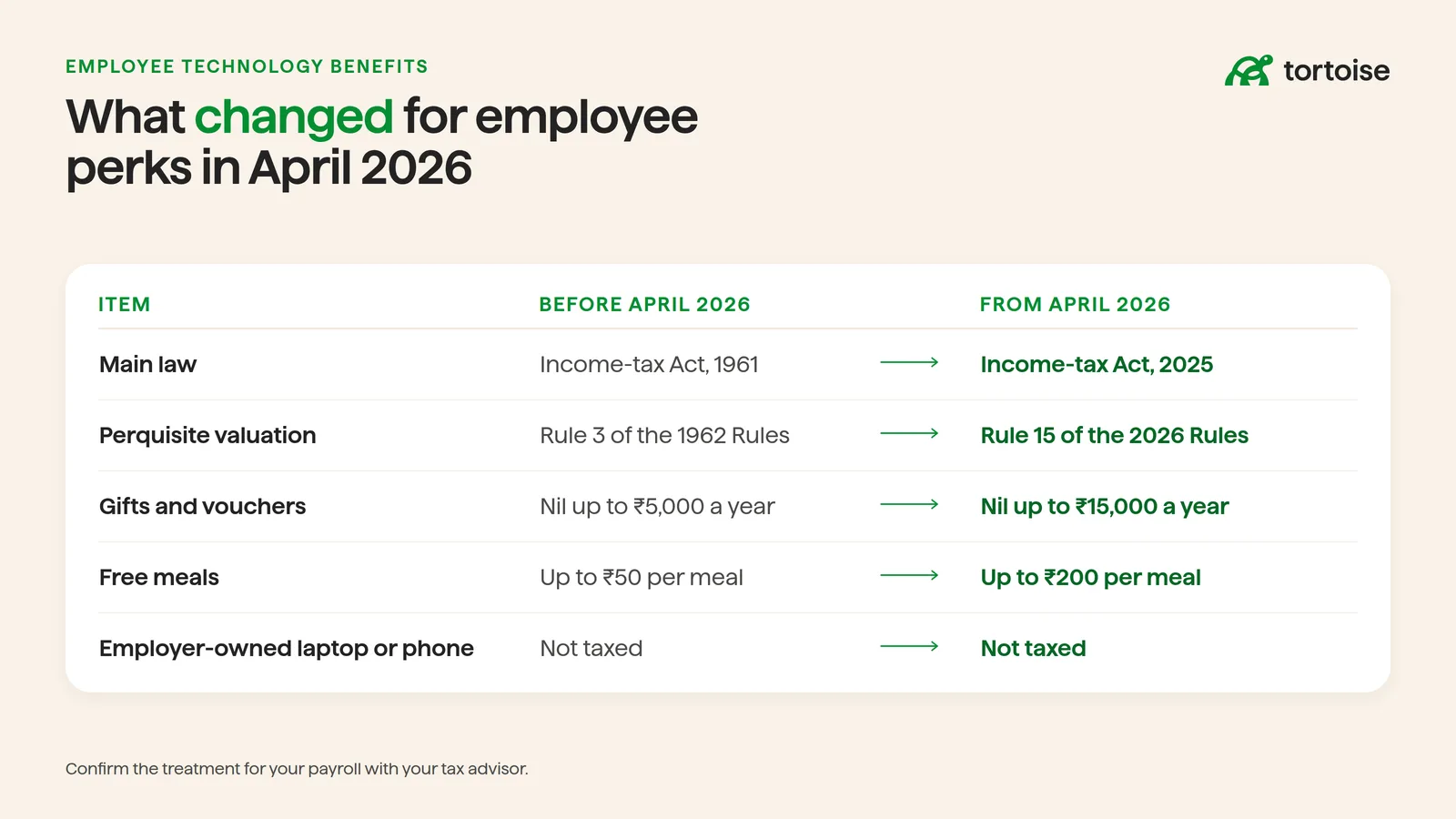
Gifts from an employer, including vouchers and tokens, have a nil taxable value if their total does not exceed ₹15,000 in a tax year. The limit was ₹5,000 under the old rules, and the Income-tax Rules, 2026 raised it.
The limit is a yearly total across all gifts, so a festival voucher and a gadget given on a work anniversary count together. Cash, and anything that can be converted into cash, is taxed as salary, whatever the amount.
For technology, a pair of earphones or a smartwatch voucher can be a tax-free gift. A laptop usually cannot, because its value is well above the yearly limit.
Technology benefits that are taxed as salary
Two common technology benefits are taxed as part of salary, even though they look similar to the tax-free ones.
A phone or laptop allowance paid in cash is taxed in full. Payroll adds it to taxable income like any other allowance, even if the employee spends every rupee on a device.
When an employer gives an employee a used device, free or at a low price, the saving is taxed as a perquisite. The value of that saving is worked out under the perquisite rules, and anything the employee pays for the device is subtracted.
This point matters at the end of any device programme. How a device passes to the employee, and at what price, affects whether a perquisite arises, so employers should check this step with their tax advisor before the first lease ends.
Why brand discounts carry no tax saving
A brand employee purchase programme lowers the price of a device, but it does not lower the employee's tax. The employee pays the discounted price from salary that has already been taxed, so the only saving is the discount itself.
That makes a brand programme quick to offer, since the employer only has to share access to a portal. Our comparison of corporate EPPs in India covers the main brand options and how they differ.
How salary-sacrifice device leasing saves tax
Salary-sacrifice device leasing is tax-efficient, not tax-free. A leasing partner leases the device to the employer, the employer gives it to the employee, and a monthly rental is deducted from the employee's gross salary.
Because the rental comes out before tax, the employee's taxable income falls by the same amount. GST on the device is also handled within the leasing structure, instead of being paid in full by the individual.
Take an employee in the 30% tax slab who pays a monthly rental of ₹4,000 from gross salary. Their taxable income falls by ₹4,000 a month, which lowers their income tax by about ₹1,200 a month before cess. Over a 24-month lease, that comes to about ₹28,800.
With the GST effect included, employees can save up to 40% on a device, depending on their tax slab. However, you should treat any worked figure as illustrative, because the final saving depends on how the programme is structured. Our guide on how device leasing works explains each step of the model.
What changed under the Income-tax Act, 2025
The Income-tax Act, 2025 came into force on 1 April 2026 and replaced the Income-tax Act, 1961. The Income-tax Rules, 2026, notified on 20 March 2026, replaced the 1962 Rules from the same date, according to the CBDT's press release. The government said it aimed to simplify the law without changing the underlying tax policy.
For technology benefits, the main treatment remains the same. What has changed is the numbering and some limits. Perquisite valuation, which sat in Rule 3 of the 1962 Rules, is now in Rule 15 of the 2026 Rules. The yearly limit for tax-free gifts also rose from ₹5,000 to ₹15,000.
Older guides that cite Section 17(2) or Rule 3 describe the previous law. The principles still hold, but payroll and tax teams should check every reference against the 2025 Act and the 2026 Rules before relying on it.
How employers keep device benefits compliant
Most tax problems with device benefits come from weak records rather than from the rules themselves. A few habits keep the treatment clean:
- Record who owns each device, whether that is the employer, a leasing partner, or the employee
- Keep a written device policy that states eligibility, limits, and what happens at exit
- Process rentals and recoveries through payroll, so every deduction has a record
- Track gifts and vouchers against the ₹15,000 yearly limit for each employee
- Agree how a device passes to the employee at the end of a lease, and at what price
Tax outcomes depend on the structure and on each employee's situation, so confirm the treatment with your finance or tax team before launch.
How Tortoise structures employee device benefits
Tortoise is an employee device benefit platform that runs device leasing through payroll for Indian employers. The programme is designed for compliance with the Income Tax Act and GST Act, and its tax structure was evaluated by Deloitte India and Lakshmikumaran & Sridharan.
Employees can save up to 40% on their devices, depending on their tax slab, and own the device at the end of the lease. The employer carries no running cost and no balance-sheet liability. Tortoise handles payroll integration and insurance through Tortoise Corporate Care, and keeps a digital audit trail of every order, consent, and deduction. The platform is ISO 27001 and SOC 2 certified.
If your finance team wants to see how this structure would apply to your payroll, we'd be glad to walk them through it.
Choosing the right technology benefit for employees
For employers, the tax treatment is one input alongside what employees want. Company-owned laptops suit devices used mainly for work. A leasing programme suits employees who want to choose and keep their own phone or laptop, and who are happy to pay for it from gross salary over the lease.
The 2026 Rules are new enough that any device or gift policy written before April 2026 deserves a fresh review. A short check now is far easier than correcting payroll records at the end of the tax year.
Disclaimer: This guide is intended for general informational purposes only and should not be treated as legal, tax, payroll or accounting advice. Applicability of employee benefit laws in India depends on several factors, including the nature of the establishment, employee category, wage levels, location, headcount, employment terms and applicable central and state laws. Tax treatment of benefits may also vary depending on the structure adopted, documentation, payroll processing and the employee's applicable tax regime. Employers should consult their legal, tax and payroll advisors before implementing or modifying any employee benefit programme.
Frequently asked questions
Is an employer-provided laptop taxable in India?
No. Using a laptop or computer that the employer owns is not taxed as a perquisite, so nothing is added to the employee's taxable salary. If the employer later hands the laptop over to the employee, free or at a low price, the value of that saving can be taxed, less anything the employee pays for it.
Is a mobile phone allowance taxable in India?
Yes. A phone allowance paid in cash is taxed in full as salary, whatever the employee spends it on. A mobile or telephone facility that the employer provides is treated differently and is not taxed as a perquisite. Many employers reimburse phone bills against actual invoices instead, with the records agreed with their tax advisor.
How much can an employer give as a tax-free gift in 2026?
From the 2026-27 tax year, non-cash gifts, vouchers, and tokens from an employer have a nil taxable value if their total does not exceed ₹15,000 in the year. The earlier limit was ₹5,000. Cash gifts, and vouchers that can be converted into cash, are taxed as salary whatever the amount.
Is device leasing through salary sacrifice tax-free?
No. Device leasing through salary sacrifice is tax-efficient, not tax-free. The monthly rental comes out of gross salary, which lowers taxable income, and GST is handled within the leasing structure. Employees can save up to 40%, depending on their tax slab, and the final saving depends on how the programme is structured.
Do these tax rules apply under the new tax regime?
In general, yes. The tax-free treatment of employer-owned laptops, phone facilities, and small gifts comes from how perquisites are valued, rather than from deductions that the new regime removes. The ₹15,000 gift limit applies under both regimes. Confirm the treatment for your payroll with your tax advisor before relying on it.
Which law covers employee perquisites from April 2026?
From 1 April 2026, employee perquisites are taxed under the Income-tax Act, 2025, with their valuation set out in the Income-tax Rules, 2026. These replaced the Income-tax Act, 1961 and the Income-tax Rules, 1962. The government's stated aim was to simplify the law without changing the underlying tax policy.
Written by
Founder & CEO
Vardhan Koshal is the Co Founder of Tortoise, India’s fastest growing employee device benefit platform. He has led India growth and product for companies like TripAdvisor and Udacity, and earlier founded Ridingo, a car pooling startup recognised by Forbes as one of the Hottest Global Startups and acquired by Carzonrent. At Tortoise he works with HR leaders, CFOs and tax experts to design compliant, high impact device benefit programs for Indian employers.