Where Device Benefits Fit in a Total Rewards Strategy for Indian Enterprises
Device benefits fit in the benefits part of a total rewards strategy, which is the plan an employer uses to manage pay, benefits, well-being, career growth, and recognition as one package. A salary-linked device benefit also adds to the pay side, because employees pay for the device from their salary before income tax. This raises the value employees get from their CTC without raising the employer's cost.
For Indian enterprises, the useful questions are what a device benefit can do that a pay rise cannot, and which employees gain the most from it.
At a glance
A total rewards strategy covers five elements: compensation, benefits, well-being, careers, and recognition. A salary-linked device benefit adds value at zero cost to the employer. Employees can save up to 40%, depending on tax slab, and own the device at the end of the lease. Employees who pay no income tax gain less.
What a total rewards strategy covers
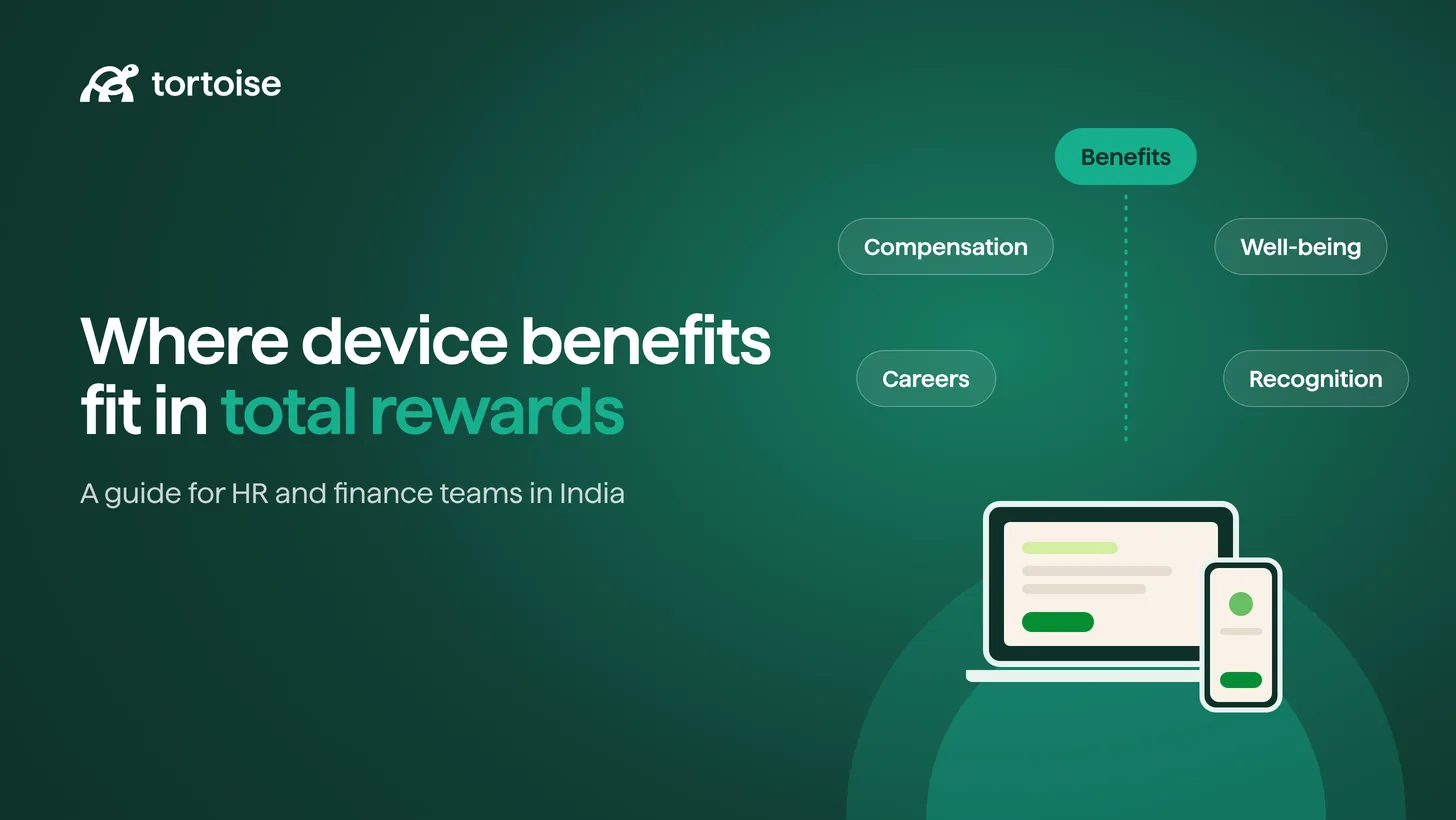
A total rewards strategy covers everything of value an employee gets from their job, whether it is paid in cash or not. Many HR teams use the WorldatWork model as their total rewards framework. It groups total rewards into five elements:
| Element | What it includes | Examples in Indian companies |
|---|---|---|
| Compensation | Fixed pay, variable pay, and long-term incentives | Basic pay, allowances, performance bonus, and ESOPs |
| Benefits | Protection and perks the employer pays for or arranges | Group health insurance, PF, gratuity, leave, and device benefits |
| Well-being | Support for physical, mental, and financial health | Counselling, wellness programmes, and flexible hours |
| Careers | Learning and growth | Training budgets, certifications, and internal moves |
| Recognition | Ways of noticing and rewarding good work | Spot awards, long-service awards, and peer recognition |
Most Indian employers already spend in all five areas. What a strategy adds is a single view of that spend, so HR can see where money goes to benefits employees barely use and where gaps push people to look elsewhere.
Why Indian employers are rethinking total rewards
Three changes have led HR teams in India to review the whole package instead of adding perks one at a time.
Salary structures have less room. The Code on Wages requires at least half of an employee's total remuneration to count as wages. Wages are also the base for PF and gratuity. So salary structures that keep basic pay low and allowances high now cost more to run. Our guide to the 50% wage rule explains how.
The new tax regime has narrowed tax-saving pay. It is now the default regime, and it does not allow most of the exemptions and deductions that many salary structures rely on. These include HRA, LTA, and investment deductions. A benefit whose value depends on one of those exemptions now reaches fewer employees.
Work has moved out of the office. Hybrid and remote employees get less from office perks such as cafeterias, cabs, and gyms. They get more from support that reaches them at home. Our post on benefits for hybrid teams covers these in detail.
Each change pushes employers towards benefits that add value without adding fixed cost and that work wherever the employee is based.
Where device benefits fit in the package
A device benefit lets employees get a laptop, phone, or tablet through their employer and pay for it in monthly deductions from gross salary. It belongs mainly in the benefits element, but it also adds value to two others. The table below shows how it fits each element:
| Element | Role of a device benefit | Strength of fit |
|---|---|---|
| Benefits | A perk employees see and use every day, alongside health cover and leave | Strong |
| Compensation | More value from the same CTC, because the rental comes out of pay before income tax | Strong for employees who pay tax |
| Well-being | No lump-sum purchase or high-interest EMI, and damage and theft cover in most managed programmes | Moderate |
| Careers | No direct role | Weak |
| Recognition | Device limits can rise with grade, though they are rarely used as an award | Weak |
A device benefit cannot stand in for pay rises, learning budgets, or recognition. It works best as one of the few benefits that employees use often and talk about. These benefits shape how people feel about their employer each month.
How a device benefit adds CTC value
A salary-linked device benefit adds value because the employee pays for the device from their salary before it is taxed. When an employee buys a laptop from their take-home pay, that money has already been taxed at their highest slab rate. When the same amount comes out of gross salary as a lease rental, no income tax is paid on it.
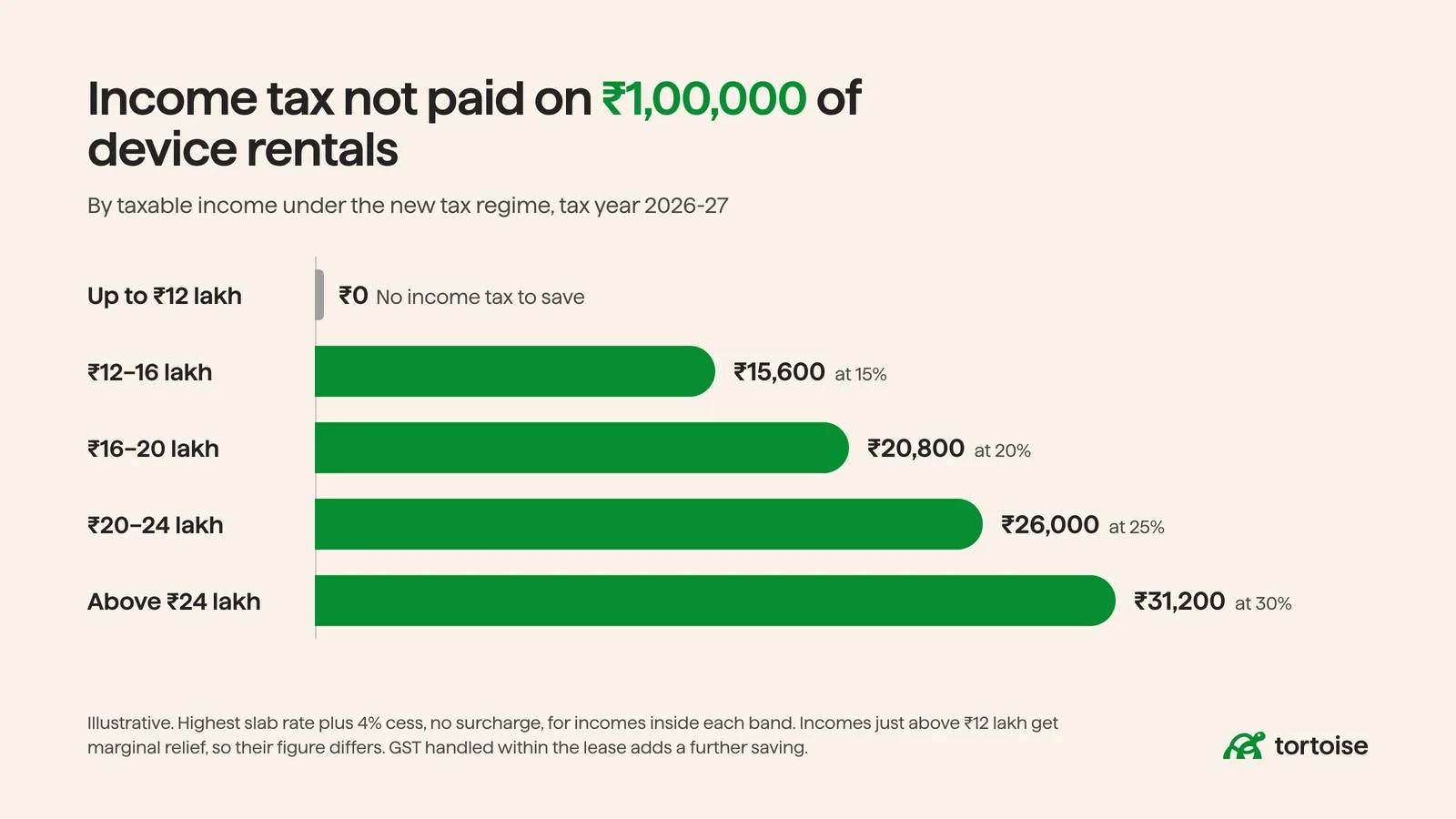
Take an employee in the 30% slab under the new tax regime. If their rentals add up to ₹1,00,000 over the lease, they pay ₹31,200 less in income tax, including 4% cess. The leasing structure also handles GST, so total savings can reach up to 40%, depending on tax slab. Our explainer on how employees save on devices works through the numbers for each slab.
The value falls for employees with little or no tax to pay. Under the new tax regime, there is no income tax on taxable income up to ₹12 lakh. Employees in this group save nothing on tax, and they get only the convenience, the choice of device, and the cover. So a device benefit does the most for mid-level and senior salaried staff. If most of your workforce earns below that line, other benefits may serve them better.
In a managed programme, the employer's cost stays at zero. The device is leased rather than bought, so it does not go on the balance sheet. Employees pay the rental through payroll.
Comparing device benefits with other perks
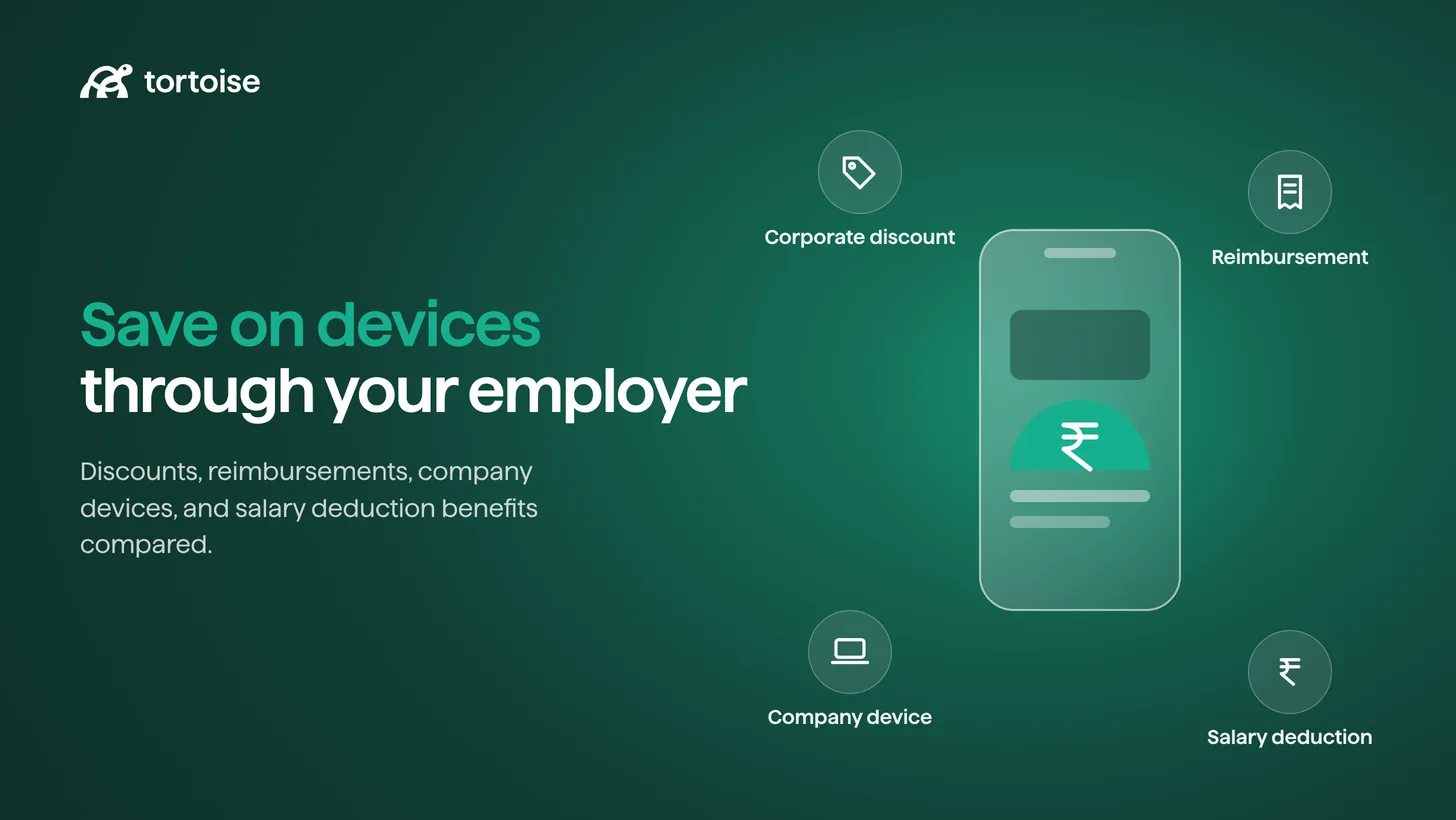
Most employers already pay for devices in some way. The table below compares the common options by their cost to the employer, their value to the employee, and where each one sits in total rewards:
| Option | Cost to the employer | Value to the employee | Where it sits in total rewards |
|---|---|---|---|
| Cash device allowance | A fixed monthly cost | Taxed as salary, so worth less than its face value | Compensation, as part of CTC |
| Reimbursement against bills | A variable cost, with claims to check | Part of the cost repaid, after paying upfront | Benefits, though hard for employees to see |
| Company-owned laptop | The device cost, plus asset tracking | Free to use, but returned on exit | Rarely counted, since it is a work tool |
| Corporate discount or EPP | None | A lower price, paid from taxed income | Benefits, as a perk |
| Salary-linked device lease | None | Up to 40% saving, depending on tax slab, and ownership at the end | Benefits, with a value that can be shown in rupees |
Most employers start with an allowance or a company laptop, and both have their uses. An allowance is simple to run, and a company laptop keeps devices under IT's control. The lease is the only option here that costs the employer nothing and still lets employees choose and keep their own device. Our guide to the tax treatment of technology benefits covers the tax side of each option.
Adding device benefits to your strategy
A device benefit works best as a total rewards decision rather than a one-off perk. These six steps keep it tied to the rest of the package:
- Add up what you already spend on devices, including allowances, reimbursements, and company-bought laptops
- Ask employees which devices they plan to buy in the next year and how they pay for them now
- Check how much of your workforce has taxable income above ₹12 lakh, since that group gains the most
- Set eligibility and device limits by grade, in line with the rest of your benefits policy
- Agree with payroll how deductions, exits, and full and final settlement will work
- Decide how you will measure the benefit, for example through adoption, employee feedback, and retention
Step 3 shows how much of the benefit's value will reach your people, so do it before you write the policy. Once the programme is live, our guide to device benefit ROI shows how to present the results to finance.
Device benefits on a total rewards statement
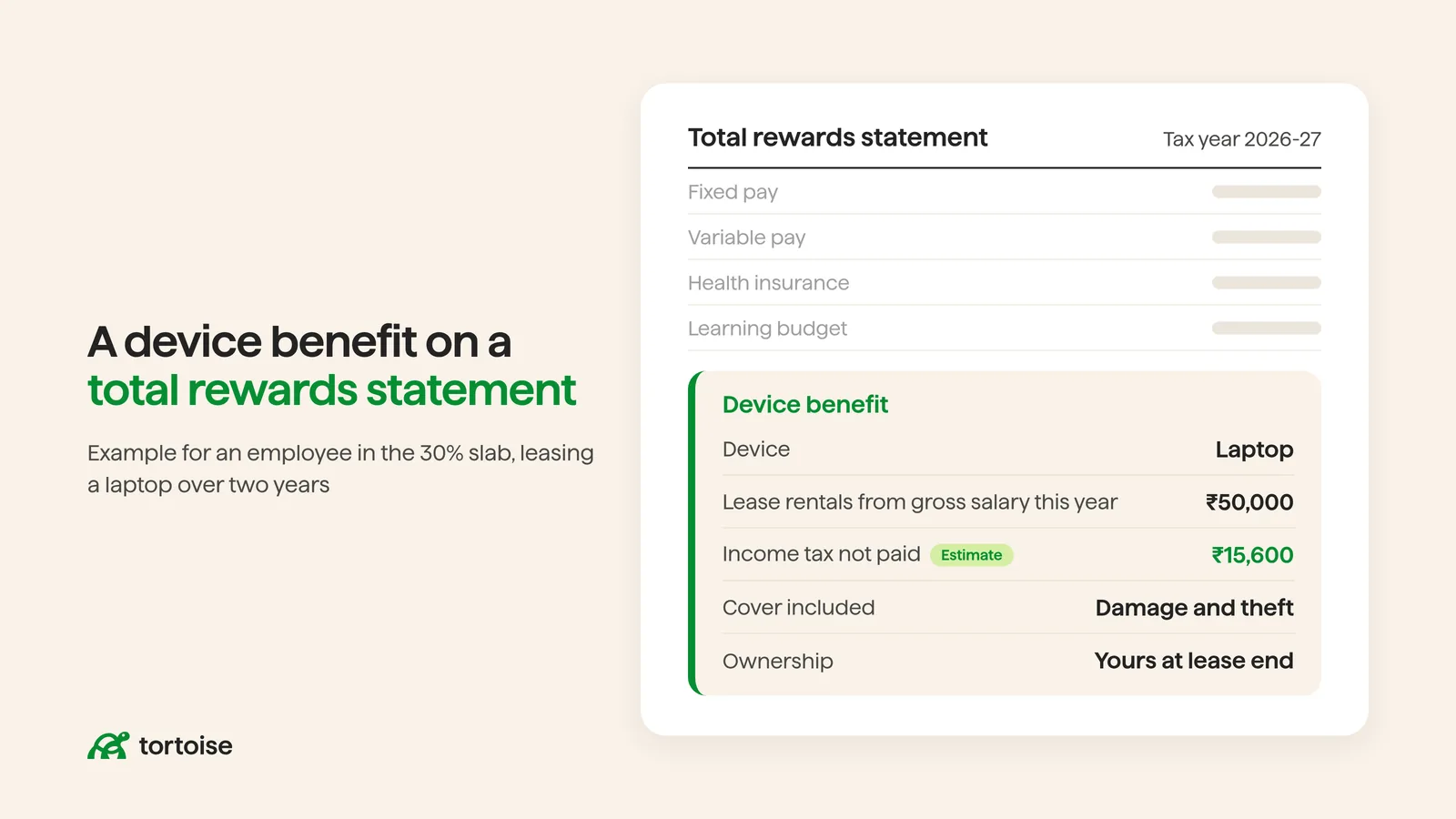
A total rewards statement is a yearly summary that shows each employee the full value of what they receive, including what does not appear on their payslip. Device benefits are easy to leave off the statement because the employee pays the rental themselves. Showing them helps employees see the savings their employer made possible.
A clear device benefit entry on the statement includes:
- The device and its retail price
- The monthly rental deducted from gross salary
- The estimated income tax not paid, based on the employee's slab
- The damage and theft cover included in the programme
- The date ownership passes to the employee
Mark the tax figure as an estimate, because the actual saving depends on the employee's tax regime and their final income for the year.
How Tortoise supports total rewards teams
Tortoise is an employee device benefit platform built for Indian employers. It brings leasing, device supply, insurance, payroll and HRMS integration, and claims onto one platform. This lets a total rewards team add a device benefit without managing another set of vendors.
Employees can save up to 40% on their devices, depending on their tax slab, and own the device at the end of the lease. The employer pays nothing to run the programme and carries no balance-sheet liability. The savings calculator in the employee app shows each employee their monthly deduction and the effect on their net salary. HR can use the same figures for the total rewards statement.
Tortoise Corporate Care covers accidental and liquid damage, theft, and absconding. The tax structure was evaluated by Deloitte India and Lakshmikumaran & Sridharan, and the platform is ISO 27001 and SOC 2 certified.
We'd be glad to help you determine where a device benefit fits in your rewards package.
Judging rewards as one package
A device benefit earns its place in a total rewards strategy when it fills a gap the rest of the package leaves open. For most Indian enterprises, the gap is a benefit that employees use every day, and that costs the company nothing. It also adds take-home value for salaried staff who pay tax. It does less for employees who pay no income tax, so it should sit beside pay, health cover, and learning rather than replace any of them.
The strongest packages are the ones employees understand. Showing the device benefit's value in rupees on the total rewards statement helps employees count it as part of what they earn.
Disclaimer: This guide is intended for general informational purposes only and should not be treated as legal, tax, payroll or accounting advice. Applicability of employee benefit laws in India depends on several factors, including the nature of the establishment, employee category, wage levels, location, headcount, employment terms and applicable central and state laws. Tax treatment of benefits may also vary depending on the structure adopted, documentation, payroll processing and the employee's applicable tax regime. Employers should consult their legal, tax and payroll advisors before implementing or modifying any employee benefit programme.
Frequently asked questions
What is total rewards in HR?
Total rewards in HR is everything an employer offers employees in return for their work, managed as one package. A total rewards strategy covers pay, benefits, well-being support, career growth, and recognition. Treating these together lets HR see what each part costs, what employees value, and where the package has gaps that push people to look at other employers.
What are the five elements of total rewards?
The WorldatWork model groups total rewards into five elements: compensation, benefits, well-being, careers, and recognition. Compensation covers fixed and variable pay, and benefits cover insurance, leave, and perks. Well-being covers physical, mental, and financial health. Careers cover learning and growth, and recognition covers the ways good work is noticed and rewarded.
Where do device benefits fit in a total rewards strategy?
Device benefits sit mainly in the benefits element, as a perk employees use every day. A salary-linked device lease also adds to compensation value, because the rental comes out of gross salary before income tax. It supports financial well-being too, by removing the need for a lump-sum purchase or an EMI.
Does a device benefit cost the employer anything?
In a managed salary-linked programme, the employer has no running cost. A leasing partner funds the device, employees pay the rental through payroll deductions, and insurance covers damage, theft, and absconding. Because the device is leased rather than bought, it also stays off the employer's balance sheet.
Do device benefits help employees under the new tax regime?
Yes, for employees who pay income tax. The rental comes out of gross salary, so employees with taxable income above ₹12 lakh pay less tax, and total savings can reach up to 40%, depending on tax slab. Employees with taxable income up to ₹12 lakh pay no tax under the new regime, so they gain mainly convenience and cover.
How do you show a device benefit on a total rewards statement?
Show the device, its retail price, the monthly rental, and an estimate of the income tax the employee does not pay because of the deduction. Add the damage and theft cover and the date ownership passes to the employee. Label the tax figure as an estimate, since it depends on the employee's regime and final income for the year.