How to Calculate the ROI of an Employee Device Benefit Program

At a glance: The ROI of an employee device benefit programme compares the employer's spend, in money and staff time, with what it gets back in retention, productivity, and avoided device costs. Device as a service charges the employer a monthly fee per device, while salary-sacrifice leasing can carry no running cost for the employer.
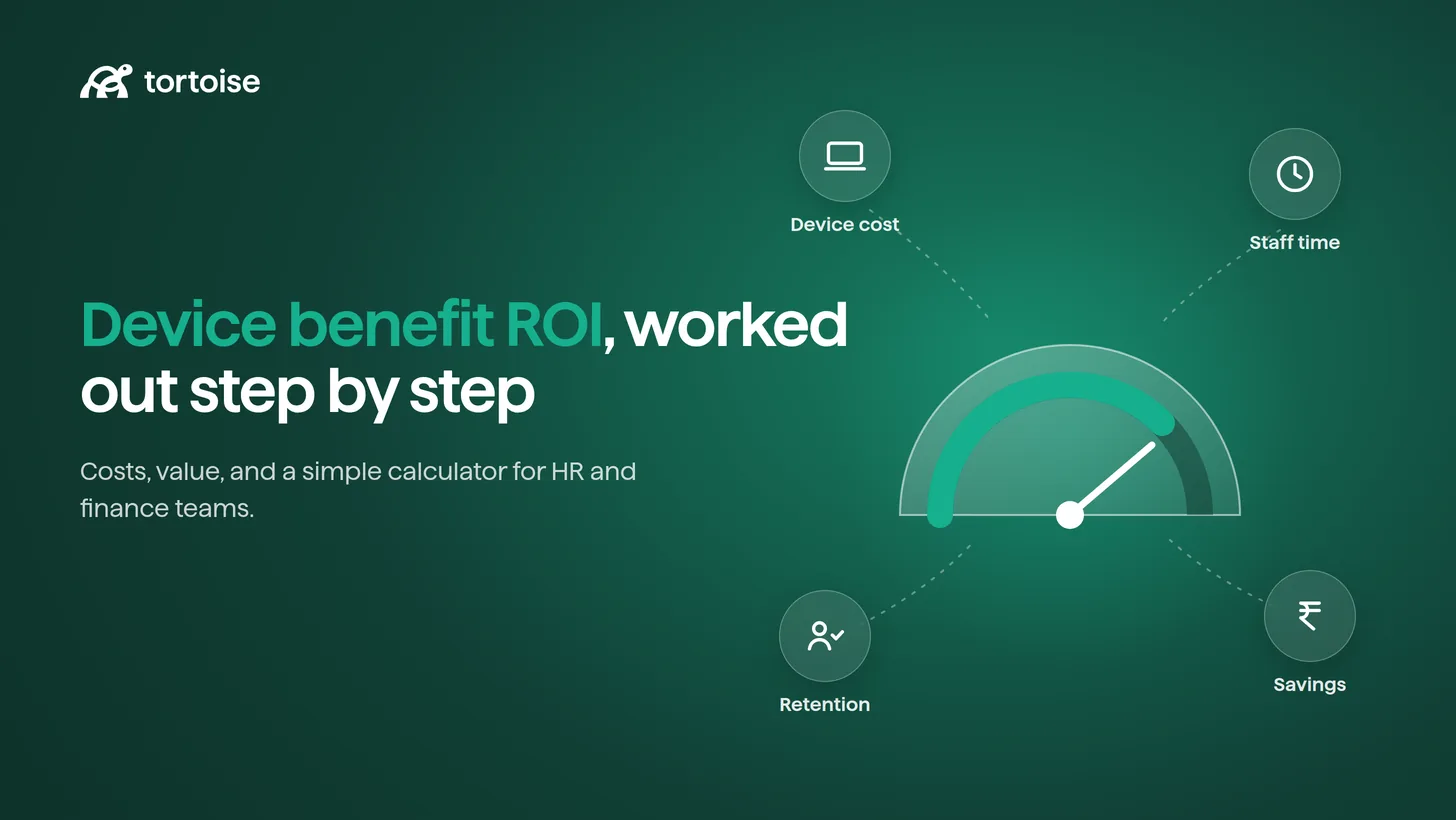
To calculate the ROI of an employee device benefit programme, subtract the programme's total cost to the employer from the value it creates, then divide the result by the cost. Multiply by 100, and that gives you the ROI as a percentage.
ROI = (value created − total cost) ÷ total cost × 100
The formula is simple. The work is in getting both sides right, because device programmes have costs that do not appear on the invoice and benefits that do not appear in the payroll report. This guide covers both, with a worked example and the inputs for a simple calculator.
What goes into device benefit ROI
Device benefit ROI has a cost side and a value side, and each has more parts than most first estimates include. The table below lists the usual inputs for each:
| Cost side | Value side |
|---|---|
| Device purchase, reimbursement, or monthly fees | Lower attrition and fewer replacement hires |
| HR and payroll time to run the programme | Hours saved from fewer device problems |
| IT time for setup, support, and repairs | Device purchases the company no longer makes |
| Losses from damage, theft, and unreturned devices | Savings employees receive, which raise perceived value |
| Insurance and extended warranties | Stronger offers when hiring |
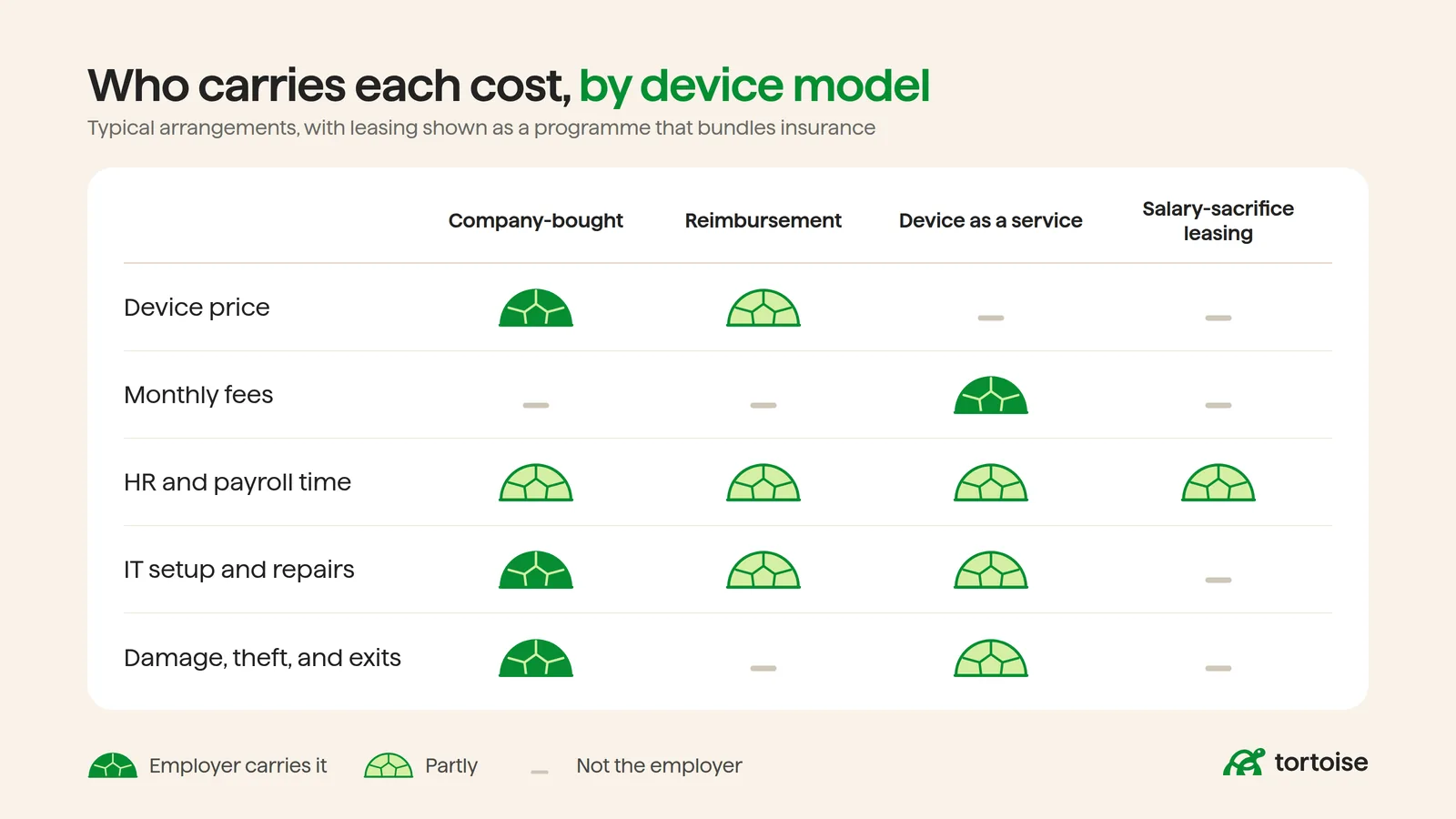
Not every line applies to every programme. A reimbursement scheme has no monthly fee, and a salary-sacrifice lease may have no device cost for the employer. The model the company chooses decides which lines carry most of the weight.
What a device programme costs the employer
The highest cost is the device itself, if the employer pays for it. A company that buys laptops or phones pays the full price upfront, records the devices as assets, and depreciates them over their life. A company that reimburses devices pays part of the price, usually after the employee buys from post-tax salary. Our comparison of device reimbursement and leasing covers how each model handles ownership and payroll.
Staff time is the cost most often left out. HR handles eligibility and policy questions, payroll processes deductions or reimbursements, and IT sets up and repairs devices. Estimate the hours each team spends per month and multiply by an hourly cost for each role.
Exits create a third cost. When an employee leaves, a company-owned device has to be recovered, wiped, and either reissued or written off. Our guide on leased devices at resignation explains how leasing programmes handle this step.
What is device as a service?
It is a model, usually shortened to DaaS, in which a company pays a provider a monthly fee per device for hardware and services such as setup, support, and replacement. It is mainly an IT procurement model for company-owned fleets. Our explainer on what device as a service is covers the model in full.
DaaS is different from employee device leasing. In DaaS, the employer pays the fee, and the device usually goes back to the provider at the end of the term. In employee device leasing, the employee chooses a device, pays a monthly rental through payroll, and often owns the device at the end. Our comparison of DaaS and employee device leasing sets out the differences.
For ROI, the difference matters most on the cost side. DaaS is a recurring cost for the employer. A salary-sacrifice leasing programme moves the device cost to the employee's gross salary, so the employer's cost can be limited to administration.
How device as a service pricing works
Pricing is usually a fixed monthly fee per device, agreed for a term of a few years. The fee depends on the device model, the length of the term, and the services included, such as repairs, replacements, and data wiping at the end.
Device-as-a-service benefits are real for IT teams. Costs are predictable, devices are refreshed on a schedule, and the provider handles much of the support work. For a company that must supply standard laptops to every employee, these can outweigh the higher total cost compared with buying outright.
For an employee benefit, the picture changes. A DaaS fee is a cost the employer pays for every device, every month, so the ROI depends on the value side being large enough to cover it. When employees choose personal devices such as phones or tablets, a model where the employee funds the device through payroll usually produces a better ROI for the employer.
Where the value comes from
The value side is harder to measure, so most companies use their own data rather than industry figures. Three sources usually make up most of the value.
The first is retention. A device benefit that employees use and value can make some of them less likely to leave. Use your own cost of replacing an employee, including hiring, onboarding, and lost output, and estimate how many exits the programme might prevent.
The second is productivity. Employees with newer, faster devices lose less time to slow machines and repairs. Track device-related support tickets before and after launch, and multiply the hours saved by an average hourly cost.
The third is avoided spend. If the programme replaces devices the company would otherwise buy or reimburse, the money no longer spent counts as value. Savings that employees receive also add to the perceived value of their pay, even though they do not reach the company's books.
A worked ROI example
The example below compares two ways a company of 500 employees could offer a device benefit to the 100 employees who take it up. All figures are illustrative, so replace them with your own numbers.
The company values each prevented exit at ₹3,00,000. It expects the benefit to prevent three exits a year and to save 400 hours of IT and support time at ₹500 an hour. The yearly value is therefore ₹9,00,000 from retention and ₹2,00,000 from time saved, for a total of ₹11,00,000.
The table below shows how ROI changes with the cost model:
| Measure | Company-funded devices | Salary-sacrifice leasing |
|---|---|---|
| Device cost to employer per year | ₹20,00,000 | ₹0 |
| HR, payroll, and IT time per year | ₹2,00,000 | ₹1,00,000 |
| Total cost to employer | ₹22,00,000 | ₹1,00,000 |
| Yearly value | ₹11,00,000 | ₹11,00,000 |
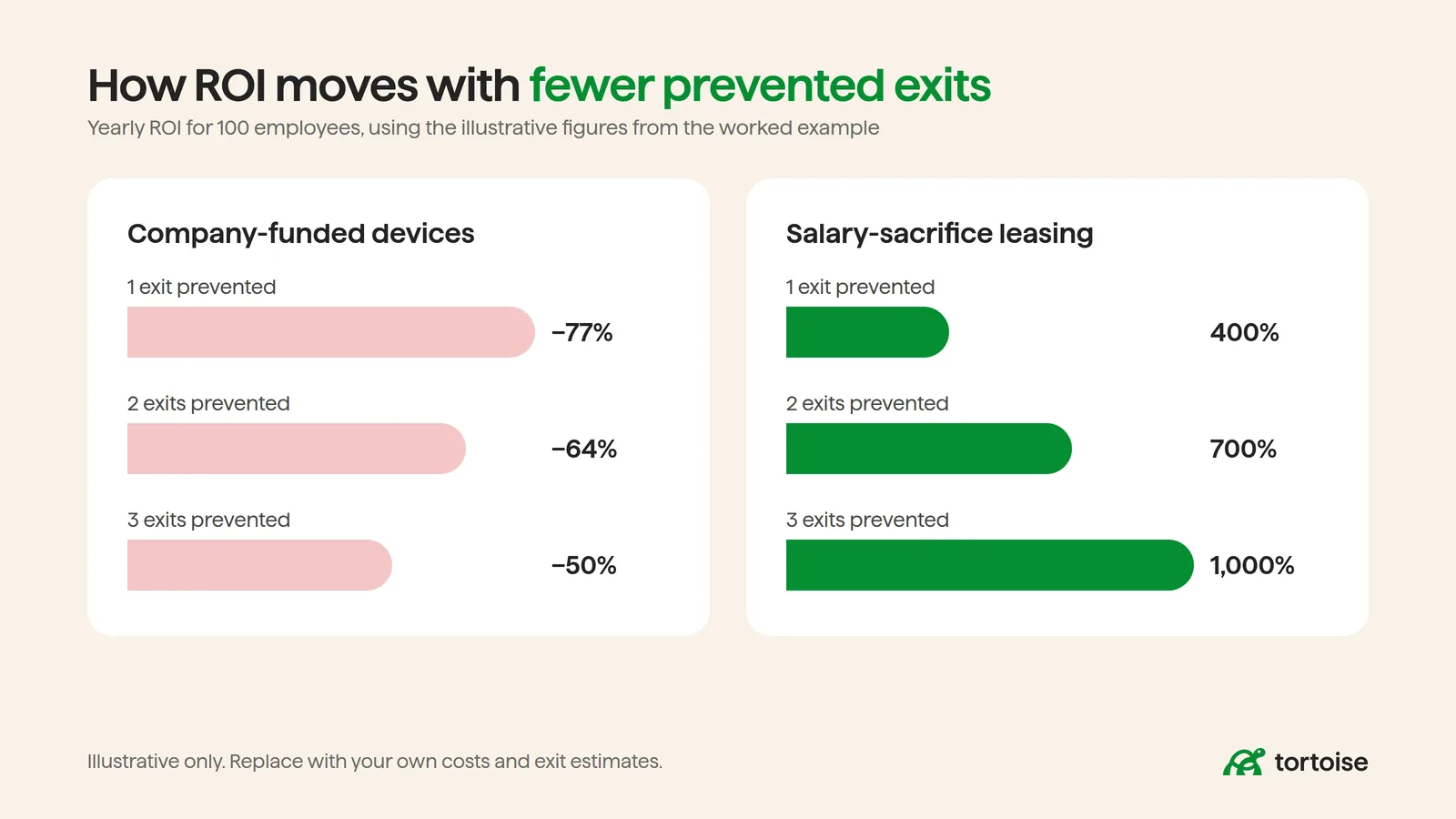
| ROI | −50% | 1,000% |
The company-funded programme assumes ₹60,000 devices bought for 100 employees and used for three years, which is ₹20,00,000 a year. On these assumptions, it costs twice what it returns in a year. The salary-sacrifice programme's net return is ten times its cost, because the employer is not paying for the devices.
Two points keep this example honest. The value side is an estimate, so check what happens if the programme prevents one exit instead of three. A company-funded programme may still be the right choice for devices every employee needs for work, even with a lower ROI.
Building an employee benefits cost calculator
For a device programme, the calculator can be a simple spreadsheet with three sections. Inputs, costs, and value each sit in their own block, so anyone can change one number and see the result.
The inputs block should hold these figures:
- Number of eligible employees and the expected take-up rate
- Average device price and the length of the lease or depreciation period
- Hours per month spent by HR, payroll, and IT, with an hourly cost for each
- Your cost of replacing an employee and the number of exits you expect the programme to prevent
The cost and value blocks then use the inputs to work out yearly totals. A final cell applies the ROI formula. Keep the take-up rate realistic, because many benefits are used less than planned, and our article on employee benefit awareness explains why.
How laptop policy for employees affects ROI
The policy sets most of the cost inputs before any device is bought. Eligibility decides how many people join, device limits set the average price, and the refresh cycle decides how often the cost repeats.
Exit rules matter as much as purchase rules. A policy that says what happens to the device when someone leaves, who pays for damage, and how lost devices are reported reduces the losses that pull ROI down. Without these rules, HR and IT end up settling each case by hand, and that time costs money too.
Review the policy whenever you change the model. Moving from company-owned laptops to employee leasing, for example, changes who owns the device, who chooses it, and how exits work.
How Tortoise changes the ROI calculation
Tortoise is an employee device benefit platform, and its model removes the largest line from the cost side. Employees lease phones, laptops, and tablets through payroll, with the monthly rental deducted from gross salary. The employer carries no running cost and no balance-sheet liability.
The remaining costs are also reduced. Tortoise integrates with payroll and HRMS systems, which limits payroll and HR time, and Tortoise Corporate Care covers accidental and liquid damage, theft, and absconding. That covers most of the loss lines in the calculation.
On the value side, employees can save up to 40%, depending on their tax slab, and own the device at the end of the lease. The programme is designed for compliance with the Income Tax Act and GST Act, its tax structure was evaluated by Deloitte India and Lakshmikumaran & Sridharan, and the platform is ISO 27001 and SOC 2 certified.
If you are building the business case for a device benefit, we'd be happy to help you work through the numbers for your team.
Start the ROI case with your numbers
The ROI of a device benefit programme depends mostly on who pays for the device. Get the cost side complete, estimate the value side with your own retention and support data, and test the result with cautious assumptions.
A one-page calculator with your headcount, device prices, and cost of replacing an employee is enough to start. It shows quickly whether the model you are considering pays for itself.
Disclaimer: This guide is intended for general informational purposes only and should not be treated as legal, tax, payroll or accounting advice. Applicability of employee benefit laws in India depends on several factors, including the nature of the establishment, employee category, wage levels, location, headcount, employment terms and applicable central and state laws. Tax treatment of benefits may also vary depending on the structure adopted, documentation, payroll processing and the employee's applicable tax regime. Employers should consult their legal, tax and payroll advisors before implementing or modifying any employee benefit programme.
Frequently asked questions
How do you calculate the ROI of an employee device benefit programme?
Subtract the programme's total yearly cost to the employer from the yearly value it creates, divide by the cost, and multiply by 100. Costs include devices, fees, staff time, and losses at exit. Value includes fewer exits, hours saved on device problems, and device spending the company no longer needs. Use your own retention and support data for the value side.
What is device as a service pricing based on?
Device as a service pricing is usually a fixed monthly fee per device for a term of a few years. The fee depends on the device model, the length of the term, and the services included, such as setup, repairs, replacements, and data wiping. The employer pays the fee, so it is a recurring cost in any ROI calculation.
What are the benefits of device as a service?
Device as a service gives IT teams predictable monthly costs, devices refreshed on a schedule, and a provider that handles much of the setup and support. It suits companies that must supply standard laptops to every employee. For an employee benefit covering personal devices, a model where employees fund devices through payroll usually costs the employer less.
What should a laptop policy for employees include?
A laptop policy for employees should cover eligibility, device limits, the refresh cycle, who pays for damage, how lost or stolen devices are reported, and what happens to the device when someone leaves. Clear exit and damage rules matter most for ROI, because they reduce losses and the HR and IT time spent settling each case.
What costs are usually missed in device benefit ROI?
The costs most often missed are staff time and exits. HR, payroll, and IT all spend hours running a device programme, and that time has a cost. Recovering, wiping, or writing off devices when employees leave adds more. Damage and theft also count, unless insurance in the programme covers them.
Can a device benefit programme cost the employer nothing?
It can come close. In a salary-sacrifice leasing programme, the employee pays the monthly rental from gross salary, so the employer does not pay for the device. With Tortoise, the employer carries no running cost and no balance-sheet liability, and employees can save up to 40%, depending on their tax slab.
Written by
Founder & CEO
Vardhan Koshal is the Co Founder of Tortoise, India’s fastest growing employee device benefit platform. He has led India growth and product for companies like TripAdvisor and Udacity, and earlier founded Ridingo, a car pooling startup recognised by Forbes as one of the Hottest Global Startups and acquired by Carzonrent. At Tortoise he works with HR leaders, CFOs and tax experts to design compliant, high impact device benefit programs for Indian employers.