Employee Benefits for Remote and Hybrid Teams in India

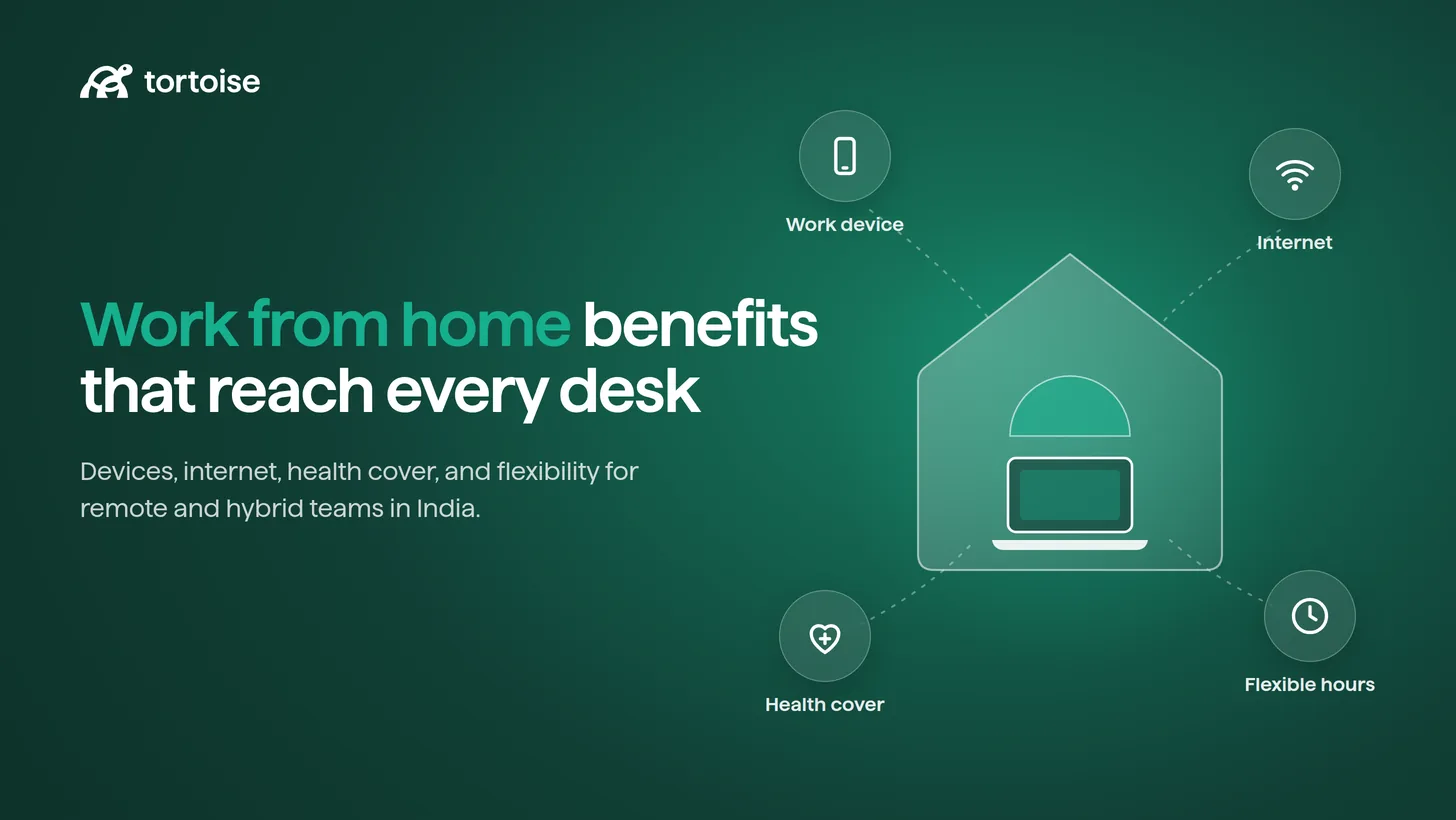
At a glance: Work from home employee benefits in India replace what the office used to provide, such as a working device, an internet connection, and IT support when something breaks. Health cover and flexible hours matter more when a team is spread across cities. The way each benefit is paid, as an allowance or a reimbursement, decides how it is taxed.
The employee benefits that suit remote and hybrid teams in India are the ones that work wherever the employee works from. In practice, that means a reliable work device, help with home internet and phone costs, health insurance that works in the employee's own city, flexible hours, and support for wellbeing and learning.
Many familiar benefits were built around an office. A cab service, a canteen, and a gym near the office give little to an employee who works from home three days a week. Remote and hybrid employees need benefits that reach them at home and stay useful when they move cities.
The table below shows the main work-from-home employee benefits, what each one covers, and how employers usually provide it:
| Benefit | What it covers | How employers usually provide it |
|---|---|---|
| Work device | Laptop, phone, or tablet for daily work | Company-owned device, reimbursement, or device leasing |
| Home office setup | Chair, desk, monitor, headset, or keyboard | One-time reimbursement against bills |
| Internet and phone | Broadband and mobile data used for work | Monthly reimbursement against bills, or an allowance |
| Health cover | Hospital cover, doctor consultations, and mental health support | Group health insurance with a wide cashless network |
| Flexibility | Choice of hours and work location within agreed limits | Written work-from-home or hybrid policy |
| Wellbeing and learning | Online courses, fitness, and counselling | Yearly budget or a flexible benefits plan |
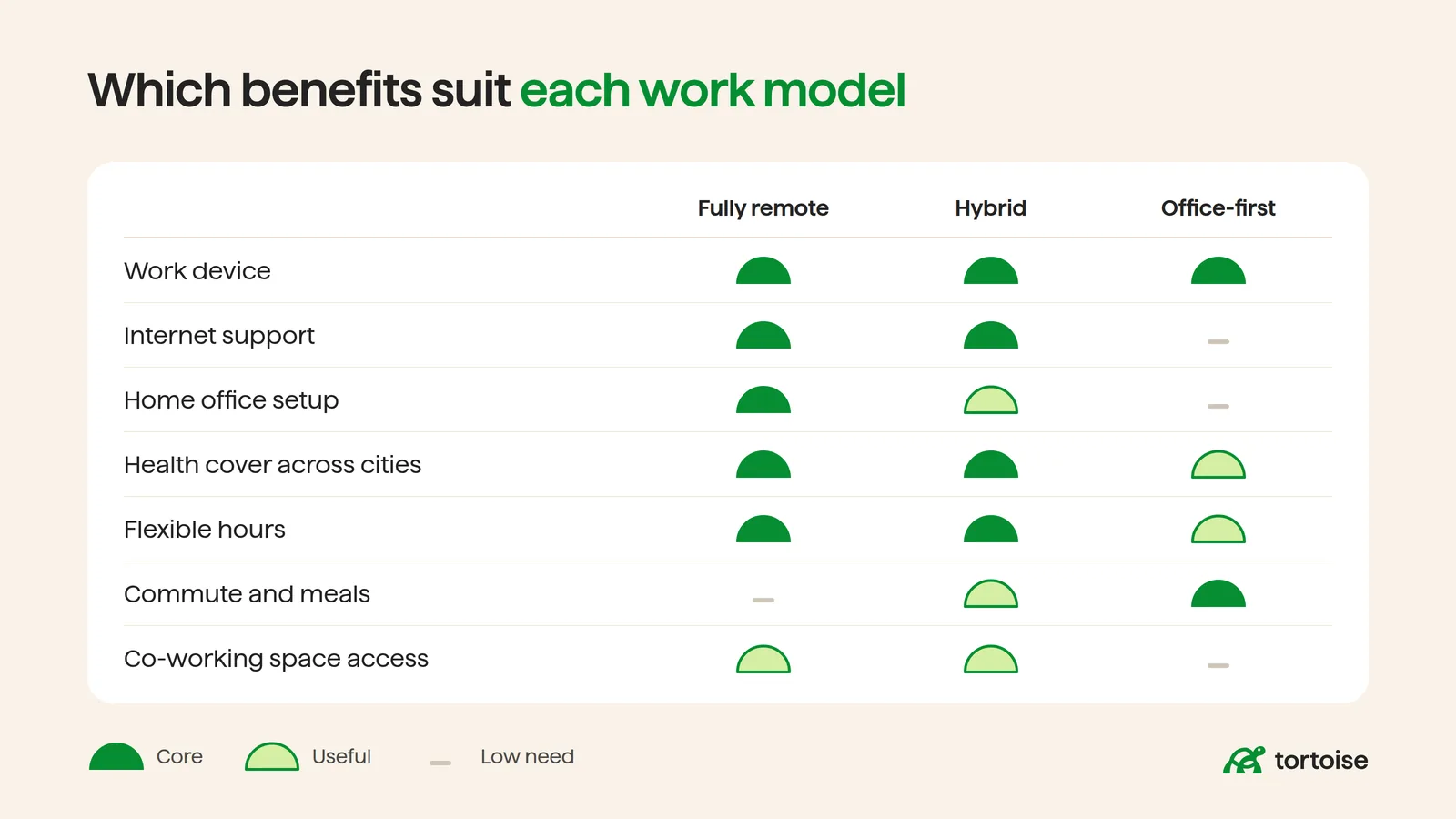
Not every team needs all six. A fully remote team leans on the first three every day, while a hybrid team also needs its office days to work well.
How remote work changes employee benefits
Remote work shifts office costs to the employee's home. In an office, the employer pays for the desk, the chair, the electricity, the internet, and the IT staff who can fix a problem in person. At home, the employee pays for most of these unless a benefit covers them.
Hybrid employees carry both sets of costs. On office days they pay for travel and meals, and on home days they pay for power, internet, and a place to work. A benefits plan that only looks at one of these leaves a gap the employee fills from their own salary.
Statutory benefits such as provident fund and gratuity apply in the same way wherever an employee works, so most of the change is in voluntary benefits. Our guide to employee benefits in India covers both kinds in full.
Benefits of remote and hybrid work
Remote and hybrid work save employees time and give employers a wider pool of people to hire from, which is why many Indian teams have kept some form of it. For employees, the benefits of remote work start with the daily commute, which can be long in larger Indian cities. They also gain more control over their day and the option to live outside the most expensive cities.
For employers, a role no longer depends on living near one office, so they can hire from across the country. They can also keep people who would otherwise resign when they move cities for family reasons, and they can plan smaller offices.
The benefits of the hybrid work model sit in between. Teams keep in-person days for onboarding, training new joiners, and planning, and use home days for focused work. That balance is only maintained when the home side is set up properly, with the right device, a steady connection, and support when something goes wrong.
There are real costs, too. New joiners learn more slowly without colleagues around, and home setups vary widely. Good benefits won't eliminate these problems, but they can ease those caused by equipment and money.
Work devices for remote employees
The work device is the most important benefit for a remote employee, because almost all of their work runs on it. A slow laptop or a phone with a cracked screen can cost hours of work, and at home there is no IT desk to walk to.
Employers in India usually choose one of three ways to provide devices:
- A company-owned laptop that the employer buys, ships, and collects back at exit
- A reimbursement, where the employee buys a device, and the employer repays part of the cost
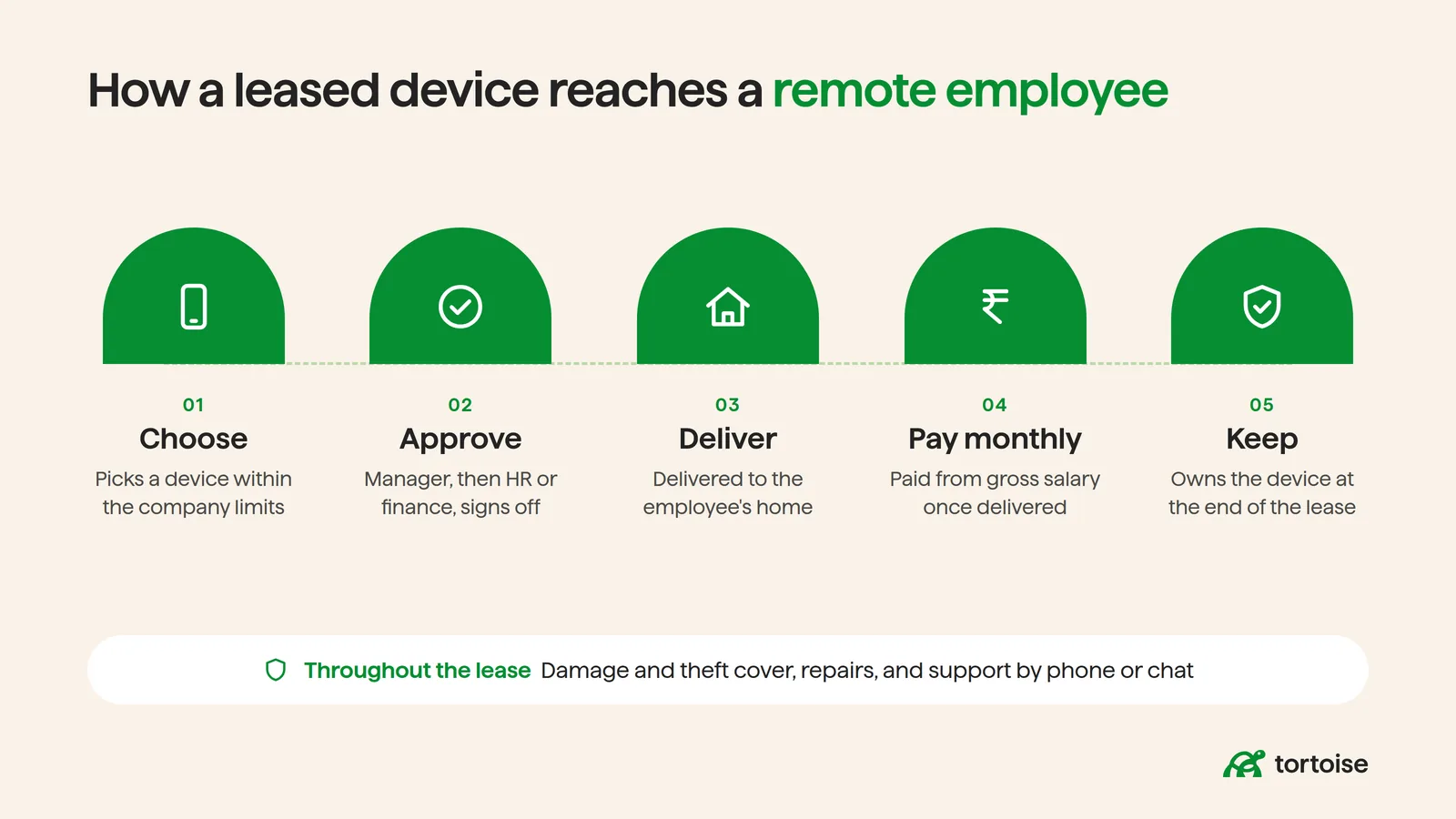
- Device leasing through payroll, where the employee picks a device and pays a monthly rental from gross salary
Each one shifts work and cost to a different place. Company-owned devices need someone to track, repair, and recover them across many cities. Reimbursements are simple, but the employee often pays the full price from post-tax salary first. Our comparison of device reimbursement and leasing sets out the trade-offs in detail.
Two questions matter more for remote teams than for office teams. The first is how repairs happen when the employee lives far from any office. The second is what happens to the device when the employee leaves, which our guide on leased devices at resignation answers.
Internet and phone costs at home
A steady internet connection is a basic need for remote work, so most employers help pay for it. The usual choice is between a fixed monthly allowance and a reimbursement paid against the employee's bills.
An allowance is easier to run, since payroll pays the same amount every month. A reimbursement takes a little more effort, because employees submit bills each month or quarter, but it usually costs the employee less tax. The tax section below explains why.
For phones, some employers provide a company connection, while others reimburse part of the employee's own plan. Either way, a written monthly limit keeps the cost predictable and avoids arguments over personal use.
Health cover for teams in many cities
Health insurance matters more for a remote team, because employees no longer live near one office or one set of hospitals. A group health policy should have cashless hospitals in the towns and cities where employees actually live, and not only in the metros.
Three features make health cover more useful for remote employees:
- Online doctor consultations, so employees can get advice without travelling
- Mental health support, such as counselling sessions, since working alone can be isolating
- Cover for spouses, children, or parents, since many remote employees live with family
Before renewing a policy, HR teams can ask the insurer for a list of cashless hospitals by city and check it against where employees are based. It is a quick check, and it shows whether the policy works for the whole team.
Flexibility, wellbeing, and learning benefits
Flexibility is a benefit in its own right for remote and hybrid teams, as long as the limits are written down. A clear policy states the core hours when everyone is available, how office days are chosen, and how quickly people are expected to reply outside those hours.
Wellbeing benefits should be usable from home. Online fitness classes, counselling sessions, and a yearly wellness budget all meet that test, while a gym tie-up near the office helps only the people who go there.
Learning budgets also suit remote teams, because most courses are now online. A yearly amount that employees can spend on approved courses or certifications gives remote staff the same chance to grow as those in the office.
How work from home benefits are taxed
The tax on these benefits depends on how they are paid. A fixed work-from-home allowance is taxed as part of salary, while repayment of actual official expenses supported by bills is generally not, according to RSM India's analysis of the current rules.
The table below shows the common ways of paying for remote work costs and how each is usually treated:
| Way of providing the benefit | Usual tax treatment |
|---|---|
| Fixed work from home allowance | Taxed as salary, with TDS |
| Reimbursement of official expenses with bills | Generally not taxed |
| Use of a company-owned laptop | Not taxed while the employer owns it |
| Salary-sacrifice device lease | Tax-efficient, with savings of up to 40%, depending on tax slab |
For many teams, the practical step is to pay internet and home office costs as reimbursements wherever employees can show bills, and to keep those bills on file.
These rules now sit under the Income-tax Act, 2025 and the Income-tax Rules, 2026, which took effect on 1 April 2026. Our guide on how technology benefits are taxed covers laptops, phones, and gifts under the new law in more detail. Treatment depends on the structure and each employee's situation, so confirm it with your finance or tax team before launch.
What Indian law says about remote work
Indian labour law now recognises work from home for the services sector. The Model Standing Orders, 2026 were notified under the Industrial Relations Code, 2020 on 8 May 2026. They allow work from home, remote locations, and virtual workplaces, according to JSA's review of the orders. The employer may permit remote work for the periods it decides, subject to the terms of appointment or an agreement with the worker.
Standing orders apply to industrial establishments with 300 or more workers, and some states may have their own exemptions, such as Karnataka's for IT and IT-enabled services. Employers below that size do not have to adopt standing orders, but the orders are a useful guide to what a remote work policy should cover.
The services orders also list false reimbursement claims as misconduct. That makes clear rules on what can be claimed, and with what bills, a good idea for any remote team. Our explainer on the new labour codes covers how the codes affect salary structures, and your legal team can confirm which orders apply to your establishment.
Keeping benefits fair for hybrid teams
Hybrid teams work best when remote and office employees get benefits of similar value, even if the benefits themselves differ. An employee who comes in daily may use the cab and the canteen, while a colleague at home needs internet support and a good chair. Both should feel the plan was built with them in mind.
A few habits help HR teams keep a hybrid plan fair:
- List every benefit that office staff use, and offer remote staff an option of similar value
- Prefer benefits that move with the employee, such as devices, health cover, and learning budgets
- Review the plan when the office policy changes, such as a move from two office days to three
- Share benefit details in writing and on video, since remote staff miss conversations in the office
Remote employees often use fewer benefits simply because they hear about them less. Our article on employee benefit awareness explains how HR teams can close that gap with regular, simple communication.
How Tortoise supports remote device benefits
Tortoise is an employee device benefit platform that runs device leasing through payroll for Indian employers, including teams that work from home. Employees log in to the Tortoise app with their work email, choose a device within their company's limits, and have it delivered to the address they choose. Salary deductions start only after the device arrives.
The employer carries no running cost and no balance-sheet liability. Tortoise Corporate Care covers accidental and liquid damage, theft, and absconding, and employees can reach support through a 24×7 toll-free number, WhatsApp, or email. Employees can save up to 40%, depending on their tax slab, and own the device at the end of the lease.
The programme is designed for compliance with the Income Tax Act and GST Act, and its tax structure was evaluated by Deloitte India and Lakshmikumaran & Sridharan. The platform is ISO 27001 and SOC 2 certified.
If your team is spread across cities, we'd be happy to show you how device benefits would reach everyone on it.
Building benefits around where people work
A good set of work-from-home employee benefits starts from where employees actually spend their working day. The device, the connection, health coverage in their city, and clear rules on flexibility matter most, and the rest can be added over time.
Start with a short survey of where employees live and what they pay for out of their own pocket to work from home. The answers usually show which two or three benefits to fix first.
Disclaimer: This guide is intended for general informational purposes only and should not be treated as legal, tax, payroll or accounting advice. Applicability of employee benefit laws in India depends on several factors, including the nature of the establishment, employee category, wage levels, location, headcount, employment terms and applicable central and state laws. Tax treatment of benefits may also vary depending on the structure adopted, documentation, payroll processing and the employee's applicable tax regime. Employers should consult their legal, tax and payroll advisors before implementing or modifying any employee benefit programme.
Frequently asked questions
What are the best work from home employee benefits in India?
The most useful work from home employee benefits in India are a reliable work device, help with internet and phone costs, support for a home office setup, and group health cover with cashless hospitals in the cities where employees live. Flexible hours, mental health support, and online learning budgets add to these. The right mix depends on whether a team is fully remote or hybrid.
Is a work from home allowance taxable in India?
Yes. A fixed work from home allowance is taxed as part of salary, and TDS applies, because it is not linked to actual expenses. Reimbursement of actual official expenses, such as internet bills, is generally not taxed when the employee submits bills and the employer keeps records. Confirm the treatment for your payroll with your tax advisor before you rely on it.
Which employee benefits work from home staff use most?
Work from home staff usually make the most use of benefits that remove a daily cost or problem, such as a good laptop or phone, internet support, and health cover they can use locally. Benefits tied to the office, such as cab services or canteen meals, give remote employees little, so hybrid plans should offer an option of similar value.
Does Indian labour law allow work from home?
Yes. The Model Standing Orders, 2026, notified under the Industrial Relations Code, 2020, recognise work from home, remote locations, and virtual workplaces in the services sector. The employer may allow remote work for the periods it decides, subject to the appointment terms or an agreement with the worker. Standing orders apply to establishments with 300 or more workers.
What are the benefits of the hybrid work model for employers?
A hybrid work model lets employers keep in-person days for onboarding, training, and planning, while employees use home days for focused work. It widens the pool of people an employer can hire from, helps keep employees who move cities, and can reduce the office space needed. These gains depend on remote employees having the right device, connection, and support at home.
How can remote employees get a work device through payroll?
Through a device leasing programme run with the employer. A leasing partner leases the device to the employer, the employee chooses it, and a monthly rental is deducted from gross salary. With Tortoise, the device is delivered to the employee's chosen address, employees can save up to 40%, depending on their tax slab, and they own the device at the end of the lease.
Written by
Founder & CEO
Vardhan Koshal is the Co Founder of Tortoise, India’s fastest growing employee device benefit platform. He has led India growth and product for companies like TripAdvisor and Udacity, and earlier founded Ridingo, a car pooling startup recognised by Forbes as one of the Hottest Global Startups and acquired by Carzonrent. At Tortoise he works with HR leaders, CFOs and tax experts to design compliant, high impact device benefit programs for Indian employers.