How Do Employees Save on Devices Through Their Employer?

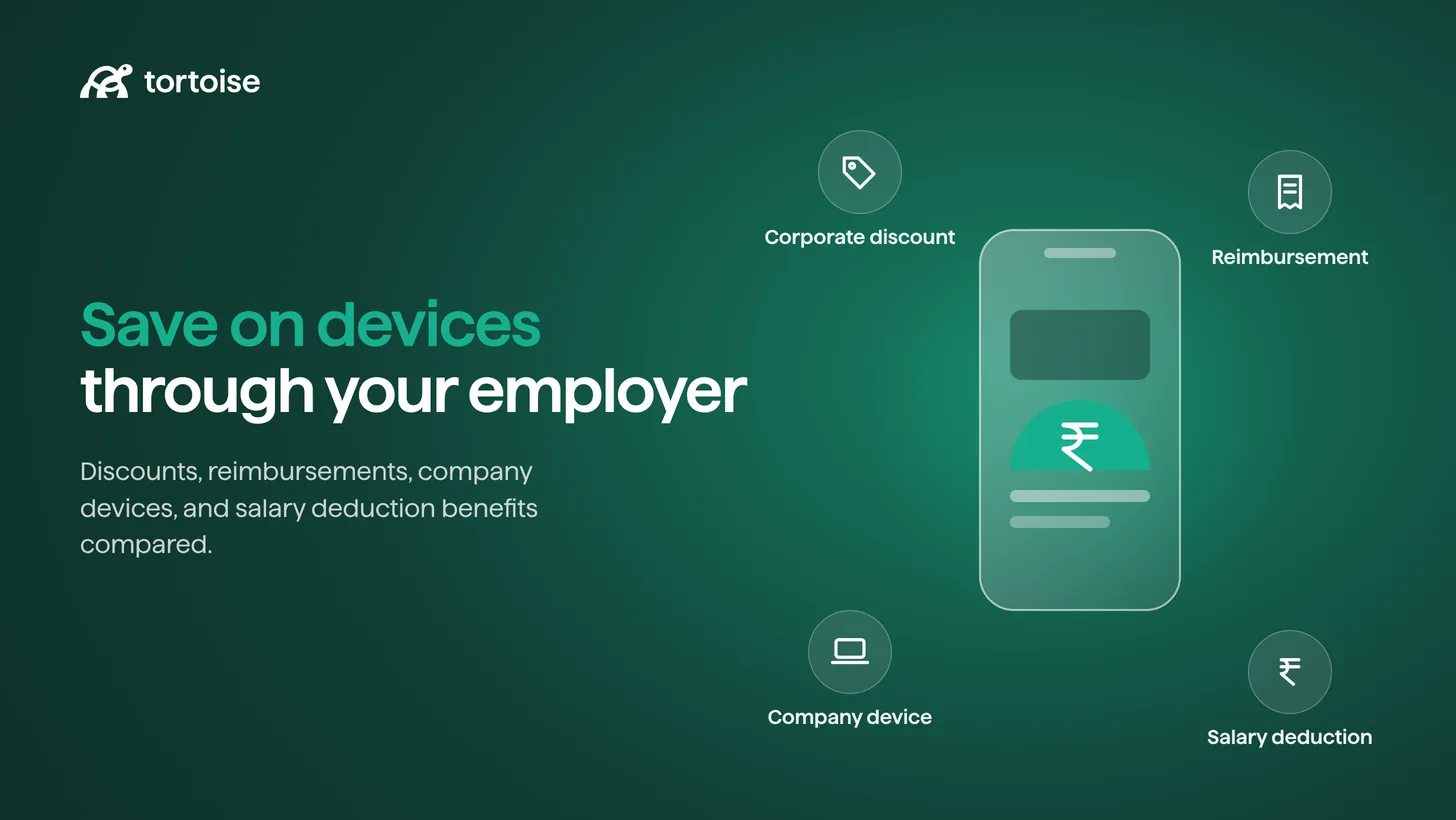
Employees save on devices through their employer in four ways. They can buy at a corporate discount, get part of the cost reimbursed, use a device the company provides, or join a salary deduction device benefit that spreads the cost across monthly payroll deductions taken before tax. Each route lowers the price in a different way, and only the last one also lowers the income tax the employee pays.
The right route depends on your tax regime, your income, the device you want, and how long you expect to stay with the employer.
At a glance
A salary deduction device benefit gives employees the largest saving on a device, up to 40%, depending on tax slab, because the monthly rental comes out of gross salary before income tax. Under the new tax regime, employees with taxable income up to ₹12 lakh get no income tax savings from it, so a corporate discount may suit them better.
Four ways to save through your employer
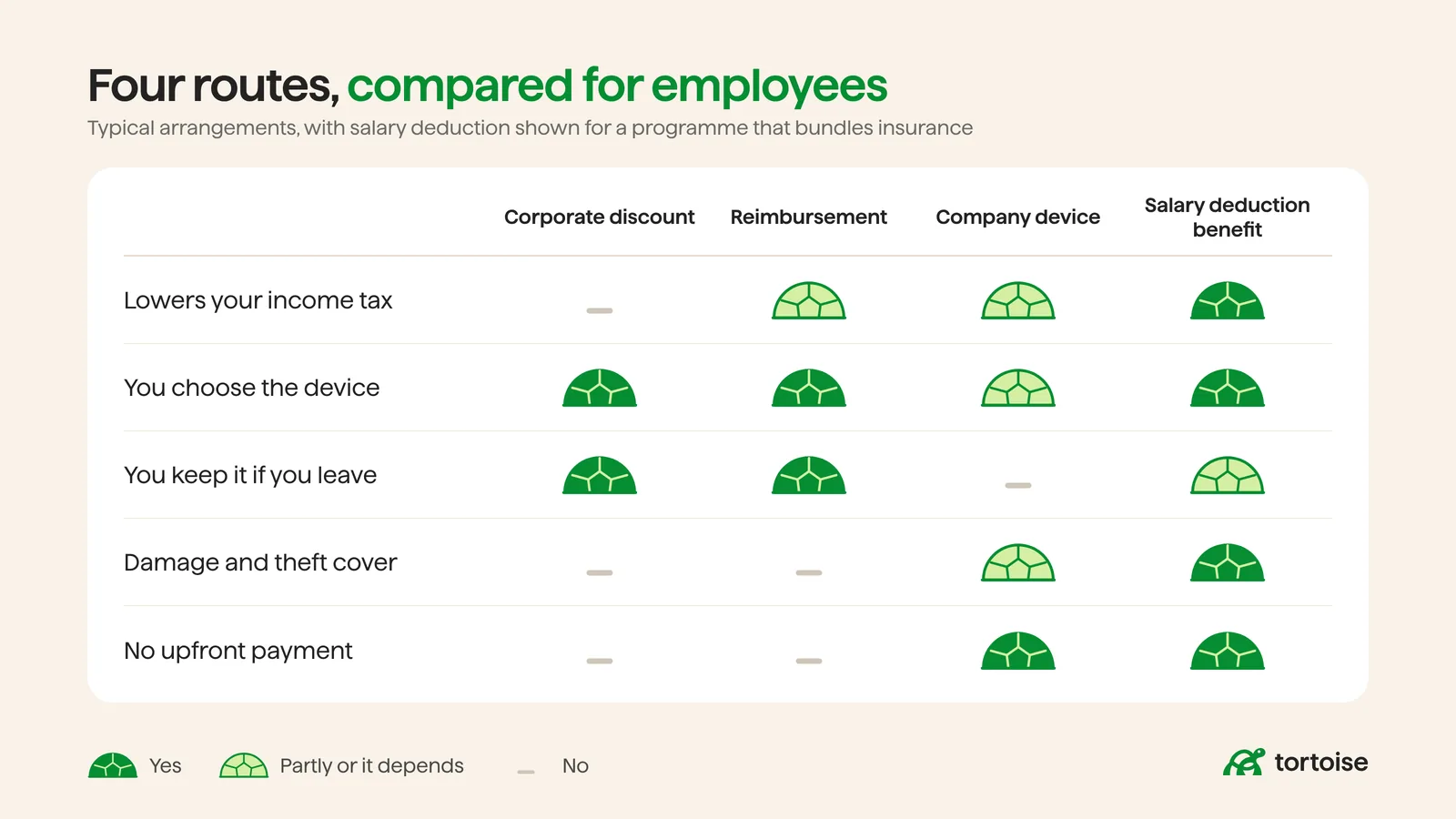
The four routes differ in who pays, how the saving arises, and who owns the device at the end. The table below sets them side by side:
| Route | How you save | Who pays | Who owns the device |
|---|---|---|---|
| Corporate discount or EPP | A lower price agreed with the brand or a reseller | You, from take-home pay | You |
| Reimbursement | Your employer repays part of the cost against bills | You first, then your employer repays part | You |
| Company-provided device | You pay nothing for a work device | Your employer | Your employer |
| Salary deduction device benefit | Monthly rental taken from gross salary, so less income tax | You, through payroll before tax | You, at the end of the lease |
A corporate discount is the simplest, but you still pay from salary that has already been taxed. A company-provided device costs you nothing, but it stays with the employer and goes back when you leave. The salary deduction route is the only one where both the price and your tax bill go down.
How a salary deduction device benefit works
This benefit lets you choose an approved laptop, phone, or tablet, and pay for it through monthly deductions from your gross salary instead of buying it outright. Your employer leases the device from a leasing partner and passes it to you under a written policy, so the device is part of your pay structure rather than a personal purchase.
From the employee's side, the steps are short:
- You pick a device within your company's eligibility limit
- Your manager or HR approves the request
- The device is delivered to the address you choose
- Monthly deductions start after delivery and run for the lease term
- At the end of the lease, ownership usually passes to you for a small amount
Because the rental is deducted before income tax is worked out, your taxable salary goes down by the same amount. Our explainer on how employee device leasing works covers the employer and leasing side of the arrangement.
Where the saving comes from
The saving comes from two places: income tax you no longer pay on the part of your salary that goes to the device, and GST handled within the leasing structure instead of being paid in full at retail. The income tax part is the easier one to put in numbers.
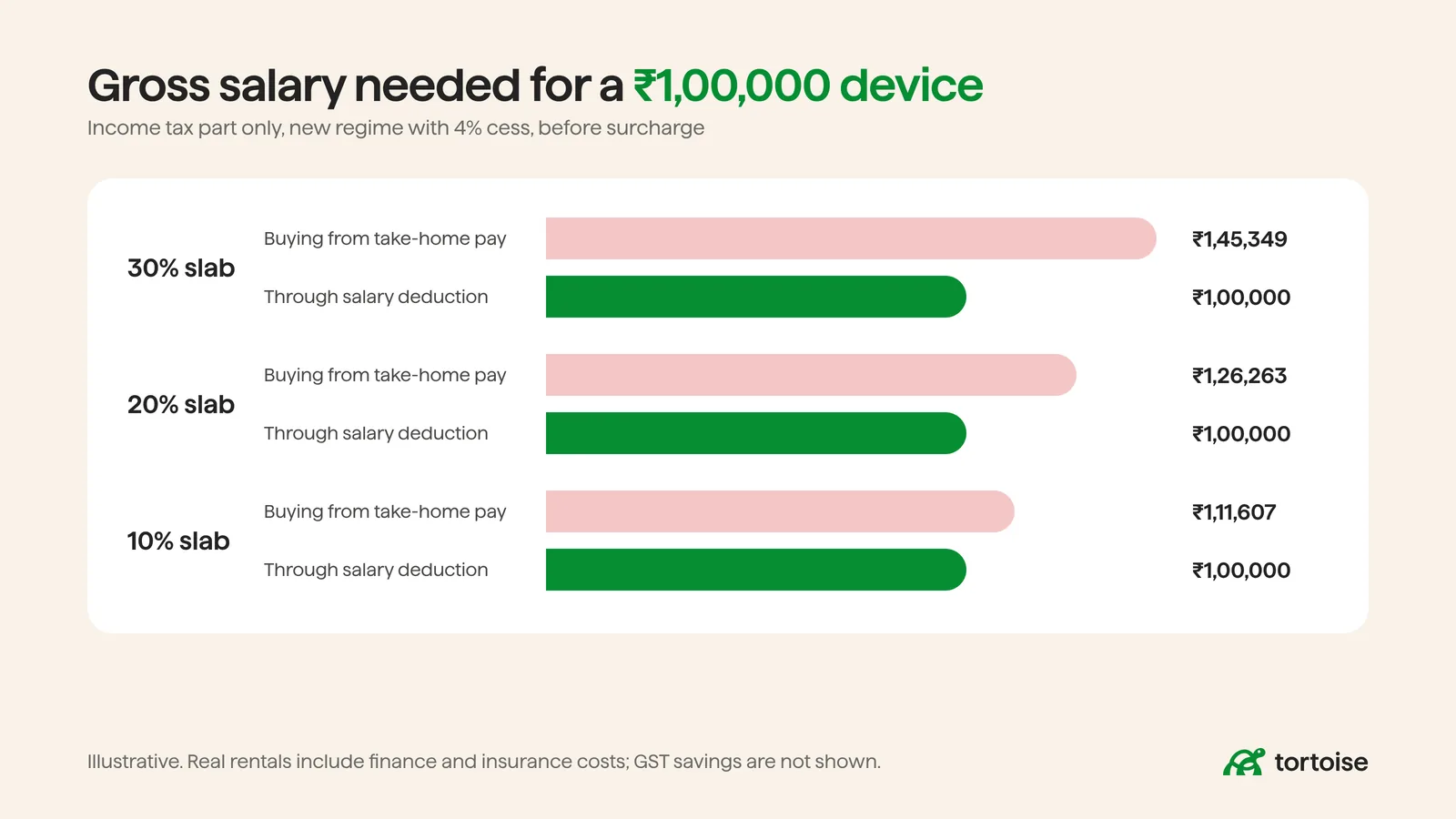
When you buy a device yourself, you pay for it from take-home pay. That money has already been taxed at your highest slab rate. When the same amount comes out of gross salary, you pay no income tax on it.
The table below shows the income tax part alone, for a device whose rentals add up to ₹1,00,000 over the lease. It uses the new tax regime rates for tax year 2026-27, with 4% cess, and leaves out surcharge:
| Your highest tax rate | Income tax not paid on ₹1,00,000 | Effective cost after the tax saving |
|---|---|---|
| 30% | ₹31,200 | ₹68,800 |
| 20% | ₹20,800 | ₹79,200 |
| 10% | ₹10,400 | ₹89,600 |
| Nil tax (taxable income up to ₹12 lakh) | ₹0 | ₹1,00,000 |
These figures are illustrative. Real rentals include the lease's finance and insurance costs, and the GST part adds a further saving on top. That combination is how the total saving reaches up to 40% for employees in the highest slabs.
What changes the size of your saving
Your tax position decides most of the saving, so check it before you choose a device. Four things change the result.
Your tax slab. The higher your slab, the more income tax the deduction saves. At the 30% rate, the income tax part alone is close to a third of the device's cost.
Your tax regime. Under the new regime, a salaried employee with taxable income up to ₹12 lakh pays no income tax after the rebate. With the ₹75,000 standard deduction, that covers a salary of about ₹12.75 lakh. Below that level, the income tax part of the saving is zero, and any saving comes from the GST and pricing side alone.
The lease terms. A longer lease means smaller monthly deductions but more finance cost. Insurance included in the rental adds to the cost, though it also removes the risk of paying for a repair or a stolen device yourself.
Leaving early. If you resign before the lease ends, foreclosure charges can be recovered from your full and final settlement, and you can usually still buy the device for a small amount. Our guide on leased devices at resignation explains the exit terms.
Corporate discounts and brand EPPs
A corporate discount or employee purchase program lowers the price you pay, but it does not change your tax. Brands such as Apple, Samsung, Lenovo, and HP run programmes for employees of partner companies, through portals where employees sign in with a work email.
The discount suits employees whose taxable income is below the new regime's ₹12 lakh limit, because a salary deduction would not cut their income tax. It also suits anyone who wants a device outside their company's approved list.
You pay the full discounted price upfront from take-home pay, the device is not insured through your employer, and the choice is limited to that brand. Our list of corporate employee purchase programs compares the main ones.
Reimbursements and company devices
A reimbursement repays part of what you spend, and a company device removes the cost altogether, but both come with conditions. They are common for phones, internet, and laptops used for work.
Telephone reimbursement is the most familiar form. When your employer repays phone or internet bills that you submit for official use, the repayment is generally not taxed as part of your salary. A fixed monthly allowance paid without bills is taxed as salary instead. Our article on work from home benefits covers the difference in more detail.
A laptop owned by your employer and given to you for work is not taxed as a perquisite in your hands while the employer owns it. The trade-off is that you do not choose the model freely, and you return it when you leave. Our guide on how technology benefits are taxed explains the perquisite rules under the Income-tax Act, 2025.
Questions to ask HR before you join
A few answers from HR will tell you whether the salary deduction route works for you. Ask these before you place an order:
- Which devices and price limits apply to my grade?
- How much will my monthly deduction be, and how long is the lease?
- Are accidental damage, liquid damage, and theft covered by the rental?
- What happens to the device and the remaining amount if I resign or transfer?
- Will the deduction appear as a separate line on my payslip?
- Do I own the device at the end, and what do I pay for it?
Ask for the answers in writing, because the device policy is a document you sign. If any answer is unclear, compare the monthly deduction with what the same device would cost you from take-home pay at your tax rate.
Seeing your saving before you order
Tortoise is an employee device benefit platform that shows employees their saving before they commit. Its in-app calculator shows the effective price, the monthly deduction, and the change in your net salary for the device you choose, so you can compare devices on real numbers instead of estimates.
Deductions start only once the device reaches you. Tortoise Corporate Care covers accidental and liquid damage and theft, and you can reach support through a 24×7 toll-free number, WhatsApp, or email. Employees can save up to 40%, depending on their tax slab, and own the device at the end of the lease.
If your employer is looking at adding a device benefit, our team would be glad to show HR how the numbers work for your team.
Check your tax rate before choosing
Start with your highest tax rate and your tax regime, because they decide whether a salary deduction saves you a third of the price or nothing on the income tax side. If your taxable income is above the new regime's ₹12 lakh limit, ask HR for the monthly deduction on the device you want and compare it with buying from take-home pay. If it is below, a corporate discount may be the better route.
Disclaimer: This guide is intended for general informational purposes only and should not be treated as legal, tax, payroll or accounting advice. Applicability of employee benefit laws in India depends on several factors, including the nature of the establishment, employee category, wage levels, location, headcount, employment terms and applicable central and state laws. Tax treatment of benefits may also vary depending on the structure adopted, documentation, payroll processing and the employee's applicable tax regime. Employers should consult their legal, tax and payroll advisors before implementing or modifying any employee benefit programme.
Frequently asked questions
How can employees save on devices through their employer in India?
Employees can save in four ways: buying at a corporate discount, getting part of the cost reimbursed, using a company-provided device, or joining a salary deduction device benefit. The salary deduction route usually saves the most, up to 40%, depending on tax slab, because the monthly rental comes out of gross salary before income tax is worked out.
What is a salary deduction device benefit for employees in India?
It is an employer-sponsored benefit where an employee chooses an approved laptop, phone, or tablet and pays for it through monthly deductions from gross salary. The employer leases the device from a leasing partner and passes it to the employee under a written policy. Deductions start after delivery, and ownership usually passes to the employee at the end of the lease.
How much can employees save through a salary deduction device benefit?
Up to 40%, depending on tax slab. The income tax part alone saves about 31% of the device's cost for an employee taxed at 30%, plus cess, and about 21% at the 20% rate. GST handled within the leasing structure adds to that. The in-app calculator on a platform like Tortoise shows each employee their own figure before ordering.
Does a salary deduction save tax under the new tax regime?
It does if your taxable income is above ₹12 lakh, because the deduction lowers the income taxed at your highest rate. With the ₹75,000 standard deduction, salaried employees earning up to about ₹12.75 lakh pay no income tax under the new regime, so the income tax part of the saving is zero for them, though the GST and pricing part can still apply.
Is a corporate discount better than a salary deduction device benefit?
It depends on your tax position. A corporate discount lowers the price but not your tax, and you pay upfront from take-home pay. A salary deduction lowers your taxable salary as well, which saves more for employees in higher slabs. If your taxable income is below the new regime's ₹12 lakh limit, a corporate discount may work out better.
What happens to my device if I leave the company before the lease ends?
Foreclosure charges for the remaining lease can be recovered from your full and final settlement, and you can usually still buy the device for a small amount. The exact terms depend on your employer's programme, so check the device policy before you order, especially if you expect to move jobs within the lease term.
Written by
Founder & CEO
Vardhan Koshal is the Co Founder of Tortoise, India’s fastest growing employee device benefit platform. He has led India growth and product for companies like TripAdvisor and Udacity, and earlier founded Ridingo, a car pooling startup recognised by Forbes as one of the Hottest Global Startups and acquired by Carzonrent. At Tortoise he works with HR leaders, CFOs and tax experts to design compliant, high impact device benefit programs for Indian employers.