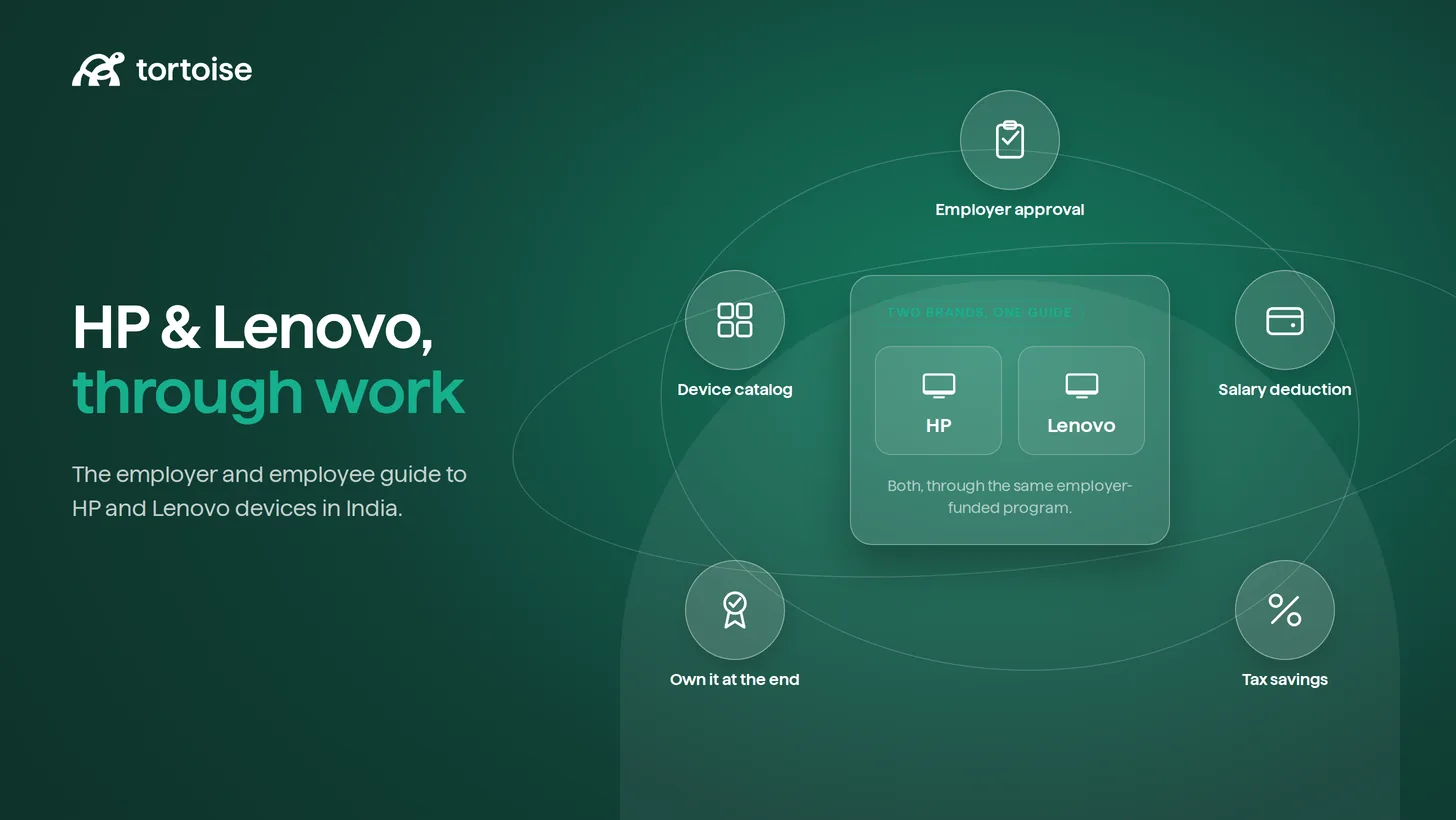
HP and Lenovo Employee Purchase Program India: The Employer and Employee Guide

When people search for HP and Lenovo employee purchase program India, they usually want a simple answer: how can employees get a laptop discount, and what does the company need to enable? The short answer is that HP and Lenovo both offer corporate purchase routes where eligible employees can access device offers through official work-email verification or organisation-level access.
For employees, these programs can reduce the cost of buying a laptop, desktop, monitor, printer, or accessory for BYOD, home office setups, productivity upgrades, or personal use. For HR, payroll, and finance teams, the bigger question is whether a brand-specific purchase discount is enough.
Yes, a purchase program helps at checkout, but a complete device benefit also needs affordability, payroll alignment, policy control, insurance, repairs, returns, and lifecycle management.
How HP’s employee purchase program works in India
HP’s employee purchase route in India is available through the HP Corporate Employee Store. The access journey is straightforward: employees enter their company email address to sign in or create an account, then access eligible corporate savings if their email or organisation is supported.
HP currently presents the store around exclusive discounts, up to ₹12,000 instant cashback, laptop exchange benefits, and other savings on eligible products. The page also makes it clear that exclusions and terms apply, so employees should verify live offers before making a purchase. Offer availability can change by product category, campaign, employer eligibility, and payment method. HP’s Corporate Employee Store is the current source of truth for access and offers.
For employers, HP’s model can be a low-admin way to help employees access discounted devices. HR may only need to share the correct store link and basic instructions. The limitation is that this remains a purchase pathway. It does not automatically create payroll deduction workflows, device policy rules, insurance coverage, repair coordination, lifecycle tracking, return handling, or refresh planning. Those pieces need a separate employer-side structure.
How Lenovo’s employee purchase program works in India
Lenovo’s Corporate Employee Purchase Program in India follows a similar but more explicit verification flow. Employees register with an official email ID, receive an email to verify whether their organisation has been whitelisted, verify access, log in, and then shop through the Lenovo Corporate Store.
Lenovo currently highlights up to 10% additional discount, bonus My Lenovo Rewards, cashback, card offers, early access to new launches, configured-by-you options, automatic warranty registration on PC purchases, no-cost EMI up to 6 months, online chat assistance, and free shipping.
As with any corporate employee discount, employees should check the official page before purchase because terms and availability can change. Lenovo’s Corporate Employee Purchase Program explains the current access steps and listed benefits.
For employees who already prefer Lenovo devices, this can be a useful route for laptops, desktops, monitors, and accessories. For employers, it works when the goal is self-serve access without building a broader benefit. The limitation is similar to HP: the program is brand-specific and purchase-led. It does not by itself create a multi-brand, payroll-linked, policy-led employee device benefit.
HP vs Lenovo employee purchase programs: quick comparison
Both programs are useful for employee self-service, but they solve a specific problem: access to brand-led purchase offers. They do not solve the full employer-side device benefit problem.
| Area | HP Corporate Employee Store | Lenovo Corporate Employee Purchase Program | HR implication |
|---|---|---|---|
| Access | Company email sign-in or account creation | Official email registration and organisation whitelisting | Eligibility depends on employer or email-domain access |
| Main benefits | Corporate savings, cashback, laptop exchange benefits | Additional discount, rewards, cashback cards, EMI, free shipping | Good for individual purchases |
| Product scope | HP laptops, PCs, printers, and accessories | Lenovo laptops, desktops, monitors, and accessories | Brand-specific device choice |
| Payment model | Employee purchase | Employee purchase | Payroll deduction is not automatic |
| Employer effort | Low | Low | Works as a light-touch perk |
| Lifecycle support | Standard purchase and warranty route | Standard purchase and warranty route | Separate support needed for policy, repairs, returns, and refresh |
That makes HP and Lenovo employee purchase programs helpful for one-time buying. It also means HR should not confuse them with a complete device benefit framework.
Employee purchase program vs device leasing: what is the difference?
An employee purchase program is not the same as device leasing. An employee purchase program helps eligible employees buy devices at discounted or promotional pricing. The employee usually completes the transaction directly through the brand store, using their own payment method or available financing option.
A payroll-linked device leasing benefit works differently. It is an employer-enabled structure where employees can access devices through monthly deductions, policy-defined eligibility, and managed lifecycle support. Depending on how the program is structured, it may also support tax optimisation opportunities, HRMS and payroll integration, insurance, repair workflows, replacements, returns, upgrades, and end-of-term management.
| Question | OEM employee purchase program | Payroll-linked device leasing |
|---|---|---|
| What does it solve? | Discounted purchase access | Structured device access and benefit management |
| How does the employee pay? | Upfront, card, EMI, or available retail financing | Payroll-linked monthly deductions, where implemented |
| Is it brand-specific? | Usually yes | Can support broader device choice |
| Does HR control policy rules? | Limited | Yes, if configured into the program |
| Does it manage lifecycle? | Limited to standard purchase support | Can include insurance, repairs, returns, and refresh workflows |
This is where the employer conversation changes. A purchase discount reduces the checkout price. A device leasing program can make the benefit easier to govern across HR, payroll, finance, and employee experience.
Indian companies prioritise device leasing when they want clearer payroll, GST, tax, and audit workflows.
Which option should Indian employers choose?
HP or Lenovo EPP access is usually enough when the company wants a simple employee perk. It works well when employees are buying devices for personal use, BYOD use, or individual productivity, and the employer does not want to subsidise purchases or manage the device lifecycle. It can also be a good first step for companies that want to test employee interest before building a wider device benefit.
A managed payroll-linked device leasing program becomes more relevant when affordability matters beyond a one-time discount. Many employees still find premium laptops expensive even after cashback or EMI offers. A monthly deduction model can make access easier, especially when the employer wants a policy-compliant benefit instead of scattered individual purchases.
HR should also consider leasing when eligibility rules need to be controlled by grade, tenure, device category, or budget. Payroll teams may need clean deduction workflows. Finance may need consistent documentation. Operations teams may need clarity on repairs, replacements, loss, damage, returns, and upgrades. Employee welfare committees may want a benefit that feels tangible without adding manual work.
Tortoise is built for this second scenario. Its device benefit model supports payroll and HRMS integrations, policy implementation, insurance and care packages, repair and replacement workflows, and end-of-life logistics for employers that want more than a discount store. Tortoise is better suited when the goal is a scalable employee device benefit across teams, not only a brand-specific purchase offer.
Employer checklist before enabling HP or Lenovo EPP
Before HR enables any corporate employee laptop discount in India, it should answer a few practical questions.
- Is the company domain eligible or whitelisted for HP, Lenovo, or both programs?
- Are employees buying devices for personal use, work use, BYOD use, or a mix of all three?
- Will the company subsidise any part of the purchase, or is the discount fully brand-funded?
- If there is a subsidy, how will payroll, tax, GST, and documentation be handled?
- Does HR need grade-wise eligibility, spending limits, device category rules, or tenure conditions?
- Who owns warranty claims, accidental damage, repairs, loss, replacement, and returns?
- Should employees get only HP or Lenovo options, or should the benefit support multiple brands?
- Is this a one-time purchase perk or a long-term employee device benefit?
The answer matters because a simple EPP can be launched with low effort, while a structured device benefit needs policy design, payroll coordination, and ongoing administration.
If your team is leaning towards the structured route, we're happy to help you scope what it would involve.
Practical next step for HR teams
If the goal is simple discount access, HP and Lenovo corporate stores may be enough. They give eligible employees a self-serve way to buy devices through official brand channels.
If the goal is affordability, payroll integration, tax optimisation opportunities, insurance, care, compliance support, and lifecycle management, HR should evaluate a managed leasing model. Tortoise helps Indian employers design and run employee device benefit programs that connect employee experience with payroll, finance, and policy requirements.
Disclaimer: This article is intended for general informational purposes only and should not be treated as legal, tax, payroll, or accounting advice. Applicability of employee benefit laws in India depends on factors such as establishment type, employee category, wage levels, location, headcount, and employment terms. Tax treatment may also vary depending on program structure, documentation, payroll processing, and the employee’s applicable tax regime. Employers should consult their legal, tax, and payroll advisors before implementing or modifying any employee benefit programme.
Frequently asked questions
What is the HP Employee Purchase Program in India?
The HP Employee Purchase Program in India is available through the HP Corporate Employee Store, where eligible employees can use a company email address to sign in or create an account and access corporate savings. Current benefits may include discounts, cashback, laptop exchange benefits, and other offer-led savings, subject to eligibility and terms.
What is the Lenovo Employee Purchase Program in India?
Lenovo’s Corporate Employee Purchase Program lets eligible employees of supported organisations access corporate store benefits after registering with an official email ID and verifying whether their organisation is whitelisted. Benefits may include additional discount, rewards, cashback card offers, EMI, free shipping, warranty registration, and early access to launches.
Are HP and Lenovo employee purchase programs free for employers?
They can be low-cost or no-cost for employers when employees buy directly through the official corporate stores and the discount is brand-funded. Employer costs can arise if the company adds a subsidy, reimbursement, payroll deduction model, managed store, or broader device benefit.
Is device leasing better than HP or Lenovo corporate discounts?
Device leasing is often better when the employer wants more than a one-time purchase discount. Leasing can support payroll-linked affordability, policy control, insurance, repairs, lifecycle management, and potential tax optimisation. HP and Lenovo discounts are better for simple, self-serve, brand-specific purchases.
Can employees get HP or Lenovo laptops through payroll deductions?
HP and Lenovo corporate stores are primarily purchase routes. Employees can access HP, Lenovo, and other laptops through payroll deductions when the employer implements a structured device leasing or employee device benefit program through a provider such as Tortoise.
Written by
Founder & CEO
Vardhan Koshal is the Co Founder of Tortoise, India’s fastest growing employee device benefit platform. He has led India growth and product for companies like TripAdvisor and Udacity, and earlier founded Ridingo, a car pooling startup recognised by Forbes as one of the Hottest Global Startups and acquired by Carzonrent. At Tortoise he works with HR leaders, CFOs and tax experts to design compliant, high impact device benefit programs for Indian employers.