
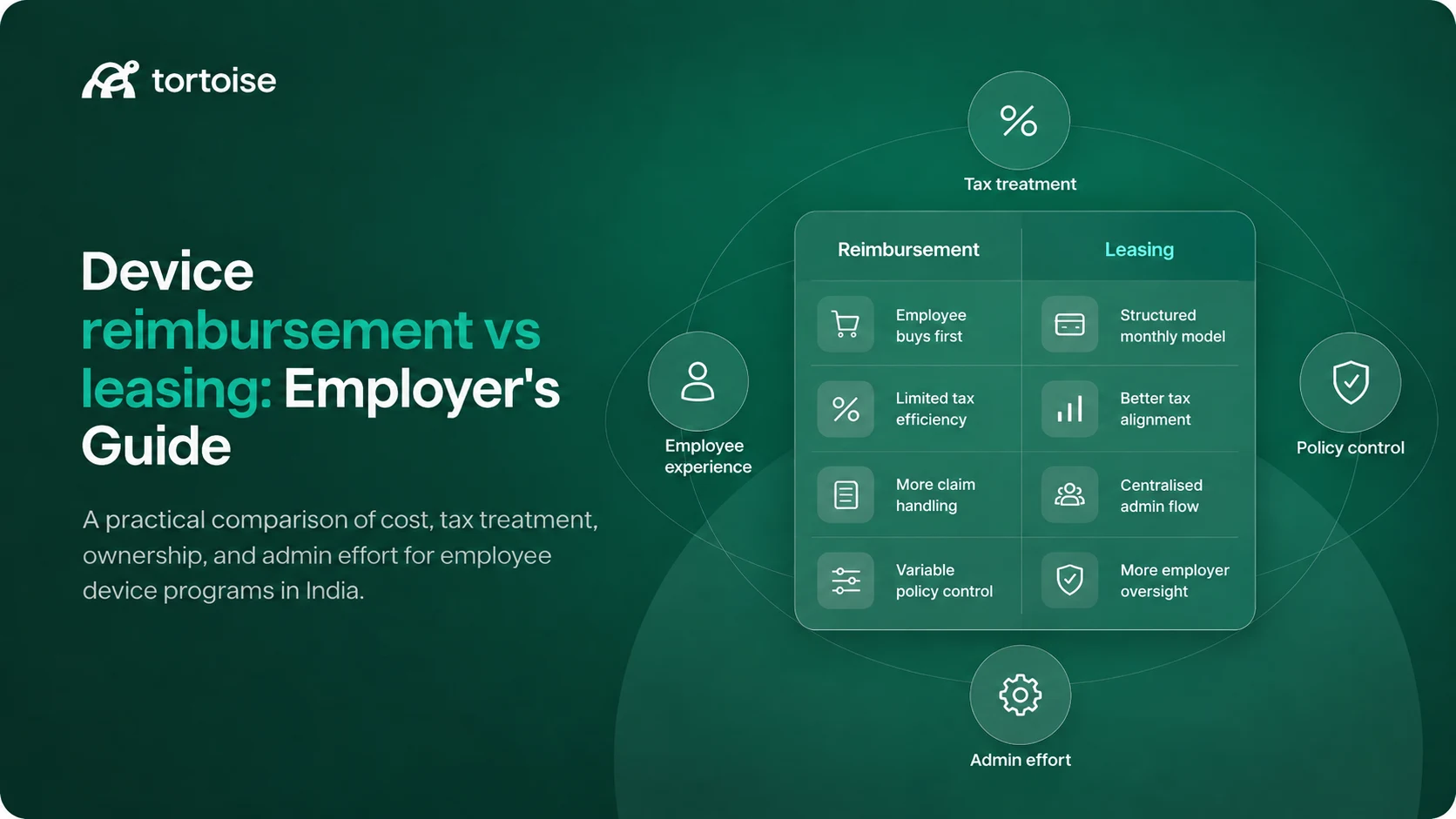
Device reimbursement vs leasing: how Indian employers should decide

For Indian employers, device reimbursement vs leasing is a choice between two operating models, not only between an invoice and a monthly rental. It affects ownership, payroll, tax treatment, security, employee experience, and who carries the work when a device is lost, damaged, upgraded, or returned.
As a rule of thumb, reimbursement works well for occasional, tightly controlled business expenses. Structured device leasing is usually a better fit for a repeatable employee device benefit, especially when employees need choice, the company wants predictable payroll deductions, and HR needs insurance and lifecycle support.
The right answer depends on how the programme will be governed, not just on the headline monthly cost.
Reimbursement and leasing: what each model actually means
Device reimbursement
With reimbursement, an employee buys a smartphone, tablet, laptop, or other approved device and submits a claim. The employer checks the invoice, confirms that the purchase meets policy, and reimburses some or all of the cost, subject to a cap or eligibility rule.
This model is familiar and easy to explain. It can work when employees make occasional purchases, the company has a small workforce, or the device is clearly required for business use. But the employee may own the device personally, leaving open questions about data access, repairs, replacement, depreciation, and what happens when they leave.
Reimbursement also places the operational burden on HR, payroll, finance, and the employee. Someone must validate invoices, manage exceptions, decide whether accessories qualify, and resolve disputes over warranties or damaged devices.
Employee device leasing
In an employee device leasing programme, the employer works with a leasing or benefit partner to make approved devices available to eligible employees. Employees choose within policy limits, the device is delivered, and the agreed rental or deduction is processed through payroll.
The arrangement should document ownership, insurance, support, exit treatment, and whether the employee can return, upgrade, or purchase the device at the end.
Leasing is not the same as an employee taking a conventional post-tax EMI. It is a structured arrangement that may connect the device, lease contract, payroll deduction, and end-of-term outcome.
Its value is therefore operational as well as financial: it can create a consistent experience across a large and distributed workforce.
Let’s give your workforce the best benefits experience!
Over 50,000 employees are already enjoying their new devices with heavy savings. Get it for your workforce too
Device reimbursement vs leasing: side-by-side comparison
| Decision factor | Reimbursement | Structured device leasing |
|---|---|---|
| Upfront employee cost | Employee may pay first and wait for reimbursement | May avoid a large upfront payment, subject to programme terms and any deposit |
| Ownership | Usually sits with the employee or is unclear | Defined in the master agreement and end-of-term policy |
| Employee choice | Depends on policy and claim approval | Can offer a catalogue or approved choice architecture |
| Payroll work | Claim reimbursement and accounting entries | Eligibility, recurring deductions, reconciliation, exits, and changes |
| Tax treatment | Depends on the purpose, ownership, use, and documentation | Depends on the exact lease, salary, ownership, use, and transfer structure |
| GST and accounting | Invoices and input-credit treatment need validation | Lease invoices, ITC, and accounting treatment need validation |
| Insurance and repairs | Often employee-managed unless separately covered | Can be bundled with insurance, care, and support |
| Security control | Harder if the employee owns and configures the device | Easier to define approved devices, onboarding, and return controls |
| Refresh cycle | Usually triggered by a new claim | Can be planned around the lease term or upgrade policy |
| Scalability | Administration grows with every claim and exception | Better suited to a repeatable benefit, if systems and SLAs are strong |
| Exit handling | Policy must address personal ownership and company data | Return, buyout, or transfer can be defined before enrolment |
The important distinction is that operational simplicity is not the same as financial simplicity. Reimbursement may look easier because it uses an existing expense process.
At scale, however, inconsistent invoices, ownership questions, support requests, and employee exits can make the total effort substantial. Leasing introduces a programme to manage, but a well-designed programme can make recurring work more predictable.
When reimbursement is the better choice
Reimbursement is often the sensible option when the need is occasional rather than programme-based. It may suit a small team, a one-off business purchase, an employee who already has a suitable device, or a role where the company only needs to cover clearly documented business expenses.
It is also useful when the company wants to keep employee choice broad and does not want to introduce a leasing partner. A straightforward policy can specify eligible categories, maximum amounts, invoice requirements, approval authority, replacement frequency, and whether the device remains the employee’s property.
The trade-off is control. A reimbursement policy should answer what happens if an employee leaves shortly after claiming, whether the company can remove corporate data, who pays for repairs, and whether the employee must return the device. If those questions are left vague, a low-friction purchase can become a difficult HR or IT case later.
Reimbursement is therefore strongest as a controlled exception or expense policy. An employee device reimbursement India policy can work well for a small, tightly managed population, but it is less suited to a company-wide benefit where dozens or thousands of employees need a consistent experience.
When leasing is the better choice
Leasing becomes more attractive when the company wants to offer devices as a repeatable employee benefit rather than process isolated claims. Employee device leasing for employees in India can be a good fit for distributed teams, competitive hiring markets, hybrid workforces, and employers that want employees to access higher-value devices without a large one-time outlay.
A structured programme can let employees choose from an approved range, see the effect of a payroll deduction, and receive protection or care as part of the offer.
For HR, the benefit is a defined operating model: eligibility, approvals, payroll files, support, insurance, refreshes, and exit events can follow a policy instead of being reinvented for every request. That consistency is the foundation of practical device lifecycle management.
Leasing can also support a deliberate device lifecycle. Rather than waiting for a broken laptop or an outdated phone to generate a new claim, the employer can plan refresh, collection, data wiping, and end-of-term outcomes. That is particularly relevant for companies that take information security and employee offboarding seriously.
Leasing is not automatically better. Poorly defined contracts can create confusion around residual value, early exit, damage, buyouts, taxation, or final settlement. The programme should be judged on its full policy and service design, not on a promised percentage saving.
Most commonly asked India-specific tax, payroll, GST, and compliance questions
What tax guidance says
Indian tax treatment depends on the facts of the arrangement. The Income Tax Department’s guidance on perquisites distinguishes between different employer-provided assets, their use, and transfers to employees.
It indicates that use of an employer-owned device is generally treated differently from a personal purchase, a concessional transfer, or an asset used under a mixed arrangement.
That means an employer should not describe every device reimbursement as tax-free, and should not assume every lease produces the same tax outcome. The relevant questions include who owns the device, whether it is provided for official use, how the employee pays, whether ownership transfers, and how the benefit is recorded in payroll.
The Income Tax Rules on perquisite valuation and the department’s Rule 3 material should be reviewed with the company’s tax adviser for the specific structure.
What payroll must validate
Payroll should map the full employee journey, not just the first deduction. Before launch, validate eligibility, deduction timing, salary changes, leave, transfers, new joiners, cancellations, arrears, refunds, early exits, and final settlement.
The process should also specify what happens if the deduction cannot be made or an employee leaves before the lease term ends.
The employee communication should show the deduction clearly and explain its effect on take-home pay. It should also separate a payroll deduction from a guaranteed tax saving. Any tax impact depends on the approved structure and the employee’s circumstances.
What finance, IT, and legal must validate
Finance should review invoices, accounting treatment, GST and input tax credit eligibility, and the treatment of any residual value or buyout. IT and security teams should define device standards, encryption, mobile-device management, access removal, data wiping, and return controls.
Legal and privacy teams should review vendor access, employee data, insurance exclusions, service levels, and the handling of lost or stolen devices.
A credible programme should be transparent about these dependencies. It should never market a fixed savings percentage as a universal result without a case-specific tax, GST, payroll, and commercial review.
A practical decision framework for HR leaders
Start with five questions:
- Who owns the device during the programme?
- How will the employee use it, and how much control does IT require?
- Will the company process a handful of requests or run the benefit every month?
- Who handles loss, damage, support, refresh, and employee exit?
- What must payroll and finance reconcile each cycle?
If the answer is “the employee owns it, the need is occasional, and use is easy to document,” reimbursement may be the cleanest route.
If the answer is “the company must control the device and data,” employer-provided equipment may be preferable. If the answer is “employees want choice, the benefit should scale, and HR needs a managed lifecycle,” structured leasing deserves serious consideration.
A useful internal scorecard can rate each option from low to high on six dimensions: control, employee value, administrative effort, cash-flow predictability, compliance confidence, and lifecycle coverage.
Do not score only the monthly price. Include the cost of HR time, failed payroll files, unmanaged repairs, security gaps, and unclear exits.
Run a small pilot before a broad launch. Test a few device categories, one payroll cycle, an insurance claim scenario, a joiner, and an exit. The pilot should expose policy gaps before they affect the wider workforce.
How Tortoise makes leasing workable at enterprise scale
Tortoise helps Indian employers treat an employee device programme as a governed HR benefit, not merely a financing arrangement.
The model can combine employee choice within company policy with smart payroll deductions, HRMS and payroll integration, insurance and care packages, lifecycle support, and clearly documented end-of-term outcomes.
That matters because the hard part is rarely selecting a device. The hard part is coordinating HR, payroll, finance, IT, employees, and the service partner without losing clarity. Tortoise’s role is to help create that connective layer: a policy-led experience for employees and an auditable operating model for the teams responsible for it.
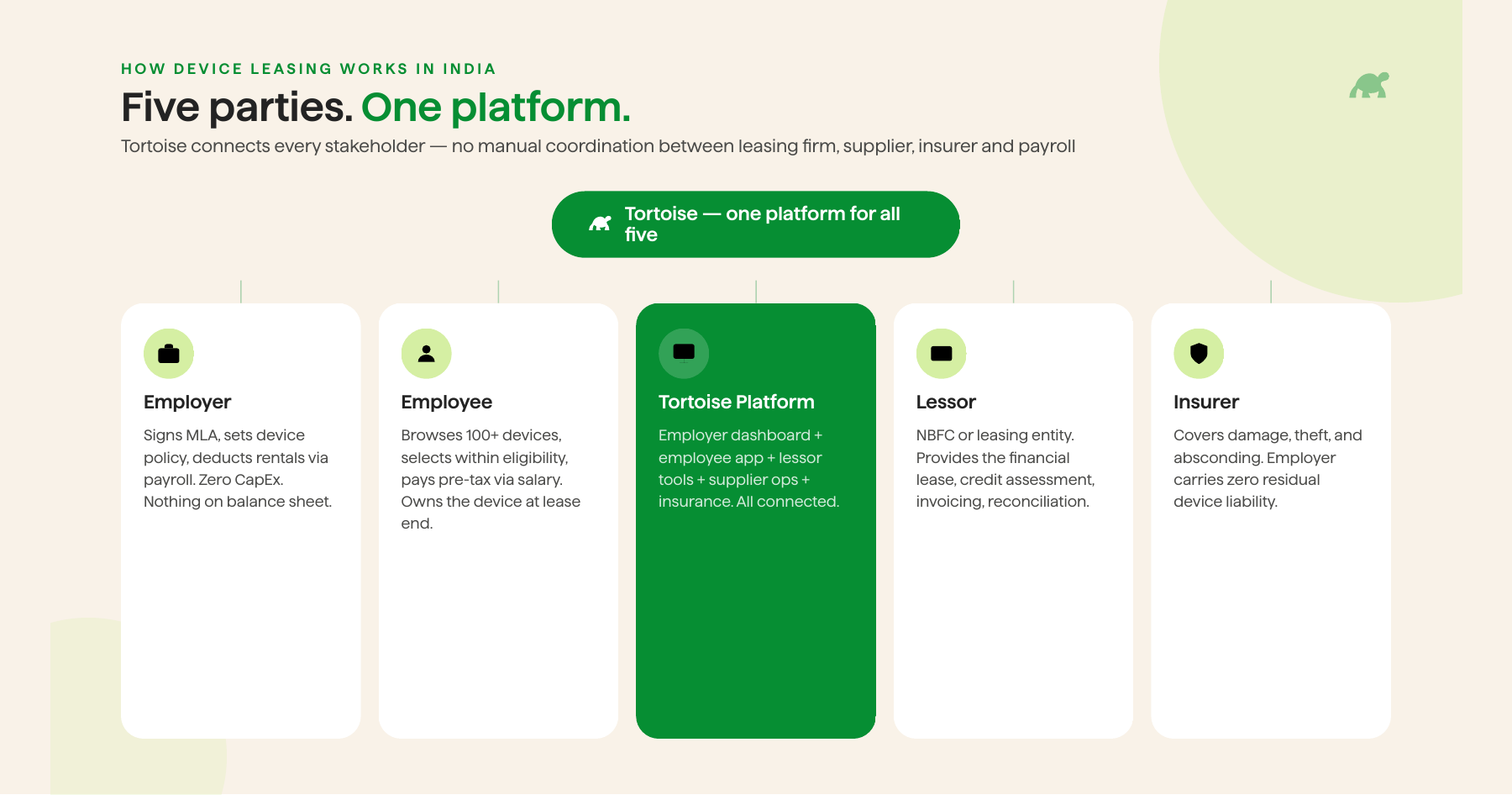
The programme can be tailored to the employer’s compliance standards, device categories, approval flows, and security requirements. Tax and GST treatment should still be validated for the chosen structure, but the operational foundation is designed to make that review, rollout, and ongoing administration more manageable.
Implementation checklist for an Indian employee device programme
Define eligible employee groups, device categories, value limits, ownership rules, lease duration, support coverage, insurance, and end-of-term choices. Bring HR, payroll, finance, IT, legal, and information security into the policy review early. Map joiner, mover, leaver, loss, damage, replacement, cancellation, and final-settlement workflows.
Then test the payroll integration with real scenarios, publish plain-language employee communications, and give managers an escalation path. Review deductions, service levels, claims, exits, and employee feedback quarterly. A programme that is easy to audit and easy for employees to understand will outperform one that only looks attractive in a spreadsheet.
Conclusion: choose the model that your organisation can govern
In the debate over device reimbursement vs leasing, reimbursement is usually best for occasional, well-documented expenses. Leasing is often better for a scalable employee device benefit that combines employee choice, predictable deductions, protection, and lifecycle management.
The decision should be based on ownership, use, payroll, tax and GST validation, security, and exit treatment, not on a headline saving. Tortoise can help Indian employers design and manage a structured device benefit that works for employees and the teams accountable for compliance. Explore how Tortoise can support your employee device programme.
Disclaimer: This guide is intended for general informational purposes only and should not be treated as legal, tax, payroll or accounting advice. Applicability of employee benefit laws in India depends on several factors, including the nature of the establishment, employee category, wage levels, location, headcount, employment terms and applicable central and state laws. Tax treatment of benefits may also vary depending on the structure adopted, documentation, payroll processing and the employee’s applicable tax regime. Employers should consult their legal, tax and payroll advisors before implementing or modifying any employee benefit programme.
Frequently asked questions
Is device leasing better than reimbursement for employees in India?
Reimbursement is often suitable for occasional, tightly controlled business expenses. Structured leasing is usually a better fit for a repeatable employee device benefit because it can combine employee choice, payroll-linked deductions, protection, and lifecycle support. The better model depends on ownership, tax treatment, security, scale, and exit rules.
Is a company laptop reimbursement taxable in India?
It depends on the arrangement. The tax outcome can vary based on ownership, official or personal use, documentation, and whether the asset is transferred to the employee. Employers should review the current Income Tax Rules and confirm the treatment with a qualified tax adviser rather than assuming reimbursement is tax-free.
Does device leasing reduce taxable salary?
A properly structured arrangement may affect taxable salary or payroll treatment, but a payroll deduction is not automatically a tax deduction. The result depends on the lease structure, ownership, use, employee circumstances, and applicable Indian tax rules. Employers should validate the structure before communicating savings.
Who owns the device at the end of a lease?
The answer depends on the agreement. Common options include returning the device, upgrading to a new device, or purchasing it at an agreed residual value. The ownership path, damage rules, and employee exit treatment should be documented before enrolment.
Can device leasing integrate with payroll and HRMS?
Yes. A structured programme can connect employee eligibility, approvals, recurring deductions, reconciliation, joiner and leaver events, and reporting with payroll or HRMS workflows. The exact integration depends on the employer’s systems and the provider’s implementation model.
Written by
Founder & CEO
Vardhan Koshal is the Co Founder of Tortoise, India’s fastest growing employee device benefit platform. He has led India growth and product for companies like TripAdvisor and Udacity, and earlier founded Ridingo, a car pooling startup recognised by Forbes as one of the Hottest Global Startups and acquired by Carzonrent. At Tortoise he works with HR leaders, CFOs and tax experts to design compliant, high impact device benefit programs for Indian employers.
RELATED READS
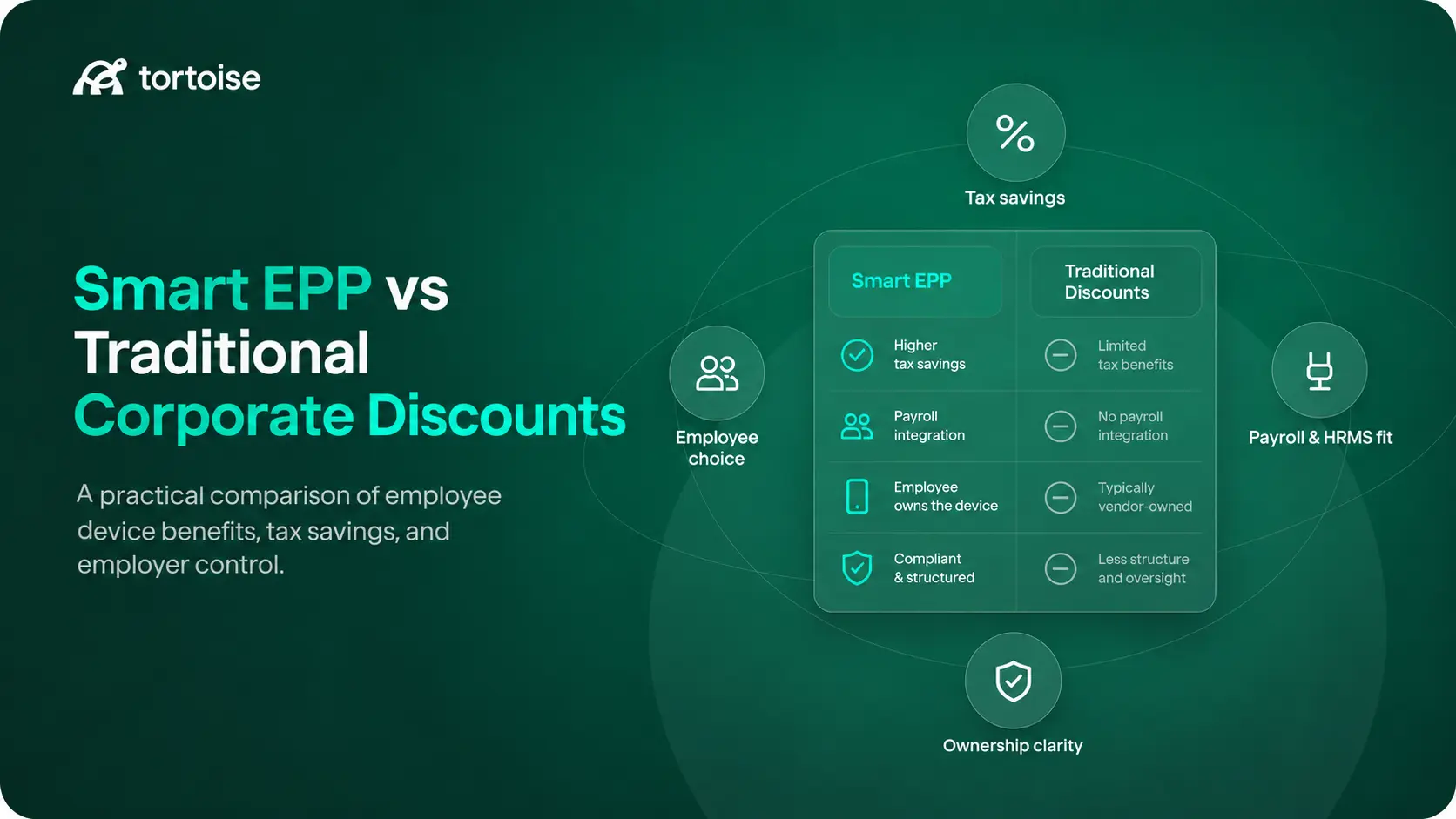
Smart EPP vs Traditional Corporate Discounts: What Employers Should Know
Vardhan KoshalSep 10, 202610 min read
How to Set Up a Corporate Employee Purchase Program in India: Step-by-Step Guide
Vardhan KoshalSep 9, 202611 min read
What to ask a device benefit provider before you sign
Vardhan KoshalSep 7, 20269 min read