How to Build an Employee Purchase Program? An HR's Guide

At a glance: An employee purchase programme (EPP) lets employees get phones, laptops, and other devices through their employer at a lower effective cost. HR sets the goal, chooses the model, writes the device policy, and runs the launch. A leasing-based EPP costs the employer nothing to run, and employees can save up to 40%, depending on their tax slab.
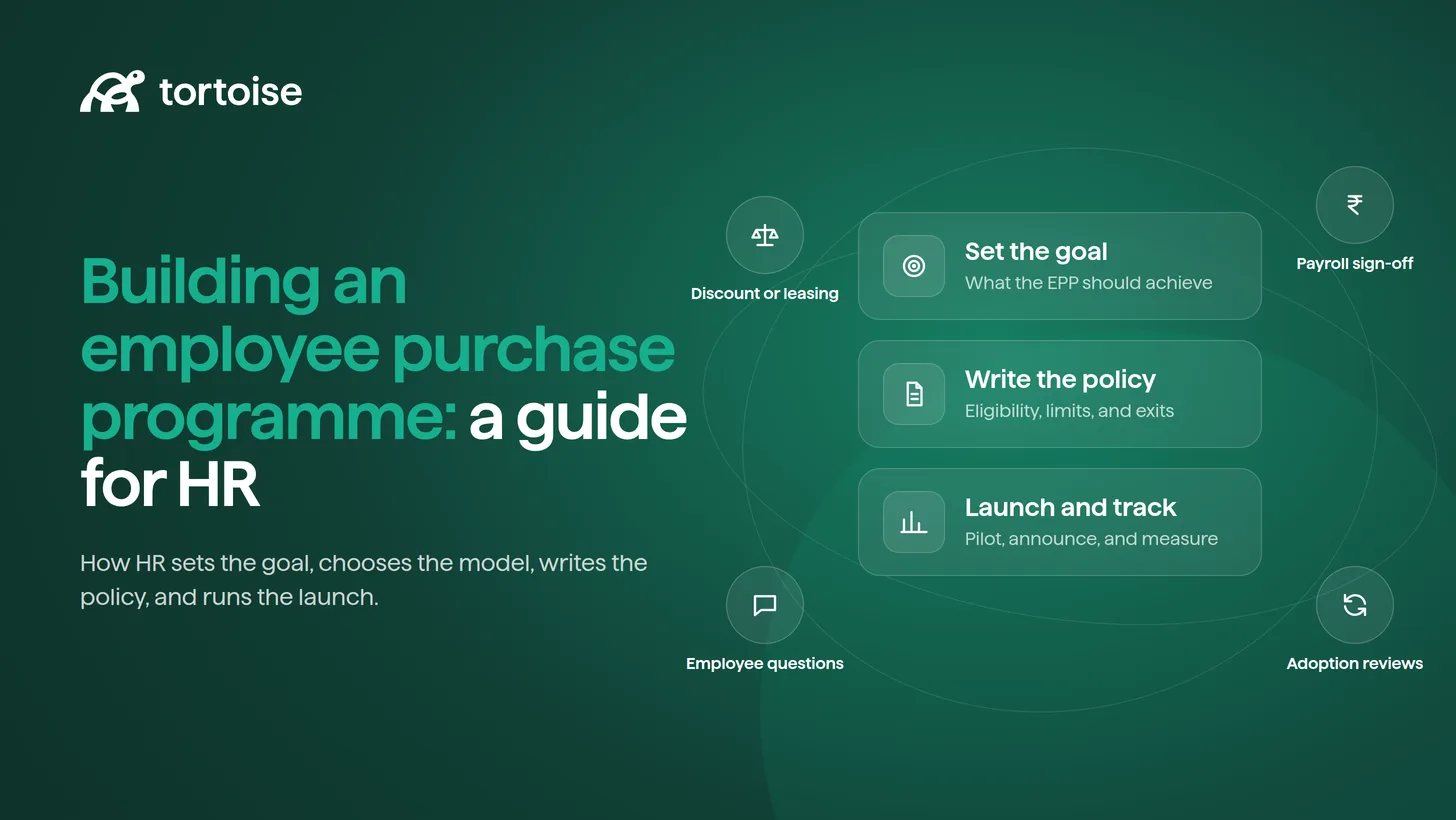
To build an employee purchase programme, HR sets a clear goal, chooses between a discount model and a leasing model, writes a device policy, and plans the launch. Finance, payroll, and IT each own part of the setup, but the policy and the employee experience are usually owned by HR.
This guide covers that HR side of the work. For the full cross-team setup, including contracts, payroll configuration, and insurance, our EPP setup guide goes through each stage in order.
A well-built EPP is one of the easier benefits to get right. Most employees buy a new phone or laptop every few years anyway, so a programme that lowers the cost of that purchase gets used without much persuasion.
What an employee purchase programme does
An employee purchase programme gives employees a better way to get personal devices through their employer. In India, EPPs come in two main forms, and they work very differently.
A discount EPP is usually run by a device brand. Employees log in to a brand portal, see a corporate discount, and pay the full discounted price themselves from their post-tax salary. The employer's role is mostly to share the link.
A leasing EPP, often called Smart EPP, works through payroll. A leasing partner leases the device to the employer, the employee uses it, and a monthly rental is deducted from the employee's gross salary. At the end of the lease, the employee usually owns the device.
Both are called EPPs, so two proposals with the same name can describe very different products. Our explainer on what Smart EPP means covers the leasing model in more detail.
Define what the EPP should achieve
Start with the goal, because it decides the model, the policy, and how you will measure success later. Most companies launch an EPP for one or more of these reasons:
- Give employees a benefit they will use to support hiring and retention
- Replace device reimbursements that create claims, checks, and tax questions
- Help employees get better devices for hybrid or remote work
- Add a visible benefit without adding to the benefits budget
Write the goal down in one sentence and share it with finance and payroll early. A goal such as "replace phone reimbursements for the sales team this year" gives every team the same target and makes the next decision easier.
Choose between a discount EPP and leasing
The model decides who pays, how much employees save, and how much work the programme creates for HR. A discount EPP is the simpler option, and for some companies it is enough. A leasing EPP takes more setup but gives employees a much larger saving.
The table below compares the two models on the points HR teams usually ask about:
| Point of comparison | Discount EPP | Leasing EPP |
|---|---|---|
| How employees pay | Full discounted price, from post-tax salary | Monthly rental deducted from gross salary |
| Typical saving | The brand's discount | Up to 40%, depending on tax slab |
| Cost to the employer | None | No running cost |
| Payroll involvement | None | Deductions through payroll each month |
| Damage and theft cover | Usually bought separately by the employee | Often included in managed programmes |
| Device ownership | Employee, from the day of purchase | Employee, at the end of the lease |
| Setup effort | Low | Medium, with a lease agreement and payroll setup |
A discount EPP suits companies that want to offer something quickly without involving payroll. A leasing EPP suits companies that want a benefit with a real saving and can support pre-tax salary deductions. Our comparison of corporate EPPs in India shows how the main brand programmes differ.
Write an EPP policy employees understand
The policy is the document HR owns, and it should answer every question an employee has before they place an order. The main decisions are listed below:
| Policy decision | Common choices | What to weigh |
|---|---|---|
| Eligibility | All permanent employees after probation, or specific grades and teams | Wider eligibility raises adoption, and a probation rule lowers early-exit risk |
| Spending limit | A fixed amount per grade, or a share of CTC | The limit should cover the devices employees want |
| Device categories | Phones, laptops, tablets, and accessories | A wider catalogue suits more employees but needs clearer limits |
| Lease tenure | Shorter or longer lease periods | A longer tenure lowers the monthly deduction, and a shorter one means faster upgrades |
| Approvals | Manager approval, HR approval, or automatic approval within limits | Fewer approval steps mean faster orders |
| Exits | Remaining dues settled through full and final settlement, with the option to buy the device | This rule causes the most disputes when it is unclear |
Keep the final policy short enough to read in a few minutes. An employee should be able to see, without asking HR, whether they qualify, what they can order, and what happens if they resign mid-lease.
Get finance, payroll, and IT on board
HR leads the programme, but finance, payroll, IT, and legal each need to sign off before launch. Finance checks that the lease stays off the balance sheet and reviews the leasing partner's credit assessment.
Payroll confirms deduction cut-off dates, monthly reconciliation, and how dues are recovered at exit. IT and security review what employee data the provider receives and which security certifications it holds. Legal reviews the lease agreement and the service agreement with the platform.
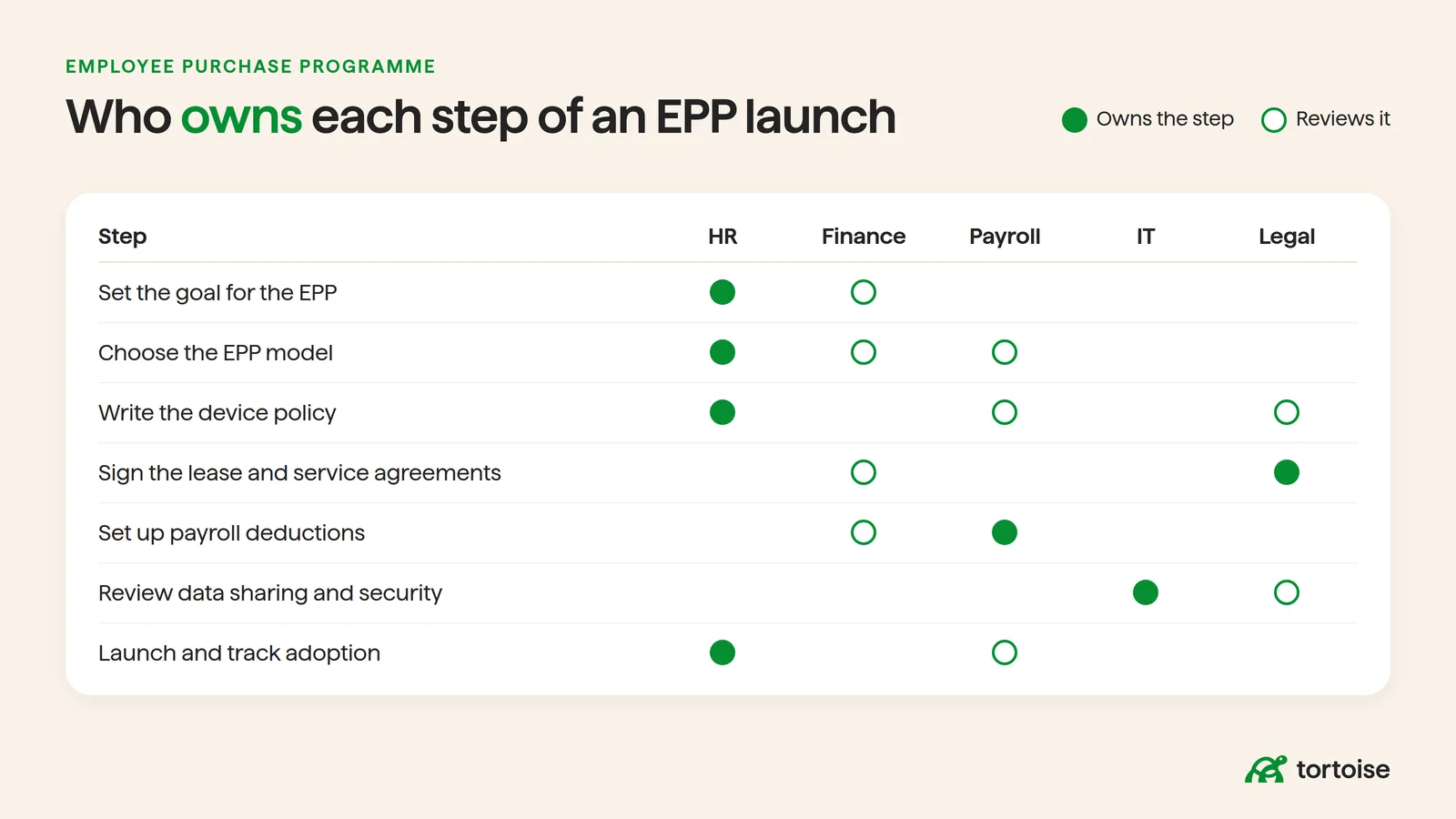
Bring these teams in during the first month, before any vendor is chosen. Most launch delays come from a payroll or legal question that surfaces a week before go-live, when it could have been answered at the start.
Plan the EPP launch and communication
An EPP only works if employees understand it, so the launch deserves as much attention as the policy. A simple launch plan follows these steps:
- Start with a pilot group, such as one team or office, to test ordering, approvals, and the first payroll cycle
- Brief managers before the announcement, since employees often ask their manager before they ask HR
- Announce the programme by email and on the intranet, with the policy, a short FAQ, and a link to the savings calculator
- Hold a short session where employees can ask about savings, ownership, and exits
- Send a reminder a few weeks later, once the first devices have been delivered
The savings calculator does most of the persuading. Once an employee can see their own monthly deduction and net saving, the benefit stops being an abstract offer and becomes a decision about a specific phone or laptop.
Answer the questions employees will ask
Employees tend to ask the same four questions, and the launch material should answer each one plainly:
- Savings: how much they save depends on their tax slab, and the calculator shows the exact figure
- Exits: if they leave before the lease ends, the remaining amount is usually settled in their full and final settlement
- Damage: a managed programme covers accidental damage and theft, so a broken screen does not mean paying twice
- Ownership: the device usually becomes theirs at the end of the lease, for a small transfer price
Our guide on leaving during a lease covers the exit question in more depth, since it is the one employees worry about most.
Track EPP adoption after launch
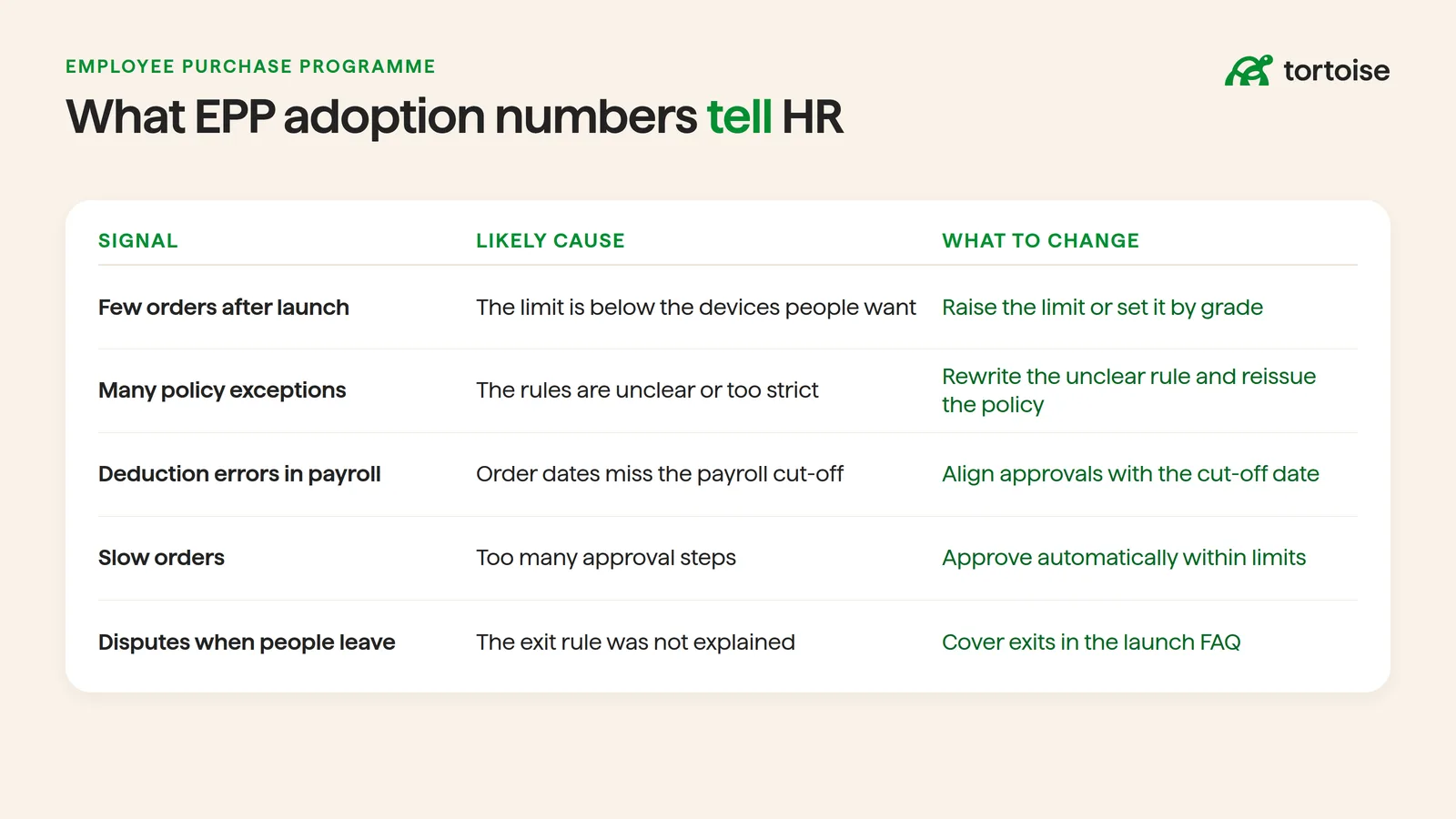
Adoption is the clearest sign that an EPP is working, and it is simple to measure from the first month. These numbers give HR an early picture:
- Share of eligible employees who have placed an order
- Time taken from order to delivery
- Number of policy exceptions HR had to approve
- Deduction errors found in the monthly payroll reconciliation
- Questions raised with HR or support in the first three months
Review these after the first quarter. Low adoption usually points to a communication gap or a spending limit that does not match the devices employees want, and both are straightforward to fix.
How Tortoise helps HR run an EPP
Tortoise is an employee device benefit platform that runs a leasing-based EPP for Indian employers. It handles payroll and HRMS integration, policy drafting, delivery, and employee support, so HR manages the programme from one dashboard instead of coordinating several vendors.
Employees use the Tortoise app to browse devices within their limit, check their monthly deduction in the savings calculator, and order with digital approvals. They can save up to 40%, depending on their tax slab, and own the device at the end of the lease. The employer carries no running cost and no balance-sheet liability.
Tortoise Corporate Care covers accidental and liquid damage, theft, and absconding, and early exits are settled through full and final settlement. The tax structure was evaluated by Deloitte India and Lakshmikumaran & Sridharan, and the platform is ISO 27001 and SOC 2 certified.
If you are drafting an EPP policy now, our team is happy to go through it with you.
An EPP succeeds when employees use it
The work HR puts into the goal, the policy, and the pilot is what keeps its workload low after launch. A clear policy means fewer exceptions, a pilot catches payroll problems before they reach everyone, and a well-chosen model means employees see a saving worth acting on.
Start with one group, check the first two payroll cycles, and widen eligibility once orders and deductions run cleanly. A programme built this way grows with very little extra effort from HR.
Disclaimer: This guide is intended for general informational purposes only and should not be treated as legal, tax, payroll or accounting advice. Applicability of employee benefit laws in India depends on several factors, including the nature of the establishment, employee category, wage levels, location, headcount, employment terms and applicable central and state laws. Tax treatment of benefits may also vary depending on the structure adopted, documentation, payroll processing and the employee's applicable tax regime. Employers should consult their legal, tax and payroll advisors before implementing or modifying any employee benefit programme.
Frequently asked questions
What is an employee purchase programme (EPP) in India?
An employee purchase programme lets employees get phones, laptops, and other devices through their employer at a lower effective cost. A discount EPP offers a brand discount that employees pay from post-tax salary. A leasing EPP, often called Smart EPP, deducts a monthly rental from gross salary, and the employee usually owns the device at the end of the lease.
Does an employee purchase programme cost the employer anything?
A discount EPP costs the employer nothing, since employees buy directly from the brand. A leasing EPP run by a managed provider also has no running cost for the employer. Employees fund their devices through salary deductions, the lease stays off the employer's balance sheet, and insurance covers damage, theft, and absconding.
How much can employees save through an EPP?
With a discount EPP, the saving is the brand's discount. With a leasing EPP, employees can save up to 40%, depending on their tax slab, because the monthly rental is deducted from gross salary and GST is handled within the leasing structure. A savings calculator shows each employee their own monthly deduction and net saving.
Who should be eligible for an employee purchase programme?
Most companies open the programme to permanent employees who have finished probation, which raises adoption while lowering the risk of early exits. Some start with specific grades, teams, or offices as a pilot. Wider eligibility usually makes sense once the first payroll cycles run without errors.
What happens if an employee leaves during the lease?
The remaining amount is usually settled through the employee's full and final settlement, and the employee can often keep the device by paying what is still due. In managed leasing programmes, insurance covers cases where an employee absconds, so the employer is not left with the cost. The policy should state this rule clearly before launch.
Which teams need to approve an EPP before launch?
HR usually leads, but finance, payroll, IT, and legal each need to sign off. Finance reviews the lease treatment and credit assessment, payroll confirms deductions and reconciliation, IT checks data sharing and security, and legal reviews the lease and service agreements. Involving them in the first month avoids late delays.
Written by
Founder & CEO
Vardhan Koshal is the Co Founder of Tortoise, India’s fastest growing employee device benefit platform. He has led India growth and product for companies like TripAdvisor and Udacity, and earlier founded Ridingo, a car pooling startup recognised by Forbes as one of the Hottest Global Startups and acquired by Carzonrent. At Tortoise he works with HR leaders, CFOs and tax experts to design compliant, high impact device benefit programs for Indian employers.